
PHOENIX—Five million-dollar homes in north Phoenix were nearly finished when the 15-gallon-per-minute well supplying the development began to run dry.
Construction manager Tanner Cook first tried the conventional approach. He drilled multiple test wells across the five-acre desert parcel in search of another water source, but each came up empty.
“We have to provide water to the homes. It’s a necessity, obviously, to live,” Cook said, standing near the original well.
When traditional drilling methods failed, Cook turned to an uncommon solution: a water dowser.
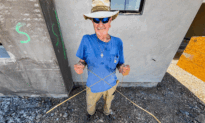
In 102-degree heat, Jack Coel arrived from Fort Mohave wearing a broad-brimmed hat and sunglasses, a blue T-shirt, and tan cargo pants. A silver Celtic cross hung from his neck.
Carrying a pair of L-shaped brass rods, three wooden stakes, a hammer, and blue tape to mark promising locations, Coel stepped onto the property.
“Accurate. Objective. Water,” he repeated, almost like a mantra, as he began walking the site.
Coel kept the rods parallel to his chest as he paced across the property until they crossed. He retraced his steps several times, counting each one.
Then he stopped.
He called out possible depths—100 feet, 200 feet, 300 feet—waiting for the rods to react as he spoke each number.
At around 500 feet, they did.
Not ideal, Coel said, but it was a start.
He knelt, drove a wooden stake into the parched earth, and tied a strip of blue tape around it.
The search continued.
At 79, Coel has spent nearly five decades practicing dowsing, an ancient technique in which practitioners use rods, forked branches, or other tools they believe can locate underground water.
He said he has completed more than 14,000 searches, helping clients find water sources around the world.
Coel has little interest in scientific explanations for dowsing. He only knows one thing—for him, it works.
He believes the ability is a gift from God and says almost anyone can learn the technique.
“Seek and ye shall find,” he often says, citing the biblical verse.
“Dowsing is not strictly for water,” Coel said. “It’s for anything you happen to be looking for. It’s all the same process, a single-minded search.”
Many people use dowsing rods to search for lost objects or answer simple yes or no questions.
Practitioners often interpret crossed rods as a yes response and rods moving apart as no.
But for Coel, the practice is not about prediction or divination. It’s all about the individual doing the looking, he said.
From Cables to Desert Wells
Coel discovered dowsing in the 1960s while serving in the Air Force as a cable splicer in Germany. A local man introduced him to the technique, and Coel soon began using the rods to locate underground cables.
“We were very fast,” Coel said of the dowsing team he trained and managed.
After completing his tour in Germany, Coel transferred to Patrick Air Force Base in Florida, where he worked on communications systems tied to the early space program.
“The headquarters were at Cape Kennedy in those days,” he said. “I got to work on all the splicing and testing for the new audio-video cable for the [first] moon landing.
“You have to learn to be single-minded. I’m kind of single-minded anyway, so it worked very straightforward for me right off.”
In the Air Force, his crew members often used bent metal coat hangers in the proper L shape. He’s been using the same brass rods for years.
“People use forked sticks. They use all sorts of things,” he said, but not all of them work the same.
Coel said he has also used only his hands, sensing when they warm over what he believes is an underground target.
“I can teach anybody to dowse,” he said. “Some people take longer than others. It’s not a theory.”
After leaving the Air Force in 1970, Coel worked for several telephone companies before turning dowsing into a water-finding business, a vocation he plans to continue until he “drops.”
As a Christian and full-time water dowser, Coel said he was called to the practice to help others.
He has developed a method to identify drilling targets, estimate depth, and assess potential water volume and quality. He prefers to discuss projects with drillers early in the process to ensure everyone is moving in the right direction.
His clients have included the U.S. Department of the Interior, Bureau of Land Management, the state of California, and numerous cities and towns.
Some drillers also practice water dowsing, though the method remains controversial and is not universally accepted.
He said he has helped locate water sources for private landowners, farmers, ranchers, and developers across the United States and internationally.
Among his celebrity clients, Coel said, were actor Ewan McGregor, musician Peter Wolf, and country singer Merle Haggard.
He was also featured as a guest expert in a first-season episode of Discovery’s “Homestead Rescue,” titled “Nevada Thirst.”
Speed and Determination
Coel said he can search large properties quickly—100 acres in as little as two hours.
“I’ll pick the best north-south direction if it’s a big parcel,” he said. “I’ve done over 300 wells that made over 1,000 gallons a minute. Half of them made over 3,000 gallons a minute.”
One of his most notable discoveries, Coel said, was an 8,000-gallon-per-minute well he located on Bureau of Land Management land in Nevada in 2006.
Coel said the irrigation management company, Aqua Trac, was seeking reliable water sources to support 15 wells capable of producing 1,000 gallons per minute.
After investing hundreds of millions of dollars in hydrological studies, satellite imagery, and ground-penetrating radar, the company had found only one viable source, he said.
“Their science didn’t do it for them,” Coel said. “Then they called me.”
Standing in the back of an open Jeep, Coel said he crossed 1 million acres of rugged terrain in 24 hours and identified 17 underground wells.
He said the first produced about 8,000 gallons per minute, and three wells eventually produced a combined 20,000 gallons per minute.
“I’ve learned what’s reliable through all the droughts—the worst droughts in over 800 years,” Coel said. “So what I’m looking for is what’s reliable.”
‘The Science’ and Dowsing
Dowsing has existed for thousands of years and has been used to search for water, minerals, lost objects, and even human remains.
Yet it remains an unregulated practice with no public database tracking professional outcomes.
At least five practitioners operate in Arizona. Universal Drilling, for example, combines traditional water-finding methods with dowsing.
Still, many scientists question the practice, saying there is no measurable evidence that rods or other tools can detect underground water.
The U.S. Geological Survey notes that dowsers often operate where groundwater already exists, so successful discoveries may be less remarkable than they appear.
“Because the drilling and development of a well often costs more than a thousand dollars, homeowners are understandably reluctant to gamble on a dry hole and turn to the water dowser for advice,” the agency said on its website.
“In a region of adequate rainfall and favorable geology, it is difficult not to drill and find water.”
The FBI has warned that unreliable dowsing methods can waste resources and create false hope.
Coel, however, said that experience and results matter.
“I know what to target,” he said. “I know what the equipment can do.”
When Science Fails
Cook said the issue is not whether dowsing can be scientifically explained. It is whether someone can find water in a landscape as dry as north Phoenix.
The company had hired Coel once before—with success.
“I wouldn’t be calling Jack if I didn’t think we had some problems,” Cook said. “We drilled multiple wells—nothing promising.
“The only thing worse than not hitting water is hitting water that’s not sufficient.”The second location Coel identified on the five-acre parcel, near the site of a future microchip plant, was about 396 feet below ground, give or take 100 feet.
It produced the highest estimated flow rate yet, with a potential source of about 27 gallons per minute.
“That’s fantastic!” Cook said, and the answer to his prayers.
 Friends Read Free
Copy
Facebook
Tweet
Friends Read Free
Copy
Facebook
Tweet