
Family farms face tough challenges in today’s economy, but some young farmers are finding success—and believe their kids will, too.
In the Midwest, where agriculture is the top industry for many states, young farmers such as Tyler Everett are finding innovative ways to keep farms afloat across multiple generations.
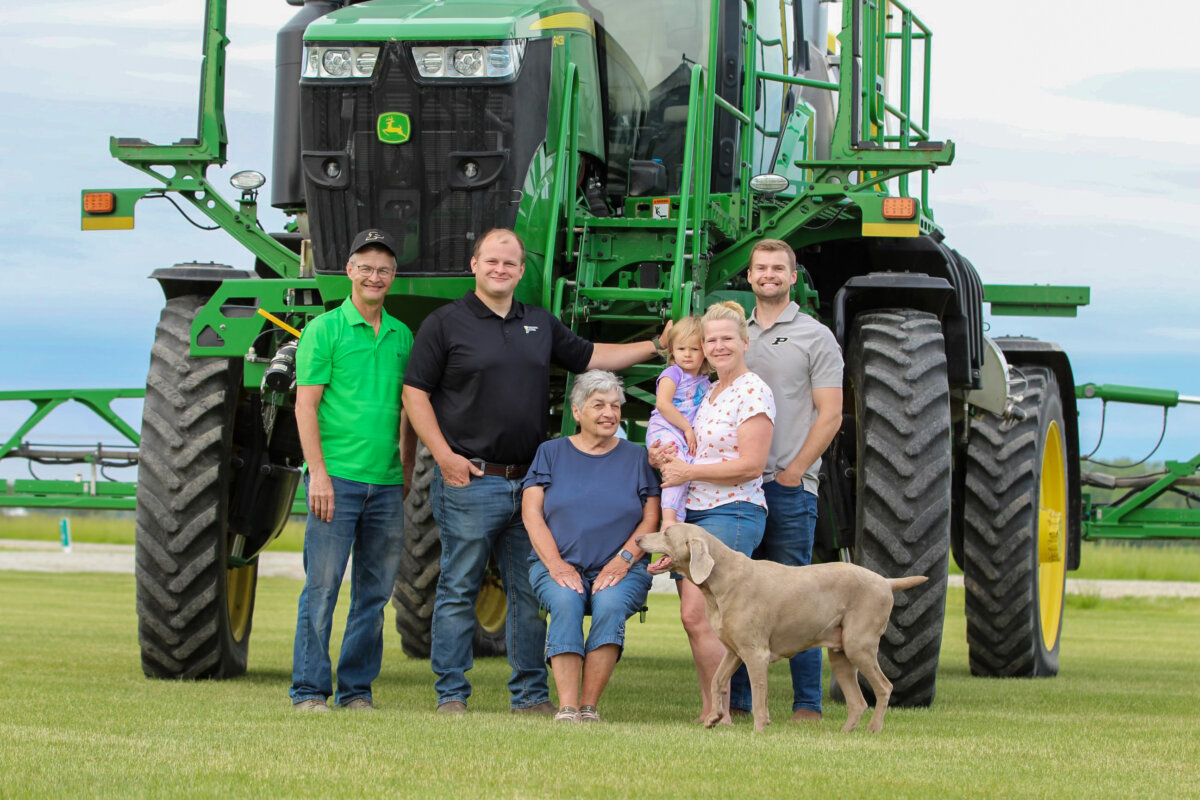
At age 35, Everett’s a fifth-generation farmer living in Lebanon, Indiana. His family’s farm, Everett Farms, was established in 1919. Everett raises corn and soybeans on 1,500 acres, putting pride and sweat into his work like his father, grandfather, and great-grandfather before him. He has a wife, Brittney, and one young daughter.
“I farmed with … my grandpa, Aaron, before he passed away a few years ago,” Everett told The Epoch Times. “I still farm with my dad, and my grandmother is an active part of our farming operation.”
Everett said that his business battles high input costs and low commodity prices but that his family tries to make good decisions and use money wisely to produce a good crop each year.
“We’re trying to make things last as long as possible,” he said. “I know a lot of farmers who buy a lot of new fancy equipment every year. I think this year we’re just kind of using what we have and we’re making what we have work, and we’re not trying to buy a bunch of new equipment. We’re making every piece of machinery count.”
The Everetts use variable rate seeding and fertilizer applications, which maximize savings by spreading the least amount of product on soil and crops. Other new technologies—such as GPS-guided sprayers and harvesters, which use satellite technology and automated steering to operate with inch-level accuracy—are helpful but more expensive, Everett said.
The two main issues that can hurt family farms are taxes and land, he said, particularly when older family members pass on.
“People see land as a quick way to get rich and not as a long-term investment,” he said.
“Things like capital gains can really hurt people, too. Some families, if they don’t have a succession lined up, if grandpa and grandma both die, … the family might have to sell a third or a quarter of the property to pay the capital gains. So there are a lot of financial negative impacts of multigenerational farming.”
Many American farmers have a tradition of passing down farms from one generation to the next. But today, the United States has more farmers who are at least 75 years old than farmers who are younger than 35, according to 2022 USDA census data. That, along with rising costs, weak commodity prices, shrinking families, and alternative career options, has put that tradition in jeopardy.
Farming in Indiana
Indiana is among the top agricultural states in the United States. Corn and soybeans are the state’s top row crops, according to the state’s Department of Agriculture, each covering about 5 million acres.
Corn leads with 31 percent of agricultural production, with sales totaling $3.28 billion. Soybeans are a close second, at 29 percent, with $3.08 billion in sales. Combined, the two account for 60 percent of all agricultural products sold in Indiana.
Beyond row crops, Hoosier farmers raise pigs, cows, and chickens and offer specialty crops including tomatoes, pumpkins, and mint.
Of Indiana’s corn and soybean farms, 94 percent—or approximately 20,000 farms—are family-owned or -operated, according to the Indiana Soybean Alliance and Indiana Corn Marketing Council. Some corn and soybean products are farmed for our food, but others serve as a leading source of protein for livestock and poultry. Corn and soybean products are also used in ethanol, biofuels, and carpet fiber. The state’s 15 biorefineries produce an estimated 1.4 billion gallons of ethanol every year, supporting 41,500 jobs in Indiana.
Some of these products stay in the state, but about $4.6 billion of Indiana’s agricultural products are exported.
Double Ridge Farms
About 90 miles northeast of Lebanon lies Hartford City, Indiana, where CJ Chalfant also works as a fifth-generation farmer. His 2,000-acre Double Ridge Farms was passed down multiple times, going back to his great-grandfather, Sherman Said.
Chalfant, 36, grows soybeans and corn with his wife, Abbey. They have two children, a 9-year-old daughter and a 6-year-old son, plus one goldendoodle. To help make ends meet, the Chalfants also operate a trucking company and seed sales business.
“You have to love it,” Chalfant told The Epoch Times. “Since I was like 5, I knew I was going to farm. I just do it, and that’s what I love. But definitely, the amount of time that I spend farming versus going out and doing something else, I could make significantly more money doing something else than farming.”
Chalfant said Indiana farmers face numerous economic challenges, the biggest of which is labor.
“[It’s hard] finding somebody that’s qualified and that you can afford,” he said. “Living costs right now for everybody are so expensive here in the U.S.”
Then there are input costs. Fertilizer, nitrogen, seed, and equipment all strain the farm’s profit margins.
“Everything’s cyclical. When [commodity] prices go up and we finally start to make some good money, all the input suppliers decide they want some of that, so they raise their input costs,” Chalfant said. “Then by the time prices come back down on what we’re selling, input prices are still high. And so there’s a lag in that.
“It’s really hard to make any money right now in farming at all because input prices are just so stinking high.”
Chalfant finds ways to counter those costs. He buys older equipment and services the machinery himself. He also shops around for low prices “just as the normal consumer would” at the grocery store, he said.
Double Ridge Farms has used GPS-based auto-steering equipment for more than a decade. Chalfant said fully autonomous farm equipment is starting to make an impact as well, but he doesn’t see that as the path to big profits—at least not yet.
“I think it’s headed the right direction; it’s just not cheap enough yet for most farmers to buy,” he said. “The problem is, you still have to put that piece of equipment in the field and tell it to go. And sometimes it can’t tell a rock from a hole, and so sometimes they’ll just stop and wait until somebody gets there [to] tell it it’s OK to continue driving.”
Farm Aid
Struggling farmers may soon get help from the federal government. In December 2025, President Donald Trump announced a $12 billion farm aid package to support American farmers hurt by low crop prices and unfair trade practices that impede exports.
The USDA plans to offer the funds through one-time bridge loan payments to American farmers to counter “temporary trade market disruptions and increased production costs.”
The money should hold farmers over until higher reference prices for crop commodities come into effect for eligible farmers under the One Big Beautiful Bill Act, beginning in October.
Chalfant said he has mixed feelings about government assistance.
“Farm aid is great, and right now it’s very important with the times that we’re in. But I would much rather have trade than aid,” he said. “I want the opportunity to sell at the price I want to sell and not have to rely on the government to give me a check to make sure that I can go next year.
“The government can do all they can to try [to] regulate or keep prices low on inputs, but at the end of the day, supply and demand is what drives that.
“If we, as farmers, … can continue to find new uses and new opportunities for soybeans and corn, that will continue to drive demand, especially if we could do that domestically and keep that within our country. Then we don’t have to worry about the political or the geopolitical side. And we can do a better job.”
Everett said much the same.
“They say everyone is three meals away from a global catastrophe,” he said. “The economics of farming is very important, to make sure farmers are able to keep farming day in and day out, and year in and year out, and to make sure that farmers have the necessary tools in the tool belt as far as disaster relief and things like that.”
Passing on Family Farms
Everett said that from a young age, he believed he might become a farmer. His other passion was baseball, which he played in youth leagues and continued playing into high school. But after he decided he “just wasn’t as good” as the top players, he began thinking about farming. His father, Doug, made him an offer.
“My dad said, ‘Hey, if you want to help me farm, I will pay you to help me plow and to work ground and do other things around the farm,’” Everett said. “I knew already that I wanted to be involved in the farm somehow, but didn’t know how. But once I started working on the farm in high school, it just became clear to me that I knew where I belonged.”
Hoosier kids have other influences encouraging them to become farmers. The Indiana 4H and Indiana Future Farmers of America Organization provide agricultural education and career development, and they have programs to inspire the next generation. Chalfant said these groups are important in the state.
But then there’s money—and other career options.
“You see a lot of the next generation that goes out and finds that job, makes a lot more money, and just doesn’t feel like they can go back and make less and be fair to their family,” Chalfant said.
He said that family farms have options if kids don’t choose farming. For example, Chalfant said he has started farming for a different land owner whose boys became electricians, not farmers. Chalfant is acquiring that farmer’s acres and farming his land.
Even so, Chalfant and Everett both said they hope one day their children will take over their farms, if that’s their desire.
“I have a child and another one on the way,” Everett said. “And if they want a farm one day, that’s great. If they don’t, I will support them and whatever they choose to do.”
He said that his extended family—including nieces, nephews, sisters, and brothers—could be the ones to take over.
Chalfant said both his kids will likely end up farming.
“I think both of them. I definitely think my son will,” he said. “He knows how to run the combine; he doesn’t know his ABCs. He’s all about farming. So we’ll see. And if they want to, we’ll make space and we’ll make it work.”
 Friends Read Free
Copy
Facebook
Tweet
Friends Read Free
Copy
Facebook
Tweet