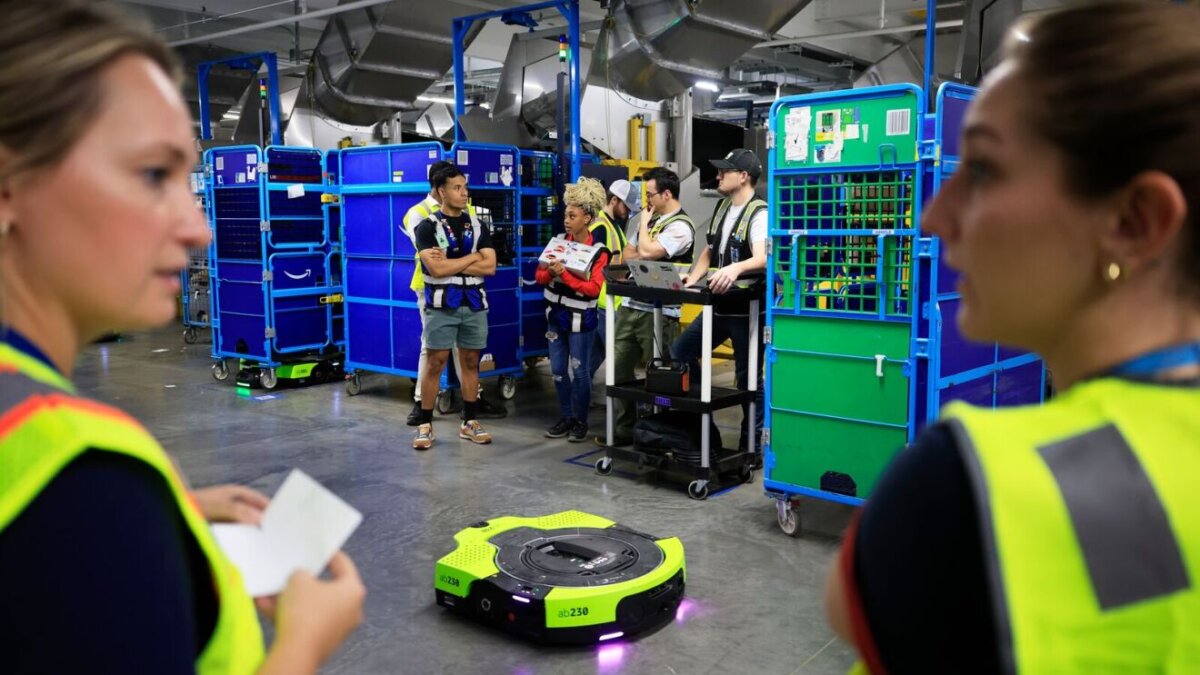

Amazon has received roughly $600 million in refunds for tariffs imposed by the Trump administration in the second quarter of 2026, with plans to distribute them to some of its customers.
“We have identified a limited set of circumstances where we can trace that we pass specific import charges onto customers. And when we receive those refunds, we will proactively contact affected customers and automatically issue refunds to them,” Amazon Chief Financial Officer Brian T. Olsavsky said during a June 30 earnings call.
Otherwise, “we’ll utilize refunds, continue to invest in low prices for customers,” he said.
The refund amount is limited for various reasons. For one, Amazon engaged in significant forward buying and prepositioned its inventory to avoid tariffs, according to Olsavsky.
Secondly, he said, Amazon is not the importer for the large majority of goods sold through its portal. Third-party suppliers sell most of the goods on the platform and handle imports and pay relevant tariffs.
In situations where Amazon saw costs rise due to tariffs, the company “largely absorbed” those costs rather than passing them on to customers, according to Olsavsky.
“You can see that in how we stayed very sharp in our price throughout the last year, with our product prices on average 14 percent less than other retailers,” Olsavsky said.
The Trump administration had imposed tariffs on its trading partners last year through executive orders under the International Emergency Economic Powers Act (IEEPA).
In February, the Supreme Court ruled that the tariffs were unconstitutional and that President Donald Trump lacked authority to levy them under IEEPA. In March, the U.S. Court of International Trade ruled that affected importers were entitled to refunds of the tariffs.
Amazon’s decision to refund tariffs to certain customers comes as the company was sued in May in a class action lawsuit. The complaint alleged that Amazon had no intention of refunding tariffs to customers.
“Amazon’s decision to forgo recovery serves its own political and commercial interests at the direct expense of the consumers who bore the tariff costs in the first place,” the lawsuit said.
“The problem is that the funds Amazon is using to stay in the President’s good graces do not belong to Amazon. These funds were wrongfully taken from consumers to cover IEEPA tariffs that have since been invalidated.”
Other companies, including Nike and Costco, were also hit with lawsuits over alleged failure to transfer tariff refunds to customers.
Tariff Refunds
According to Customs and Border Protection (CBP), it has launched a Consolidated Administration and Processing of Entries (CAPE) functionality with its Automated Commercial Environment—the centralized digital system for processing imports and exports—to streamline the submission and processing of refund requests.
In a July 13 filing with the U.S. Court of International Trade, Brandon Lord, executive director of the Trade Programs Directorate at CBP’s Office of Trade, said that as of July 10, roughly $121.75 billion in potential and certified refunds had been accepted for processing through CAPE.
As a result, a total of around $86.3 billion in refunds had been sent to the Department of the Treasury for disbursement to businesses.
A total of 229,609 CAPE declarations were submitted by businesses as of July 10, out of which 161,792 declarations passed the required validations.
Meanwhile, on July 22, Sen. Ron Wyden (D-Ore.) introduced the Congressional Trade Powers Reform Act, which sought to curb the president’s trade policy powers and return authority to Congress.
According to the Act, a president must obtain congressional approval to impose tariffs under Sections 201, 232, and 301. Section 201 allows for temporary tariffs to protect the domestic industry from any surge in imports. Section 232 enables the imposition of tariffs on imports for national security reasons. Section 301 targets unfair trade practices.
“Congress must reassert its authority over trade and tariffs to stop any president from being able to unilaterally change the worldwide economy at the click of a button,” Wyden said in a statement.
 Friends Read Free
Copy
Facebook
Tweet
Friends Read Free
Copy
Facebook
Tweet