

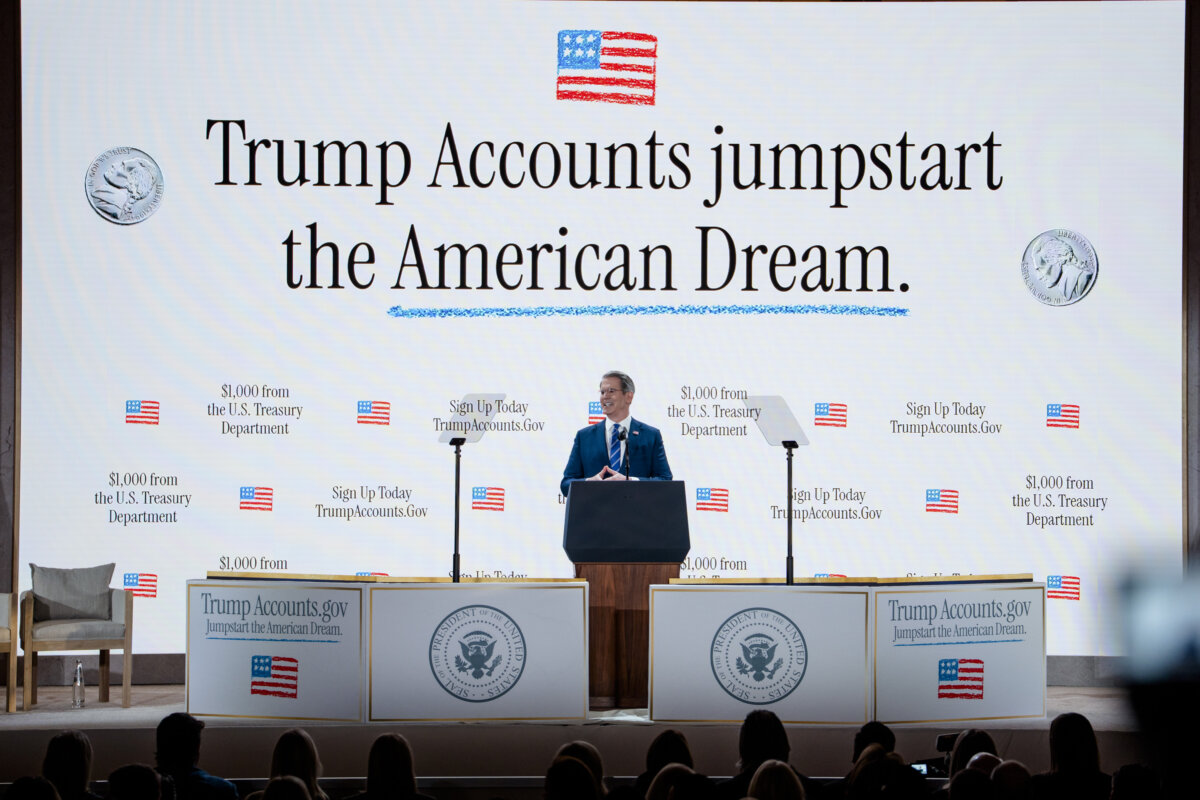
The Treasury Department launched the Trump Accounts app nationwide on May 28.
Parents or guardians will not be able to fund these new tax-deferred accounts until July 4, but they can now download the app from the Apple and Google stores.
The app was designed in partnership with the Bank of New York Mellon and Robinhood.
“The Trump Accounts app delivers a simple, secure way for households to begin engaging with a program designed to build long-term financial strength from day one,” Treasury Secretary Scott Bessent said in a statement.
“By putting easy access to Trump Accounts directly in the hands of parents and young Americans, we are helping to ensure that America’s youth are included in this new era of economic participation.”
Parents or guardians can open an account by completing IRS Form 4547 on TrumpAccounts.gov.
More than 5 million children have already registered for the accounts—also known as 530A accounts—created under the “One Big Beautiful Bill Act” last summer.
The app’s sign‑up requires verifying the email used in the application, adding and confirming a phone number, and creating a password, with the option to enable push notifications.
Families will receive an email before July 4 with instructions to complete the setup.
Seed Deposits Coming Soon
Starting on July 4, eligible children—born between 2025 and 2028—will receive the $1,000 pilot program contribution from the Treasury Department.
Families can then contribute up to $5,000 per year until the beneficiary turns 18. Employers can also add up to $2,500 per worker annually, which counts toward the $5,000 limit.
An increasing list of companies and philanthropists—such as Chipotle, Coinbase, Intel, JPMorgan Chase, and Steak ‘n Shake—has committed to matching the Treasury’s $1,000 seed deposit.
Children ages 10 or younger born before Jan. 1, 2025, could also receive $250 if they reside in a zip code with a median income of $150,000 or less.
This is due to a $6.25 billion pledge from tech billionaire Michael Dell and his wife, Susan, announced last year.
The accounts will be invested in U.S. equity index funds, whether mutual funds or exchange-traded funds, rather than individual stocks.
Others suggest that the accounts should expand at some point.
Altimeter Capital CEO Brad Gerstner said Trump Accounts should allow stock donations in the future.
“We all want to maximize more multi-billion gifts into kids accounts and the gifts may be cash/shares!” he said in a May 6 post on X.
Sen. Ted Cruz (R-Texas) also suggested that the accounts could be a model for Social Security personal accounts.
“Conservatives in America for 50 years have been trying to do that—have been trying to do Social Security personal accounts,” he said at the Milken Institute Global Conference earlier this month.
“Here’s the dirty little secret: Trump Accounts are Social Security personal accounts.”
Beginning at age 18, beneficiaries may access up to 50 percent of the account for qualified expenses, such as tuition, workforce training, a first home purchase, or the launch of a business. Non‑qualified withdrawals are treated as ordinary income.
At 25, beneficiaries may withdraw the full balance for qualified purposes, with ordinary‑income taxation applied to any non‑qualified use.
After age 31, the account is closed, and the remaining funds may be used for any purpose, subject to long‑term capital gains tax.
Value Estimates
Since President Donald Trump unveiled the program, economists have been crunching the numbers to estimate how much these accounts could be worth in 20 years.
Based on how much the U.S. stock market has swelled over the past two decades—the blue-chip Dow Jones Industrial Average has surged by more than 300 percent over the past 20 years—researchers are optimistic that account valuations could balloon.
The Milken Institute, in a March 2025 paper, projected that $1,000 accounts could grow, on average, to $8,000 after 20 years. After 40 years, they could reach $69,000.
At a press briefing in February, White House press secretary Karoline Leavitt estimated that the projected value of these accounts could top $1 million.
“If you are a parent who maximizes contributions to your child’s Trump account, its projected value could reach nearly $1.1 million by the time your child turns 28 years old, based on average historical stock market returns,” Leavitt told reporters.
In addition to a hefty capital gain for young Americans, it can also serve as a tool for teaching personal finance proficiency, the paper’s authors noted.
“The program could also increase financial literacy of participants and their parents, which in turn would likely increase savings rates and wealth creation,” the Milken Institute paper reads.
“Since all newborns would receive the grants, the program would reduce wealth inequality.”
Jacki Thrapp contributed to this report.
 Friends Read Free
Copy
Facebook
Tweet
Friends Read Free
Copy
Facebook
Tweet