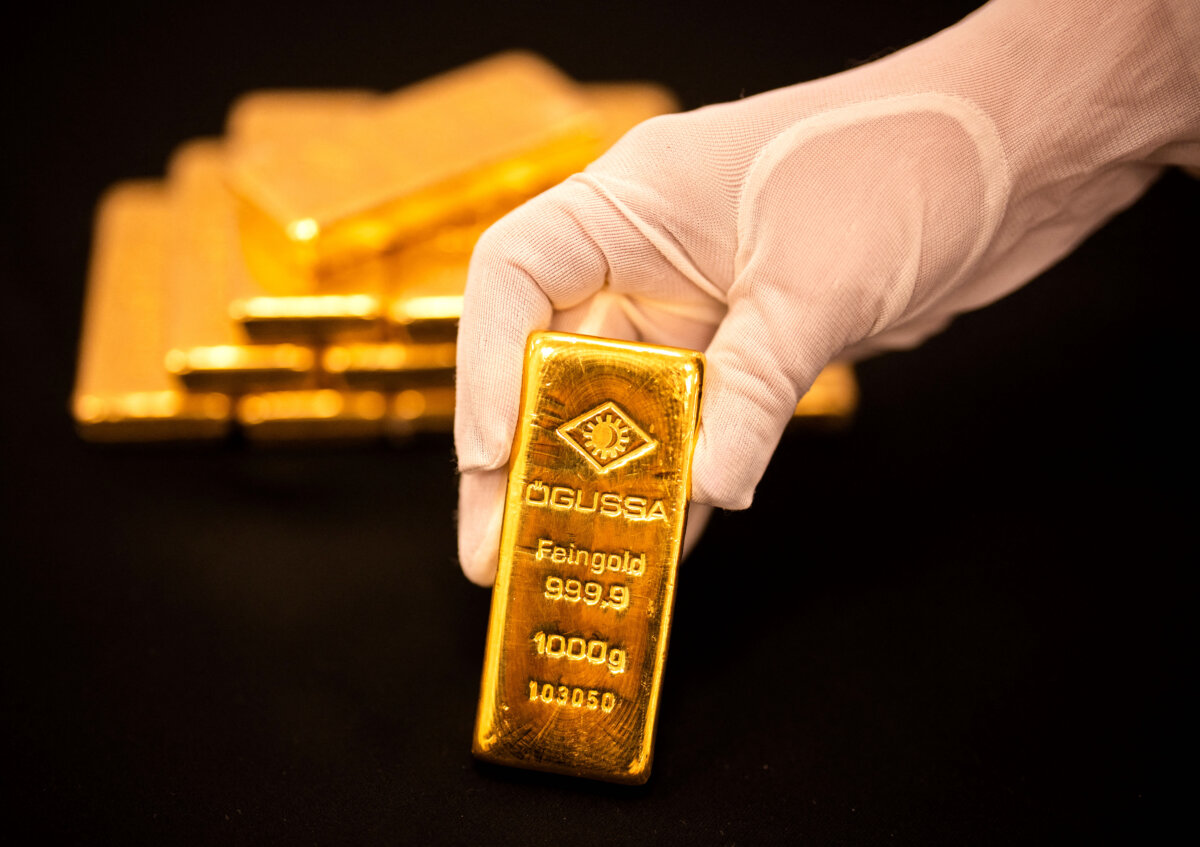

Spot gold prices continued to decline in early morning global trade on Monday, slipping below the $4,600 per ounce level before pulling back.
Gold prices crashed by over 9.8 percent on Friday after hitting a peak of around $5,595 per ounce on Thursday. As of 9:05 p.m. ET on Sunday, the bullion was trading at $4,723, down 2.92 percent from Friday’s close, after hitting a low of $4,586. Silver prices were down by 1.53 percent, trading at $83.40 per ounce.
The U.S. dollar index was up marginally by 0.09 percent. A stronger dollar makes precious metals like gold and silver more expensive for buyers in other currencies as these are priced in dollars, which weakens global demand for the bullion.
In a Jan. 30 report, Ole Hansen, head of commodity strategy at Saxo Bank, attributed the decline in bullion prices partly to profit booking by investors.
Strong monthly gains in gold and silver prices have made trading conditions “increasingly difficult,” with market makers becoming reluctant to take or hold risks, which leads to thinner liquidity in the market, according to Hansen.
For instance, gold traded across nearly a $500 range on Thursday and Friday, while silver traded in a range of $15 to $23, Hansen said, calling such large price movements “not a sign of healthy, orderly markets.” Instead, it suggests that markets are seeing a breakdown in liquidity.
“While the underlying reasons for holding gold remain as strong as ever—including persistent fiscal and debt concerns, ongoing central bank demand, geopolitical uncertainty and the need for portfolio diversification—the surge this month has left the yellow metal vulnerable to a pullback,” he wrote.
“We expect any setback to be met with fresh demand, with USD 6,000 emerging as a potential next upside target over time.”
As for silver, the metal may struggle to keep up with gold’s pace, he said. Since silver is heavily reliant on industrial demand, any dip in demand could dampen the metal’s prices. For instance, in the solar industry, the sector may increasingly seek out alternative materials rather than relying on silver.
“In addition, a rise in scrap supply is expected in the coming months as owners cash in long-held bars, cutlery, and jewellery following a seven-fold increase in prices over the past decade,” Hansen warned.
In the short-term, the partial U.S. government shutdown could act as a support for gold and silver prices due to uncertainty created by the situation. The federal government entered the shutdown just after midnight on Saturday. The House of Representatives is set to vote on reopening the government on Monday.
Meanwhile, total global demand for the yellow metal had hit a “new all-time high” of 5,002 tons in 2025, according to a Jan. 29 report from the World Gold Council.
Global investment demand hit a “landmark” 2,175 tons and was the main driver behind the bullion’s performance, it said. Central bank demand continued to remain elevated, while jewelry demand dipped 18 percent year-over-year.
Louise Street, senior markets analyst from the World Gold Council, said that consumers and investors both bought and held gold amid an environment where geopolitical and economic risks have become the new normal.
While jewelry demand dipped, it did so only by 18 percent compared to a 67 percent price increase, which shows “continued consumer willingness to buy at elevated prices,” Street said in the report.
“With economic and geopolitical instability showing little sign of retreat in 2026, momentum from last year’s strong gold demand is likely to persist. In the first month of this year, gold has already pushed past US $5,000/oz for the first time, underscoring gold’s role as a safe haven in uncertain times.”
 Friends Read Free
Copy
Facebook
Tweet
Friends Read Free
Copy
Facebook
Tweet