

The United States and South Korea finalized the terms of a major trade agreement on Oct. 29 as U.S. President Donald Trump headed toward the final hours of his Asian tour on the Korean Peninsula.
On Oct. 29, South Korea finalized a bilateral trade agreement originally announced by Trump in July. The new deal will set U.S. tariffs on Korean goods at 15 percent, and Seoul will invest $350 billion in the United States.
The latest announcement came after Trump’s meeting with South Korean President Lee Jae Myung in South Korea’s southeastern city of Gyeongju, following nearly three months of intense negotiations.
Kim Yong-beom, presidential chief of staff for policy, told reporters during a press briefing on Oct. 29 that the $350 billion pledge includes $150 billion for shipbuilding investments. The annual investment cap will be set at $20 billion, he noted.
Trump provided more details on these investments in a post on Truth Social.
“South Korea will be building its Nuclear Powered Submarine in the Philadelphia Shipyards, right here in the good ol’ U.S.A.,” Trump wrote. “Shipbuilding in our Country will soon be making a BIG COMEBACK.”
Under the agreement, U.S. tariffs on Korean products will fall to 15 percent from 25 percent as agreed in the initial deal announced in July. Tariffs on Korean cars will also be set at 15 percent.
Pharmaceutical and lumber products will be granted Most Favored Nation treatment, while airplane parts, generic pharmaceuticals, and certain natural resources will be exempt from U.S. tariffs.
In a statement released on Oct. 29, the White House stated that the state visit to South Korea “underscored America’s prominent role as the preeminent Pacific power.”
The statement notes that South Korea is committed to spending billions of dollars with several U.S. companies. The largest planned expenditure is the purchase of $36.2 billion worth of aircraft from Boeing and $13.7 billion worth of GE Aerospace engines by passenger carrier Korean Air, according to the statement.
Trump stated in a post on Truth Social that the U.S. ally also agreed to purchase “vast quantities” of American oil and natural gas.
He said that oil and natural gas “investments into our Country by wealthy South Korean Companies and Businessmen will exceed 600 Billion Dollars.”
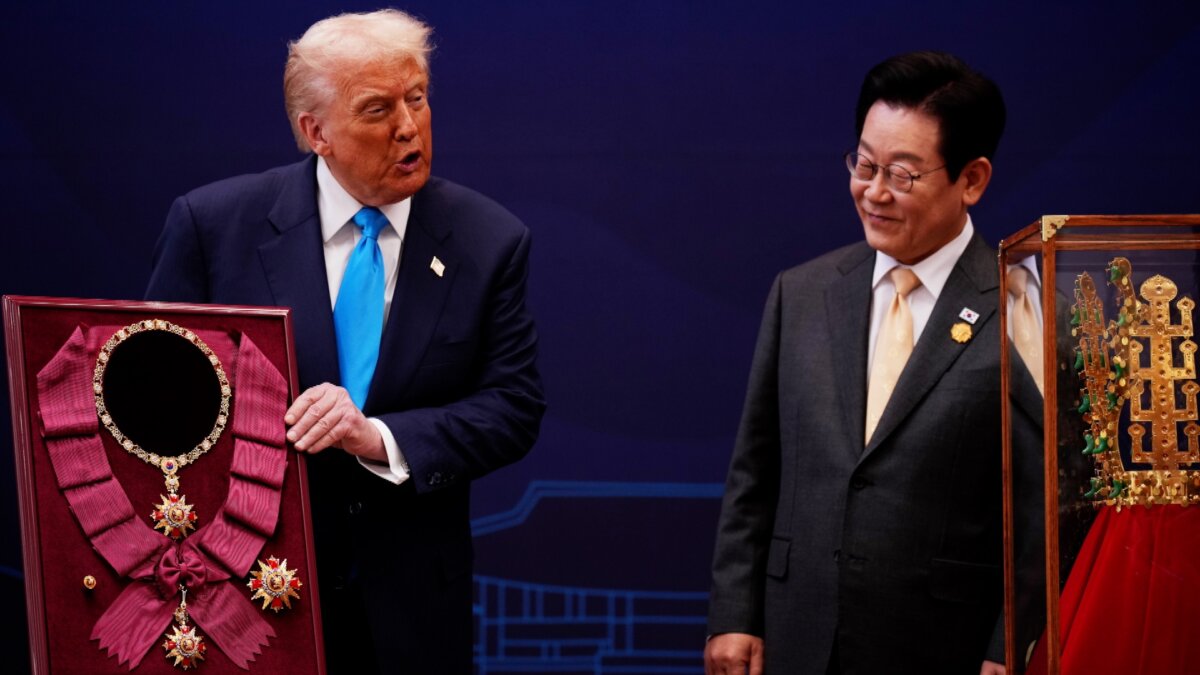
The state visit was punctuated by ceremonial pageantry. As part of his second official state visit to South Korea, Trump was welcomed into the Grand Order of Mugunghwa. The honor is typically given in recognition of service to South Korea.
Lee said that the award was given in recognition of Trump’s role as a peacemaker.
“You have been successful in bringing peace to many parts of the world,” Lee said during an official reception in Gyeongju. “I hope that your peacemaking skills can be applied to the Korean Peninsula.”
On Truth Social, Trump also praised the military relationship between the two nations, which he said is “stronger than ever before.”
In light of the close relationship between the two, Trump said he gave South Korea his authorization to build “a Nuclear Powered Submarine, rather than the old fashioned, and far less nimble, diesel powered Submarines that they have now.”
Trump’s visit came a day after North Korea stated that it test-fired a nuclear-capable cruise missile, underscoring the perpetual tension between the communist regime in Pyongyang and its southern neighbor. Although Trump expressed interest in meeting North Korean leader Kim Jong Un, no meeting was arranged during his trip. The two previously met in 2018 and 2019.
At the Gyeongju event, Lee said Trump’s continued efforts to reach out to the head of the isolated nation are a positive for the country. North Korea and South Korea signed an armistice in 1953 but never officially ended hostilities with a peace agreement.
“I believe that we’ve been planting good seeds for a better future,” Lee said at the Gyeongju event.
During his Asian trip, Trump also plans to meet with Xi Jinping, head of the Chinese communist regime, in Busan, South Korea, on Oct. 30.
The Oct. 30 meeting will likely include discussions of the ongoing trade negotiations between the world’s two largest economies.
On Oct. 26, U.S. Treasury Secretary Scott Bessent said in an interview with NBC’s “Meet the Press” that Beijing and Washington have “reached a very substantial framework” on outstanding trade issues ahead of the Busan meeting. Trump had previously threatened a 100 percent tariff on goods imported from China.
During his Oct. 26 media appearances with both NBC and ABC, Bessent said that the United States expects a deferral on China’s sweeping rare earth export controls. Moreover, there is an expectation of a substantial purchase agreement for American agricultural products.
Ahead of his South Korean reception, Trump told reporters that he was expecting “a very good outcome for [the United States] and for the world.”
Along with trade issues, Trump said he plans to press the Chinese leader to crack down on the export of fentanyl precursor chemicals. The talks may also touch on historic points of contention like Taiwan and China’s military ambitions in the Pacific.
Trump’s Asia tour has included stops in Japan and Malaysia, where the president focused on trade agreements and regional disputes, including cease-fire arrangements in Southeast Asia.
Reuters contributed to this report.
 Friends Read Free
Copy
Facebook
Tweet
Friends Read Free
Copy
Facebook
Tweet