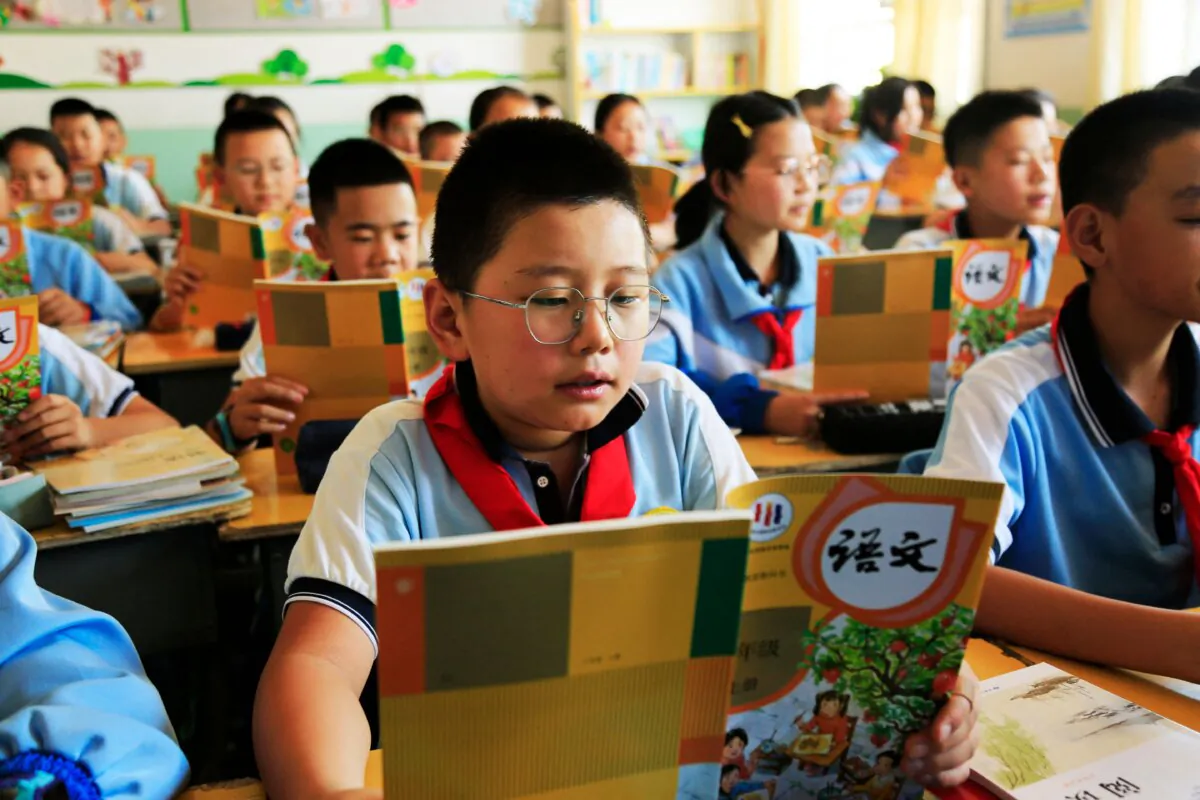

As China’s population declines at an accelerating pace, classrooms across the country are emptying out—and schools are shutting down at all levels.
The impact is especially visible in northeastern China, once the country’s industrial heartland. Provinces such as Heilongjiang, Jilin, and Liaoning attracted millions of workers during decades of state-led industrial expansion. However, years of economic stagnation, rising unemployment, and declining marriage and birth rates have dramatically reshaped the region’s demographics.
Several individuals in China spoke to The Epoch Times about the issue on the condition of anonymity out of fear of reprisal.
A schoolteacher in Jilin Province told the publication that the decline in student enrollment has become impossible to ignore.
“In one township in northeastern China, there used to be nine elementary schools and four middle schools. Now they’re all gone,” he said.
The teacher said shrinking student populations are also undermining employment prospects for teachers, many of whom have been laid off, reassigned, or forced to leave the profession entirely.
“Soon there won’t be a need for so many teachers anymore,” he said.
“Five years from now, the number of elementary school students could be cut in half. Middle schools will face the same problem a few years later.”
China’s population has declined for four consecutive years, and the country’s birth rate has fallen to the lowest levels recorded since the Chinese Communist Party came to power in 1949.
The education sector is emerging as one of the clearest signs of that demographic shift.
School Closures Spread Beyond Rural Regions
Although northeastern China has been among the hardest hit, similar patterns are appearing in major cities, including Beijing and Shanghai, where high living costs, economic uncertainty, and changing social attitudes are discouraging younger generations from marrying or having children.
A Beijing resident told The Epoch Times that neither he nor his sister plans to marry, citing financial pressure and unstable employment conditions.
“Many young people around us no longer want to get married or have children,” he said.
He said neighborhood schools and kindergartens have already begun disappearing as enrollment falls.
“The population is falling off a cliff,” he said. “Elementary schools and kindergartens here have already been merged. Some kindergartens are simply gone because there are no children left.”
In Shanghai, a longtime resident told The Epoch Times that the economic downturn, combined with the effects of China’s strict controls during the COVID-19 pandemic, accelerated the demographic decline.
“A lot of nurseries and elementary schools that used to operate have now been merged or shut down,” he said. “People have left. There’s no one left.”
Official Chinese statistics continue to place the country’s population at more than 1.4 billion. However, the Shanghai resident suggested the real number may be significantly lower.
Chinese domestic media have also reported a nationwide wave of kindergarten closures in recent years.
In Shanghai alone, 54 kindergartens closed in 2024, according to Chinese online news portal Sohu. Official figures showed that in the southeastern city of Xiamen, the number of children fell by 23,000 from 2024 to 2025, leading to the closure of 136 kindergartens and the loss of more than 1,000 teaching jobs, according to Chinese online news portal NetEase.
The contraction is now spreading beyond early childhood and primary education into higher education.
According to data from China’s Ministry of Education, universities across the country eliminated 5,345 academic programs between 2020 and 2024, according to Chinese online news portal Sina. The number of canceled majors rose sharply over that period, from 518 in 2020 to 1,428 in 2024.
At the same time, more than 25 private colleges shut down between 2021 and 2025, according to Chinese news portal Tencent.
Hong Ning contributed to this report.
 Friends Read Free
Copy
Facebook
Tweet
Friends Read Free
Copy
Facebook
Tweet