
Florida cities, public agencies, universities, and other covered entities have less than a month to comply with a new foreign-interference law that takes effect July 1, ending covered sister-city agreements with foreign countries of concern and removing the Florida-China Linkage Institute from state law.
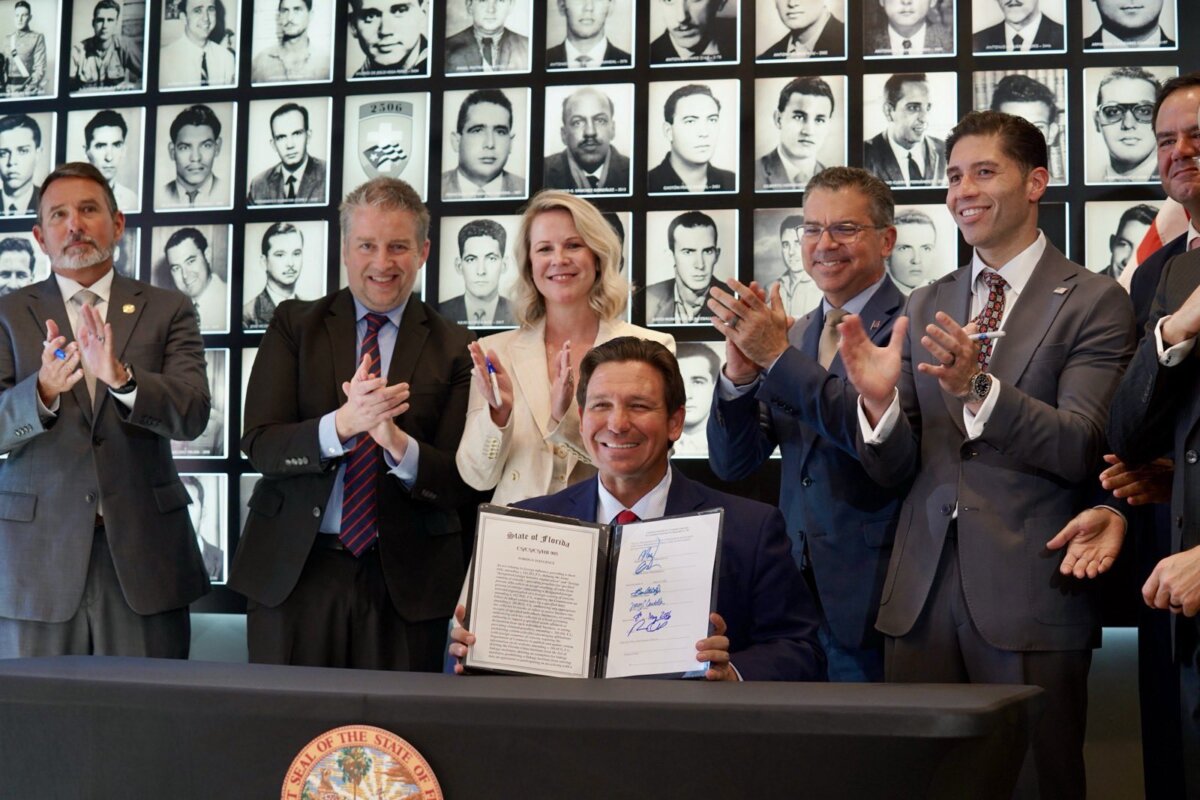
The measure, HB 905, formally titled the Foreign Interference Restriction and Enforcement Act, was approved by Gov. Ron DeSantis on May 8.
The law applies to a statutory list of “foreign countries of concern”: China, Russia, Iran, North Korea, Cuba, the Maduro regime in Venezuela, and Syria.
While the law is not limited to China, two of its most direct China provisions remove the Florida-China institute from the state’s linkage-institute system and require ethics training to include known efforts by foreign countries of concern to influence subnational governments, including the Chinese Communist Party’s (CCP) United Front strategy.
DeSantis said in a May 8 signing statement that the legislation strengthens Florida’s defenses against “foreign adversaries” by adding restrictions on agreements and partnerships involving countries of concern and by tightening ethics and disclosure requirements for elected officials and government employees.
China Linkage Institute Removed
The enrolled bill, presenting the official version passed by both chambers, deletes the Florida-China institute from Florida’s statutory list of postsecondary linkage institutes.
Before the deletion, the statute listed the institute as a partnership involving the University of West Florida, the University of South Florida, and Eastern Florida State College.
Florida law describes linkage institutes as programs between Florida postsecondary institutions and selected foreign countries. According to a final bill analysis by the state House, current law authorized such institutes to promote economic, cultural, educational, and social ties, including cooperative research, student and faculty exchange, cultural exchange, bilateral commerce, and language training.
The new law also bars any remaining linkage institute from entering into an agreement or participating in activities with a foreign country of concern or an organization in such a country.
That provision reaches beyond China.
The remaining statutory linkage institutes include programs involving Japan, France, Israel, West Africa, Eastern Europe, Mexico, Brazil, the Caribbean, Canada, Spain, and the United Kingdom.
Ethics Training to Include United Front Strategy
The law requires the Florida Commission on Ethics to update minimum ethics-training rules by Nov. 1.
The training must include known efforts by foreign countries of concern to target and influence subnational governments, including the CCP’s United Front strategy, according to the enrolled bill.
It must also cover how to identify, recognize, and report suspected foreign-influence campaigns, and enhanced penalties for violations involving gifts from foreign countries of concern or designated foreign terrorist organizations.
The House analysis, citing the U.S.-China Economic and Security Review Commission, says China uses United Front work to manage, co-opt, and mitigate potential opposition to CCP authority. It says United Front activity abroad includes efforts aimed at ethnic Chinese individuals and broader operations through affiliated organizations targeting foreign institutions and governments.
Under the new law, a public officer, agency employee, local government attorney, or candidate who violates Florida’s gift rule by soliciting or accepting something of value from a person or entity acting for a foreign country of concern or designated foreign terrorist organization must repay double the value of any pecuniary benefit received, in addition to other criminal or civil penalties.
Sister-City Agreements Face Termination
The law also changes Florida’s rules for sister-city and sister-state affiliations.
The enrolled bill says the state protocol officer may still coordinate activities that encourage sister-city and sister-state affiliations with foreign countries, but those activities may not encourage affiliations with foreign countries of concern or their subdivisions.
It also requires the Florida Department of State to publish and update each quarter a current list of foreign consulate offices and sister-city and sister-state affiliations, including copies of the agreements.
The law separately provides that a state agency, political subdivision, or public school authorized to spend state-appropriated funds or levy ad valorem taxes may not enter into an agreement with, or accept a grant from, a foreign country of concern, its subdivisions, or an entity controlled by such a country.
“All agreements” covered by that provision, including sister-city agreements, are terminated as of July 1 if they constrain the public entity’s freedom of contract, allow a foreign country of concern to direct the curriculum or values of a Florida program, or promote an agenda detrimental to the safety or security of the United States or its residents, according to the enrolled text.
The Florida Department of State’s December 2024 sister-city directory listed Florida affiliations with cities in China and Russia, including Qufu, Taizhou, Guilin, Qingdao, Xiamen, Rugao, Lanzhou, Yingkou, Novorossiysk, Murmansk, and Vladimir.
Family Law, Criminal Penalties
HB 905 also reaches into adoption and surrogacy contracts.
The enrolled bill prohibits a preplanned adoption agreement if the volunteer mother, intended father, or intended mother is a citizen or resident of a foreign country of concern.
It also says a gestational surrogacy contract may not be entered into in Florida if any party is a citizen or resident of a foreign country of concern, and that contracts executed in violation of the provision are void and unenforceable as against Florida public policy.
The law creates a new criminal reclassification provision for offenses committed to benefit, promote, or further the interests of a foreign government, a designated foreign terrorist organization, or an agent of either.
Under that provision, penalties can be increased by one degree. A second-degree misdemeanor can become a first-degree misdemeanor; a first-degree misdemeanor can become a third-degree felony; and a first-degree felony can become a life felony. A person convicted of a first-degree felony or life felony under the section must receive at least 15 years in prison.
The measure also authorizes local tax collectors or local governments to revoke or refuse to renew a business tax receipt for a person or entity doing business with Cuba in violation of federal law. The Cuba-related suspension provision expires Oct. 2, 2028, unless reenacted by the Legislature.
Earlier Restrictions
Florida had already passed several foreign-country-of-concern measures before HB 905.
The governor’s office said in its signing statement that earlier laws restricted foreign donations to Florida universities, strengthened penalties for trade-secret theft tied to hostile foreign actors, restricted certain property purchases by hostile foreign governments and entities affiliated with the CCP, limited government contracts involving foreign countries of concern, blocked foreign-controlled companies from accessing sensitive personal information, and banned TikTok and other foreign-controlled applications from state devices and networks.
Under existing Florida law, a state university or state college may not accept a grant from, enter into an agreement with, or establish a partnership with a foreign country of concern or a foreign principal unless the state’s Board of Governors or State Board of Education approves the arrangement, according to section 288.860, Florida Statutes.
 Friends Read Free
Copy
Facebook
Tweet
Friends Read Free
Copy
Facebook
Tweet