
Manila has urged Beijing to remove a movable floating platform and related structures from Bajo de Masinloc, also known as Scarborough Shoal, after Philippine agencies publicly documented an occupied platform, new buoys, and other objects inside the contested South China Sea feature.
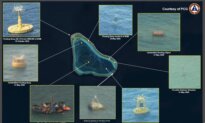
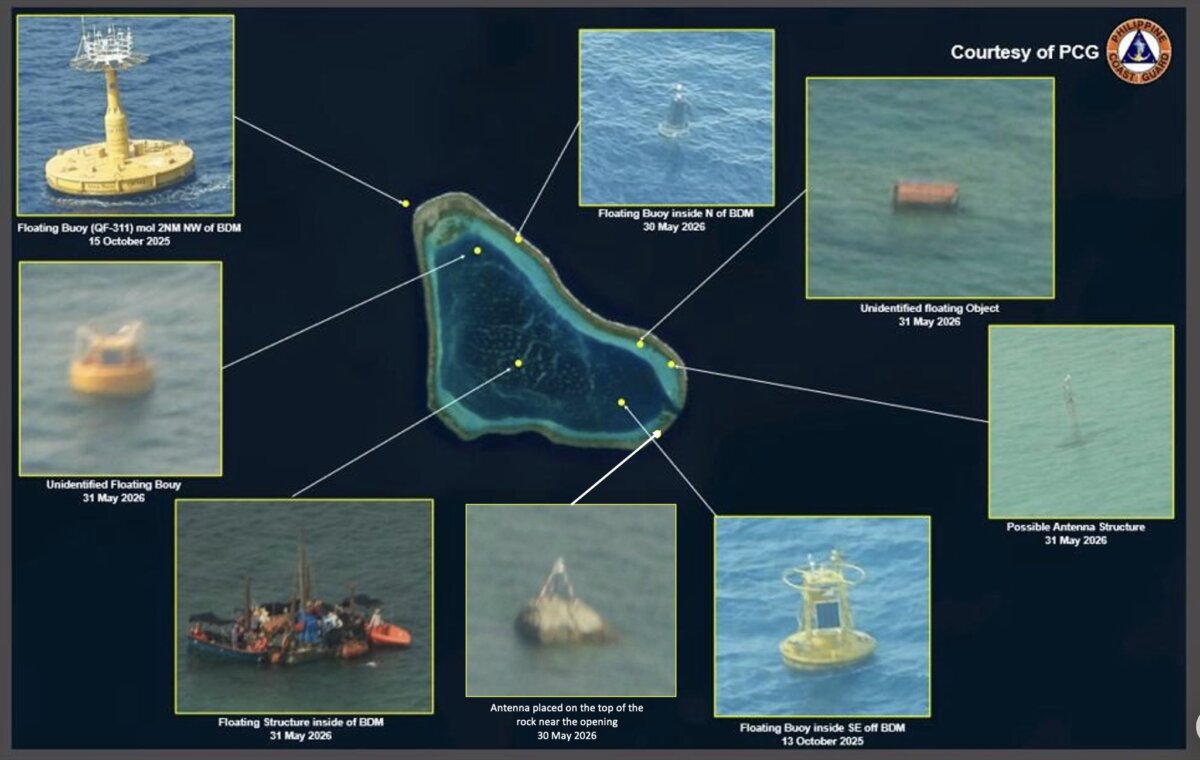
At a June 10 press briefing, Philippine Coast Guard spokesperson Commodore Jay Tarriela presented a monitoring timeline showing what he described as a movable floating platform, three newly installed floating buoys, two earlier buoys placed last October, an unidentified floating object, and antenna structures inside or near the shoal.
Tarriela stated that the platform and related structures were placed without Philippine consent or authorization and called their presence a violation of Philippine sovereignty and jurisdiction.
Rogelio Villanueva Jr., Department of Foreign Affairs spokesperson for maritime affairs, said in a statement read at the briefing: “We therefore urge China to withdraw and remove the platform structures from Bajo de Masinloc.”
Villanueva said Manila had undertaken “appropriate diplomatic action, including several demarches and a diplomatic protest to the People’s Republic of China.”
Philippine authorities warned that Manila would not allow the shoal to become another artificial island, while saying that agencies were still assessing the platform’s purpose and had not observed any dredging vessels in the area.
Small Platform, Wider Concern
Tarriela called the object a “movable floating platform,” not a permanent structure.
He described the platform as having a deck area of about 30 square meters and measuring roughly 5 to 7 meters across. Tarriela said it was surrounded by fenders, which could help protect it while being towed or moved alongside a vessel.
Tarriela also noted four metal poles on the platform, which he assessed could be used to keep the platform stationary at a particular location.
The Philippine government’s West Philippine Sea Transparency Office released images and briefing materials connected to the platform and other objects documented at the shoal.
Tarriela said commercial satellite imagery showed no man-made structure at the entrance of Bajo de Masinloc on May 20. By May 25, he said, commercial imagery showed a square object near the southeastern entrance of the shoal.
The Bureau of Fisheries and Aquatic Resources conducted a maritime-domain-awareness flight on May 26, followed by a Philippine Coast Guard low-altitude monitoring flight on May 28, Tarriela said.
According to the brief, during the May 28 flight, a People’s Liberation Army Navy helicopter intercepted or harassed the Philippine Coast Guard aircraft.
On May 30, Philippine monitoring documented six Chinese nationals standing on the platform. A Chinese rubber boat was seen installing an antenna on one of the rocks near the entrance of the shoal.
Tarriela said China sent a fighter jet during the May 30 flight, describing the action as harassment while the Philippine Coast Guard aircraft was conducting routine maritime monitoring.
On May 31, Philippine agencies documented the platform moving from the shoal entrance farther inside, with two Chinese service boats supporting it, according to Tarriela. About 12 to 15 Chinese personnel were seen aboard the service boats and platform during the movement.
Philippine monitoring also documented an unidentified floating object resembling a container drum, a possible antenna structure near the southern part of the entrance, and an additional buoy in the northern part of the shoal.
Purpose Still Unclear
Tarriela said the presence of Chinese research vessels led him to believe the platform could be connected to marine scientific research, but he said the specific data being collected remained unknown.
Philippine representatives declined to speculate about the purpose of the objects.
Tarriela said no dredging vessels had been monitored at the shoal.
Villanueva said the government’s next steps would be based on verified facts, Philippine law, international law, and national interest.
He added that China’s responses to earlier Philippine diplomatic representations could not be disclosed, though he said Manila remained ready to communicate with Beijing.
Mischief Reef Lesson
Asked at the press briefing whether the structures recalled what happened at Mischief Reef, where China initially placed small structures before later developing the reef into a major artificial island, National Maritime Council spokesperson, retired Vice Admiral Alexander S. Lopez, said the Philippines had learned from past experience.
Lopez referred to the “nightmare of Mischief” and described Beijing’s approach as “salami slicing,” a term used to describe incremental actions that gradually change conditions on the ground or at sea.
Lopez said the Philippine government would use diplomatic, legal, and peaceful means to protect the country’s territory, sovereignty, sovereign rights, and jurisdiction.
The warning stopped short of saying reclamation had begun at Scarborough Shoal. Philippine officials described the platform and other objects as developments being monitored and assessed.
Legal Dispute
Chinese foreign ministry spokesman Lin Jian responded on June 9 by asserting Beijing’s sovereignty claim over the shoal, which China calls Huangyan Island.
Bajo de Masinloc lies about 120 nautical miles from the Philippine province of Zambales, and more than 500 nautical miles from Hainan, China’s southernmost province, Tarriela said at the briefing.
Manila says the shoal is part of Philippine territory and falls within the Philippine maritime zones under the United Nations Convention on the Law of the Sea, or UNCLOS.
Villanueva said the structures were inconsistent with UNCLOS, the 2016 South China Sea arbitration award, and China’s commitments under the 2002 Declaration on the Conduct of Parties in the South China Sea.
The 2016 arbitral ruling rejected Beijing’s sweeping historic-rights claims in the South China Sea and found that the Chinese regime had unlawfully interfered with traditional fishing activities at Scarborough Shoal. The tribunal did not decide sovereignty over the shoal itself.
Beijing rejected the ruling and did not participate in the arbitration.
Tarriela said two Chinese research vessels remained under monitoring at the shoal as of the June 10 briefing.
 Friends Read Free
Copy
Facebook
Tweet
Friends Read Free
Copy
Facebook
Tweet