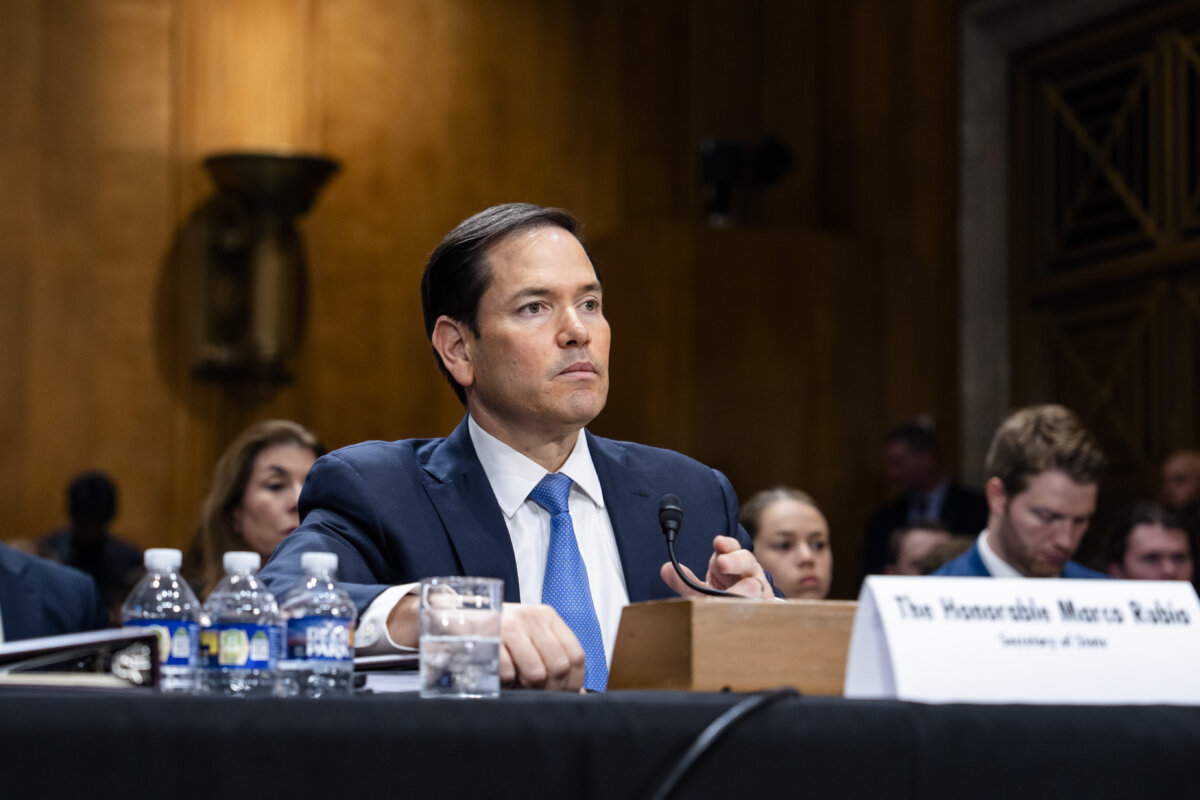

U.S. Secretary of State Marco Rubio criticized Hong Kong authorities over their decision to issue a new round of arrest warrants and bounties targeting pro-democracy activists overseas, some of whom are based in the United States.
“The extraterritorial targeting of Hong Kongers who are exercising their fundamental freedoms is a form of transnational repression,” Rubio said in a statement on July 26. “We will not tolerate the Hong Kong government’s attempts to apply its national security laws to silence or intimidate Americans or anyone on U.S. soil.”
Hong Kong’s national security police announced on July 25 that 19 people were wanted for “organizing, establishing, or participating in” a group called the “Hong Kong Parliament,” accusing the organization of plotting to “subvert state power.”
Among the 19 were businessman Elmer Yuen, commentator Victor Ho, and activists Johnny Fok and Tony Choi. Police had previously issued arrest warrants against the four, each carrying a bounty of HK$1 million ($127,000).
Police offered rewards of HK$200,000 ($25,480) for the 15 remaining wanted individuals.
Beijing’s Office for Safeguarding National Security in Hong Kong applauded the police’s decision as an “act of justice” in a statement issued on Friday.
The office’s director, Dong Jingwei, was among a group of six Chinese and Hong Kong officials sanctioned by the U.S. government in March for rights abuses in Hong Kong and efforts of transnational repression on U.S. soil.
“With this new round of arrest warrants and bounties, the Hong Kong government continues to erode the autonomy that Beijing itself promised to the people of Hong Kong following the 1997 handover,” Rubio added.
“Freedom of speech and political discourse are core American values, which the Trump administration will continue to defend.”
Hong Kong Parliament has an electoral committee based in Canada, according to its website. The group was established with the doctrines of “opposing one-party dictatorship and tyranny,” advocating universal suffrage based on a one-person-one-vote basis, and pursuing the goal of “Hong Kong people ruling Hong Kong.”
The group said on its website that it held an election on June 30, when 15 individuals—from countries including Australia, Canada, Thailand, the UK, and the United States—were elected to a four-year term. There were 15,702 eligible votes for the election.
Many of those elected, including Keung Ka-wai, Ho Wing-yau, and Agnes Ng, were among the 19 wanted by Hong Kong authorities.
In a statement issued on its Facebook page on July 27, the Hong Kong Parliament said that the arrest warrants and bounties issued by Hong Kong authorities “represent a clear escalation of Beijing’s transnational repression,” extending to countries including the UK, the United States, Canada, Australia, and those in the European Union.
“The deployment of bounty-driven tactics to target individuals abroad reflects an increasing disregard for international legal standards and norms of state conduct,” the group added.
The group said it “stands as both a representative voice and a protective institution for Hongkongers worldwide” and will “continue to uphold universal values and pursue the reconstruction of a free, fair, and self-governing Hong Kong.”
Sen. Jim Risch (R-Idaho), chairman of the Senate Foreign Relations Committee, also issued a statement on X criticizing the Hong Kong officials.
“Hong Kong’s authoritarian leaders are increasingly harassing and threatening its citizens abroad, and their newest round of bounties on pro-democracy activists undermine international legal norms and state sovereignty,” Risch wrote on July 25. “This cannot be tolerated.”
Hong Kong authorities began issuing arrest warrants and bounties in July 2023, adding new names in December 2023 and again in December 2024.
The Canadian and British governments have also issued statements condemning Hong Kong’s latest round of arrest warrants and bounties.
In a joint statement, British Foreign Secretary David Lammy and Home Secretary Yvette Cooper characterized the Hong Kong authorities’ move as “another example of transnational repression.”
“It encourages reckless behaviour on UK soil and damages Hong Kong’s international reputation,” the pair stated. “We call on the Chinese and Hong Kong authorities to end the deliberate targeting of opposition voices in the UK and elsewhere.”
 Friends Read Free
Copy
Facebook
Tweet
Friends Read Free
Copy
Facebook
Tweet