
Taiwan’s national security chief said China deployed more than 100 vessels across the First Island Chain in the days after President Donald Trump’s Beijing summit with Chinese leader Xi Jinping, warning that Beijing is threatening regional peace and stability.
Joseph Wu, secretary-general of Taiwan’s National Security Council, wrote on X on May 23 that Taiwan’s intelligence, surveillance, and reconnaissance showed China had deployed more than 100 vessels “around the 1st Island Chain” over the previous few days. He said the timing came shortly after the Beijing summit and accused China of “wrecking the status quo” in the region.
Deployment Across Strategic Waters
China has increased its naval, coast guard, and auxiliary vessel presence around the First Island Chain, a series of islands and archipelagos stretching from Japan through Taiwan to the Philippines. Taiwan has not publicly released a vessel-by-vessel breakdown by type, location, or duration.
According to the U.S. Department of War, the First Island Chain forms a key strategic arc along China’s maritime periphery. Its 2025 Annual Report to Congress notes that China’s military focus includes the First Island Chain running from the Japanese archipelago toward the Malay Peninsula. The 2026 U.S. National Defense Strategy identifies a strong defense along the First Island Chain as a central component of U.S. Indo-Pacific strategy.
Coast Guard Standoff Near Pratas
The maritime warning came as the Taiwanese coast guard reported a separate confrontation near the Taiwan-controlled Pratas Islands, also known as Dongsha, in the northern South China Sea.
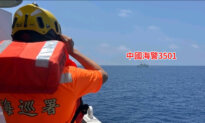
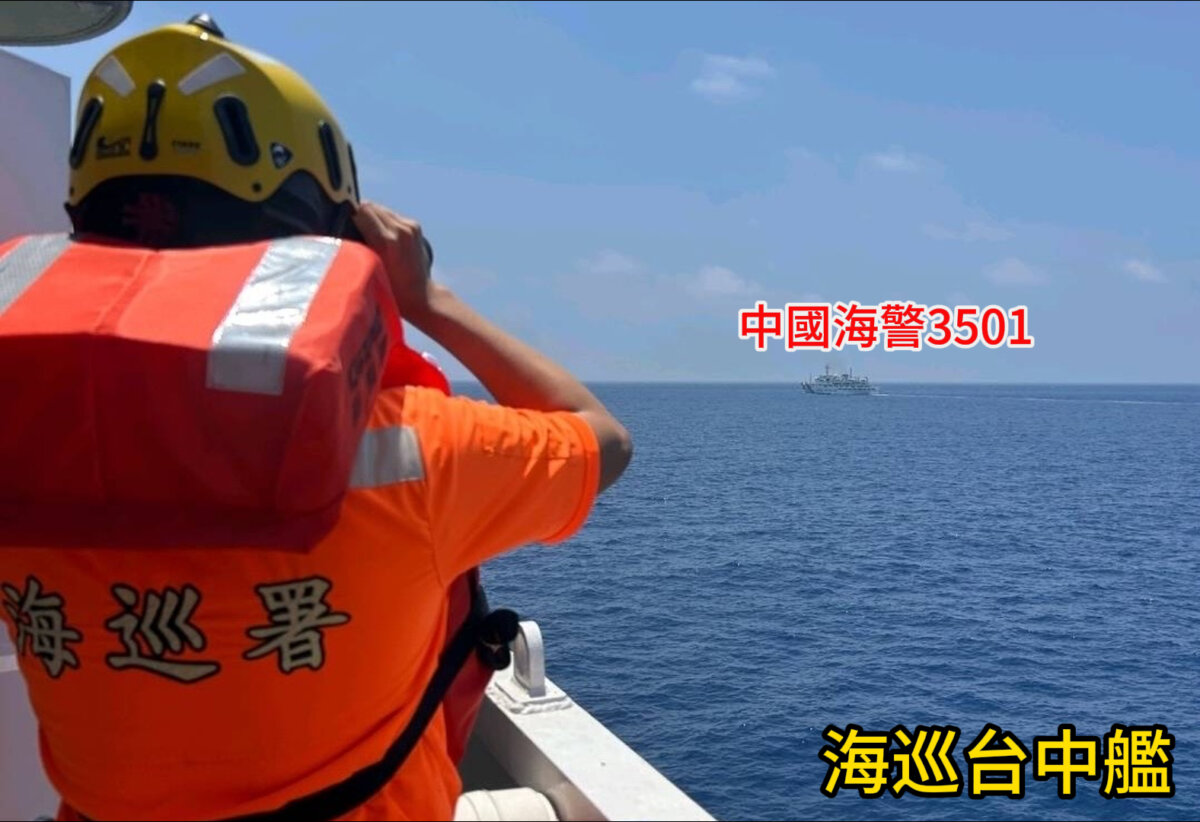
The Taiwanese Coast Guard Administration (TCGA) stated that Chinese coast guard vessel 3501 entered restricted waters around Pratas on May 23, prompting Taiwan to dispatch its Taichung patrol ship for a close-range response and radio exchange over sovereignty. The Chinese vessel later left the area after the standoff.
The incident fits a broader pattern near Pratas. The Asia Maritime Transparency Initiative (AMTI) at the Center for Strategic and International Studies said in a March report that Chinese Coast Guard and Maritime Safety Administration activity around Pratas has risen sharply in recent years, from no observed Chinese law enforcement vessel activity in 2021 to 60 days of activity in 2025. AMTI said the trend suggests Beijing’s operations around Pratas are shifting from limited patrols to a more regularized presence.
Chinese Research Ship Near Taiwan
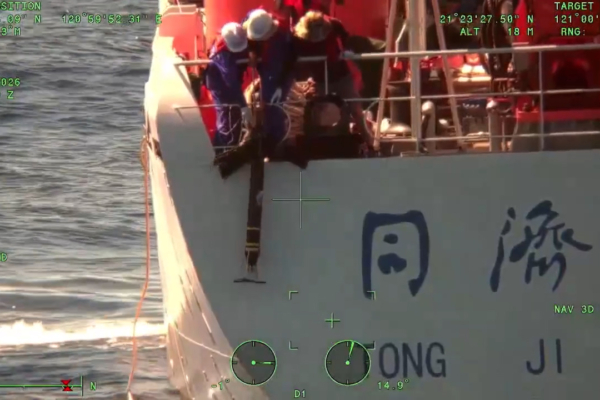
The Pratas standoff followed Taiwan’s report that it had driven away the Chinese research ship Tongji after detecting illegal survey activity near Taiwan.
The TCGA said the Tongji was first detected on May 7 southeast of Eluanbi and appeared again on May 15 about 33 nautical miles east of Hualien Port, where it deployed scientific instruments near Taiwan’s restricted waters. TCGA said it dispatched the patrol ship Lanyu to disrupt the operation, forcing the Chinese vessel to retrieve its equipment and depart the area.
TCGA said the activity appeared aimed at collecting seawater and seabed data that could help the People’s Liberation Army build hydrological, acoustic, and anti-submarine records. TCGA has tracked about 41 Chinese research vessels operating around Taiwan, part of a Chinese research fleet of more than 120 vessels whose activities have expanded beyond the First Island Chain toward Guam and Hawaii.
Taiwan Issue Raised at Summit
The deployment also came after Xi told Trump during their Beijing summit that Taiwan was the most important issue in China–U.S. relations.
Spokesperson Guo Jiakun said on May 14 that Xi told Trump that if the Taiwan issue is handled properly, the bilateral relationship will remain stable, but if not, the two countries could face “clashes and even conflicts,” according to the ministry’s official briefing.
Beijing claims Taiwan as part of China and has not ruled out using force to bring the island under its control. Taiwan’s government rejects China’s sovereignty claim, saying the Republic of China, Taiwan’s official name, and the People’s Republic of China are not subordinate to each other.
US Arms Package Adds Backdrop
The maritime activity also coincided with renewed questions in Washington over a proposed U.S. arms package for Taiwan. Acting U.S. Navy Secretary Hung Cao told lawmakers that some foreign military sales were being paused to ensure sufficient munitions for Operation Epic Fury, a U.S. military campaign linked to the Iran conflict.
Congress approved a $14 billion weapons package for Taiwan in January, though Trump has not yet signed off on it. Cao told lawmakers the decision on future arms sales would be up to Secretary of War Pete Hegseth and Secretary of State Marco Rubio.
 Friends Read Free
Copy
Facebook
Tweet
Friends Read Free
Copy
Facebook
Tweet