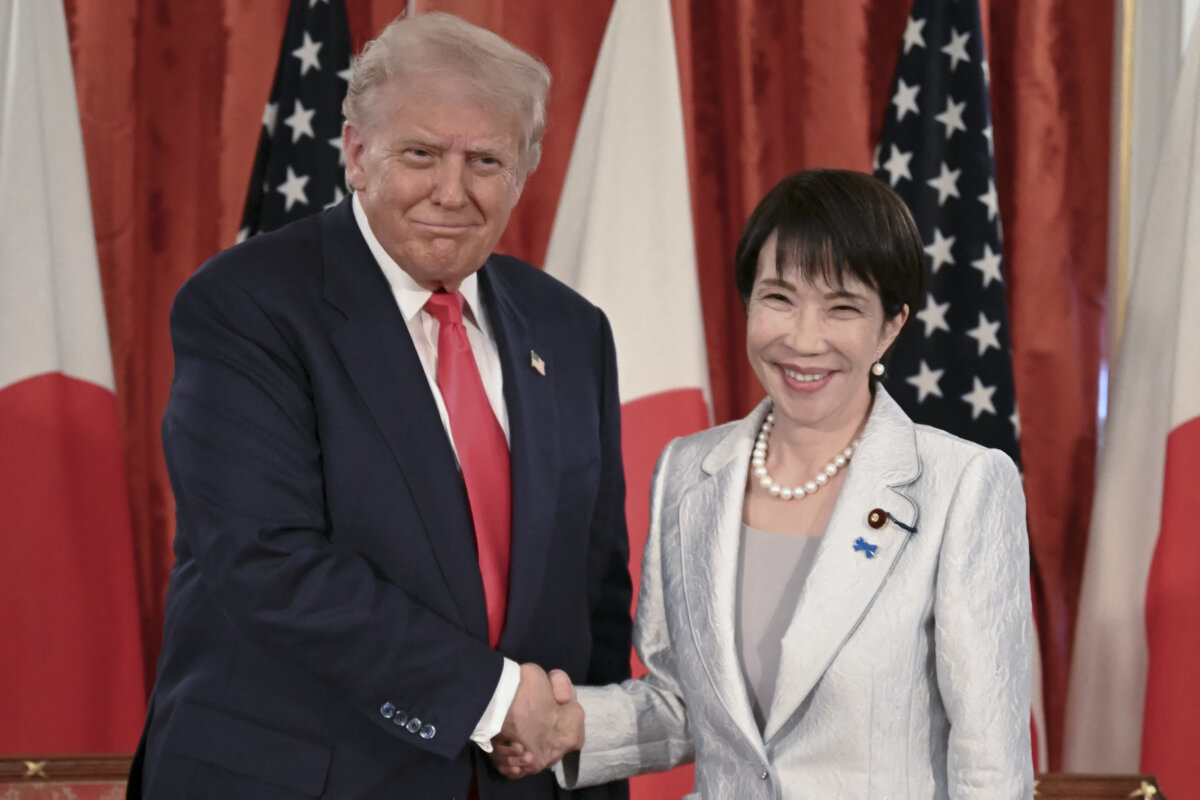

U.S. President Donald Trump reaffirmed the U.S.–Japan alliance in a telephone call with Japanese Prime Minister Sanae Takaichi on May 15, hours after concluding two days of meetings with Chinese leader Xi Jinping in Beijing.
Trump joined the call from aboard Air Force One. The conversation began at 7:30 p.m. Tokyo time, lasting about 15 minutes, according to Japan’s Ministry of Foreign Affairs.
The ministry said that Trump gave Takaichi a detailed explanation of his China visit and that the two leaders exchanged views on China-related economic and security issues as well as developments in the Indo–Pacific.
Takaichi told reporters that she and Trump reaffirmed an “ironclad” bilateral alliance and agreed to maintain close communication on Indo-Pacific issues. She said Trump briefed her on his China visit on the condition that their conversation remain confidential.
The two leaders also discussed Iran. The Japanese Foreign Ministry said Takaichi reiterated Japan’s position that de-escalation should be achieved as soon as possible, and it stated that the two leaders reaffirmed continued U.S.–Japan communication on the issue.
The ministry said Trump and Takaichi reaffirmed the “unwavering” Japan–U.S. alliance and agreed to continue close coordination, potentially including next month’s G7 summit.
When asked, Takaichi did not say whether Taiwan had been discussed during the call.
Her response came as Trump separately told reporters aboard Air Force One that he had discussed Taiwan arms sales with Xi, made no commitment, and would decide on the issue soon.
Taiwan Arms Sales Remain in Focus
Trump said aboard Air Force One that he and Xi “talked a lot about Taiwan” but that he did not believe there was conflict over the issue. He said Xi asked directly whether the United States would defend Taiwan if China attacked, but Trump declined to answer.
Before the Beijing trip, Trump had said he would discuss Taiwanese arms sales with Xi.
“I’m going to have that discussion with President Xi,” Trump told reporters at the White House on May 11 when asked about Washington’s support for Taiwan’s defense.
He said that Xi would like the United States not to proceed with the arms sales.
The Trump administration notified Congress in December 2025 of arms packages for Taiwan totaling approximately $11.1 billion, delivered through the State Department and the Defense Security Cooperation Agency, according to official DSCA notifications and statements from both governments.
The United States remains Taiwan’s most important international backer and is bound by law to help with its defense, even though Washington does not maintain formal diplomatic relations with Taipei.
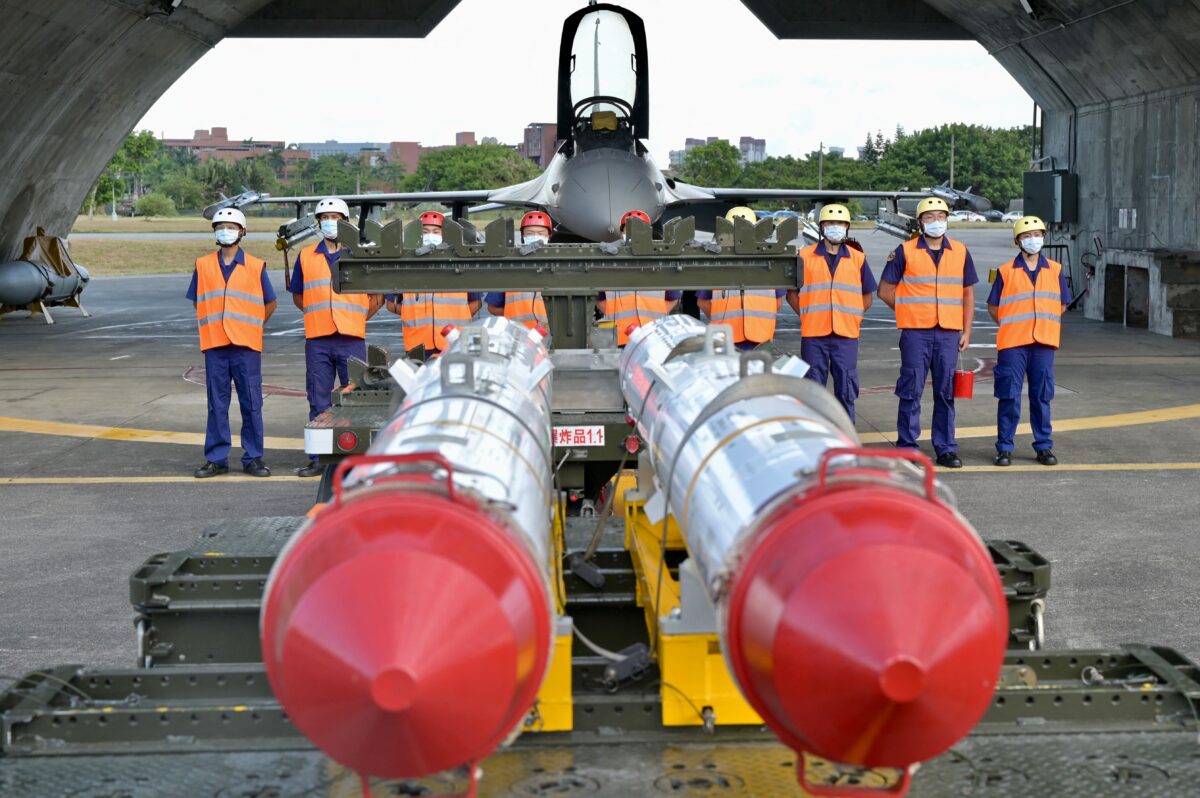
A separate potential package worth about $14 billion has drawn bipartisan pressure in Washington.
On May 11, Sens. Jeanne Shaheen (D-N.H.) and Thom Tillis (R-N.C.), joined by Sens. Chris Coons (D-Del.), John Curtis (R-Utah), Tammy Duckworth (D-Ill.), Jacky Rosen (D-Nev.), Andy Kim (D-N.J.), and Elissa Slotkin (D-Mich.), urged Trump to formally notify Congress of the package before his summit with Xi.
The senators, in a letter to the president, noted that the proposed sales—which include counter-drone assets, an integrated battle command system, and medium-range munitions—had been preapproved by Congress in January 2025. They urged Trump to make clear to Beijing that American support for Taiwan “is not up for negotiation.”
US Says Taiwan Policy Unchanged; Taipei Welcomes Assurance
Taiwan’s government responded to the Trump–Xi summit by pointing to U.S. statements that Washington’s long-standing Taiwan policy had not changed.
Taiwan’s Ministry of Foreign Affairs said that, in a May 14 interview in Beijing about the Trump–Xi summit, U.S. Secretary of State Marco Rubio emphasized that U.S. policy toward Taiwan had remained unchanged.
Rubio also said the Trump administration had continued arms sales to Taiwan and opposed any change to the status quo by compulsion or force, according to the ministry.
Taiwanese Foreign Minister Lin Chia-lung thanked the United States for repeatedly clarifying its support for peace and stability in the Taiwan Strait and for reiterating that U.S. policy toward Taiwan remained consistent.
Lin said Taiwan would continue strengthening its self-defense capabilities and working with the United States and other democratic partners to defend peace, stability, and prosperity across the Taiwan Strait and the region, according to the ministry.
Japan’s Strategic Position
For Japan, Taiwan is closely tied to its own security debate and to the U.S. military posture in the western Pacific.
Japan hosts approximately 60,000 U.S. troops, plus about 35,000 dependents, and 7,000 civilian and contractor employees, according to U.S. Force Japan figures.
The country serves as Washington’s central forward operating hub in the Indo-Pacific, and it hosts major bases including those in Okinawa that would play a key role in any regional contingency.
Takaichi has taken a firm stance on regional security issues.
In November 2025, she said in the Diet that a Chinese military move against Taiwan could constitute a “survival-threatening situation” for Japan under its security laws. Chinese Foreign Ministry spokespeople accused her of interfering in China’s internal affairs and crossing a red line.
The call between Trump and Takaichi was the first visible allied reassurance after the Beijing summit. Japan’s Foreign Ministry said the two leaders agreed to maintain close coordination going forward, including potentially at the G7 summit in France next month.
 Friends Read Free
Copy
Facebook
Tweet
Friends Read Free
Copy
Facebook
Tweet