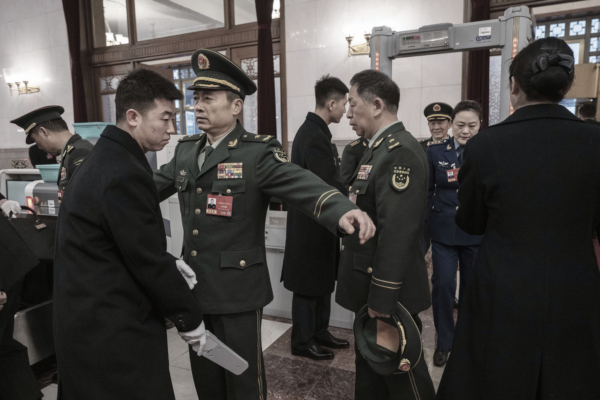
A senior leader at one of China’s top military research universities has been out of public view for nearly six months, as a series of quiet personnel changes reshapes the institution’s leadership.
Maj. Gen. Yong Chenggang recently made his first public appearance under a new title—“head of military affairs” at China’s National University of Defense Technology (NUDT)—a role traditionally held by the university’s president. The development suggests that the current president, Maj. Gen. Li Xiang, is no longer in the post, although the Chinese regime has issued no formal announcement.
A New Face Emerges in a Key Role
Yong appeared in his new capacity on April 27 at an academic conference hosted by Renmin University in Beijing, according to the university’s official website. The event brought together more than 30 senior officials from the regime’s ministries, the Central Military Commission, and academia.
His placement on the official attendee list—ranked alongside high-level Chinese Communist Party officials and ahead of other university officials—signals elevated status. It was the first time Yong had been publicly identified as NUDT’s “military affairs head.”
Public records show that Yong, who holds the rank of major general, previously served as dean of the university’s School of Basic Military and Political Education and currently heads its education and training department.
Li Xiang, the official president of the NUDT, has not been seen in public since November 2025, when he attended a political study session at the university. Since then, he has been absent from official events and from state media reports, an unusual development for a figure of his rank and position.
As a radar systems expert and member of the Chinese Academy of Sciences, Li had led NUDT since 2019. He built a career in advanced radar target recognition and was considered a leading figure in China’s defense technology research community.
His unexplained disappearance follows a pattern seen in previous cases involving Chinese officials, in which prolonged absences often precede formal investigations or removals. However, no such action has been publicly confirmed in Li’s case.
Leadership Turnover Extends Beyond Presidency
The leadership changes are not limited to the presidency.
In late December 2025, Maj. Gen. Zhang Zhan appeared publicly for the first time as the university’s political commissar, indicating that his predecessor, Lt. Gen. Chen Guoqiang, had stepped down.
Chen, a career political officer in China’s airborne forces, had only been appointed to the role months earlier, in September 2024. His transfer from a higher-ranking position in the Central Commission for Discipline Inspection (CCDI) appears to be a demotion.
Further signs of trouble emerged in early 2026. Chen was absent from a key CCDI meeting. By March, official updates showed that he had lost his standing as a member of the CCDI, and his biography was removed from the agency’s website.
In April, another shift occurred. Tian Yuefeng, an official with a background in China’s Academy of Military Sciences, surfaced as NUDT’s deputy political commissar and head of its disciplinary body—replacing Zhang, who had moved up to the top political role just months earlier.
Tian’s appointment marks the latest in a series of rapid personnel changes at China’s leading military research university, with both its administrative and political leadership undergoing turnover within a short period.
Based in Changsha, NUDT is one of China’s premier military research institutions, directly overseen by the Central Military Commission. It plays a central role in developing advanced defense technologies, including supercomputing systems and satellite navigation infrastructure.
The university traces its origins to the People’s Liberation Army Military Academy of Engineering, founded in 1953, and was restructured in 2017 as part of sweeping military reforms that consolidated several elite academies.
The recent leadership reshuffle—and the unexplained absence of its president—comes amid a broader anti-corruption campaign and internal tightening within China’s armed forces, which has seen multiple senior officials investigated, removed, or disappear from public view in recent years.
While the reasons behind the changes at NUDT remain unclear, the pattern of abrupt personnel shifts and prolonged absences is likely to continue to draw scrutiny.
Dongfang Hao contributed to this report.
 Friends Read Free
Copy
Facebook
Tweet
Friends Read Free
Copy
Facebook
Tweet