Live chat
March 23, 2024
American Thought Leaders
Live chat
 Expand
Expand
 Expand
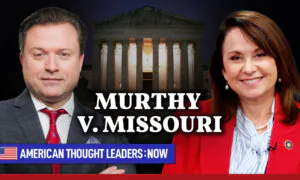
[FULL TRANSCRIPT BELOW] Earlier this week, the Supreme Court heard oral arguments in Murthy v. Missouri, the landmark free speech case revolving around government communications with Big Tech companies.
“I left the court really scratching my head at some of the questions that the justices offered to the new solicitor general from Louisiana,” says Louisiana Gov. Jeff Landry, who was among those who first brought the case against the Biden administration back when he was Louisiana’s attorney general.
“Some of the questions seem to really leave you wondering whether or not the Court still has a real appreciation for the First Amendment,” Mr. Landry said.
Where is the case headed? What might the Supreme Court decide?
We also take a look at Mr. Landry’s first few months as governor and get his take on the Supreme Court allowing Texas to enforce a law on arresting suspected illegal immigrants.
Views expressed in this video are opinions of the host and the guest, and do not necessarily reflect the views of The Epoch Times.
*Big thanks to our sponsor for this episode Patriot Gold Group. Check them out here: https://ept.ms/3sr5LhH
FULL TRANSCRIPT
Jan Jekielek:
Governor Jeff Landry, so good to have you back on American Thought Leaders.
Governor Jeff Landry:
It’s great to be back now as governor.
Mr. Jekielek:
You were attorney general [AG] in Louisiana for eight years. Liz Murrill, who was recently on the show, is the AG now. You were very involved in this case, originally Missouri v. Biden, and now Murthy v. Missouri. What is your reaction to the recent oral arguments before the Supreme Court?
Governor Landry:
I left the court really scratching my head at some of the questions that the justices offered to the new Solicitor General from Louisiana. By the way, the new Attorney General, Liz Murrell, is going to do a fantastic job. She has argued before the court five or six times. But some of the questions leave me wondering whether or not the court still has a real appreciation for the First Amendment.
The reason that the First Amendment was placed in the Bill of Rights was because it should be unquestionable that the government cannot infringe upon the First Amendment rights of a citizen. That answer should be, “No, it cannot.” The justices seem to be convinced that there are times when the government can censor American speech, but they seem unable to use a narrow test. It seems like they want to broaden that test. I’m hoping maybe that was just a couple of questions they needed to answer before they got to the right conclusions. But we’ll see.
Mr. Jekielek:
That was my impression as well when I watched the session. Justice Jackson kept mentioning that the government can have a compelling interest that is justification for abridging First Amendment rights. That was the implication. How do you understand this?
Governor Landry:
Under Supreme Court precedent, they set up a two-pronged test that says that the government may violate a person’s constitutional rights if it can prove that it has a compelling interest in doing so. Justice Jackson seemed to skip over the fact that first you must find that the government has violated someone’s First Amendment rights. She didn’t stipulate that under this condition that the government did. If they did, then the government would have to prove that they had a compelling interest to do so.
To give you an example, let’s say you shared some information that the government claimed was a danger to national security and then the government squashed it. You went to court and said, “The government has squashed my speech.” The judge would say, “Yes, they did.” Then the government would come in and say, “If we did, we had a compelling interest to do so, because it was detrimental to national security.”
That’s not what Justice Jackson was saying in the court. She was trying to broaden that test to basically say, “We don’t even have to say whether the government has violated someone’s First Amendment. We can just say the government always has a compelling interest in its duty to protect the public.” I think that was a problem.
What’s interesting, though, is the court just recently released a case where it said that you cannot take someone’s post down if they’re saying things that you don’t like on your official Facebook or social media platform. But then they seem to say that while you can’t, as government actors, they can take someone else’s post down. They seem to want to let the government take your entire social platform down. That’s the interesting part because this seems to be a conflict.
It’s going to be interesting to see what they come up with in this case. What do you mean by taking the entire social platform down? What the justices were questioning and leading to was that if the White House calls and says, “We don’t like what Jan is saying on his Facebook page. Take it down or throttle it back.” The justices seem to agree that the White House could do that. Yet, last week they said that if you put a post on the president’s social media or Facebook page that the White House doesn’t like, they can’t take it down.
Now, think about that. You’re trying to square those things, but you can’t. They don’t make any sense. Either the First Amendment means one thing or the other. It can’t mean one or the other. That’s the confusing part about the case.
But when you think about this in simple terms, if not for this case, we would not have known that the FBI knew and was in possession of the Hunter Biden laptop. We would not have known that there was evidence that the Covid-19 virus most likely came out of a lab in Wuhan.
We wouldn’t have known all of the things that the government was doing to suppress people’s speech about other methods of protection from the virus, such as ivermectin and hydroxychloroquine. All of that came out in this case. We were able to extract that information and peel the curtain back off everything the government was trying to suppress.
If the justices rule against this, Americans will not have a way to find out what the government is doing when they need to question the government. They won’t know that the government is trying to squash their speech. The government will be able to pick up the phone, call the social platform and say, “We don’t like what Jan is saying. Take it down,” and you will have no recourse.
Mr. Jekielek:
Justice Alito and Justice Thomas were the only ones asking questions that would suggest a differing view.
Governor Landry:
It was surprising. Justice Thomas doesn’t say much, but based upon his line of questioning, he is suspicious and certainly wants to ensure that Americans can speak freely in a forum and question government actions without government interference. Justice Alito asked the same type of questions. Justice Kavanaugh wasn’t really one way or the other, although his line of questioning was pretty good. Justice Barrett’s and Justice Gorsuch’s questions were somewhat concerning. With Chief Justice Roberts, we never really know where he is at.
Mr. Jekielek:
Please outline the basic principles of this case for us.
Governor Landry:
This case is about whether American citizens can express their views that may be contrary to the government’s position on an issue without fear of the government pressuring those social media platforms from taking down their content. That’s it. It’s about whether or not we’re going to be free from government intervention when we question the government on a private platform like social media.
That’s a pretty scary thing, because in today’s world, social media platforms basically act like virtual public squares. It’s where people express their views. It’s what the internet was supposed to be about. It was about giving us a virtual marketplace of ideas where we could talk back and forth and question and discuss issues. We thought it was free from government intervention.
We’re finding that the government, when it doesn’t like things that you post, has the ability to pressure and coerce those social platforms to either take you down, put you in Facebook jail, moderate your content, or simply just eviscerate you from that virtual public square.
Mr. Jekielek:
How important are the oral arguments in the judicial process?
Governor Landry:
That question has been debated since the court was established. The oral debates used to have a lot more weight back in the day. There are hundreds of pages of briefs. There are amicus briefs that are filed, and the court takes all of that in consideration. Sometimes the justices tend to tip their hand. Sometimes they’re asking questions to vet something that was vexing them. It doesn’t mean that’s the position they are taking. We’ll see in June when the court makes the decision, or maybe sooner.
Mr. Jekielek:
How important is the outcome of this case?
Governor Landry:
This is the most important First Amendment case in the last hundred years. I said that when we filed this case. I said it when the district judge granted the injunction. I said it when the Fifth Circuit upheld the injunction but narrowed it. I said that we would be at the Supreme Court. I didn’t think that the court would ask the questions they asked yesterday, which concerns me, because I do believe it’s one of the most important First Amendment cases in the last hundred years.
Mr. Jekielek:
Are you still involved in some way?
Governor Landry:
I’m involved by watching it from the sidelines and certainly discussing it with the new Attorney General. I’m happy to lend an ear, but it’s in the Attorney General’s hands now and I feel very confident. She’s very confident and is going to do well.
Mr. Jekielek:
Let’s talk about your first two-and-a-half months as governor. Right away, you had a special legislative session on crime. Please tell us about that.
Governor Landry:
We campaigned last year on three important issues, crime, education, and the economy, because Louisiana has terrible metrics, especially on crime. We have three cities in the top ten most dangerous cities in America. In the last couple of years, New Orleans was in the top ten of the most dangerous cities in the world.
We made a promise to the people of Louisiana that we would have a crime session to fix the structural defects in our criminal justice system through the legislature. That’s exactly what we did, and the legislature responded phenomenally. They passed 20 bills in ten days that either further strengthened or reversed bad criminal justice reforms, and put in place positive criminal justice reforms that placed the victim first and not the criminal.
We went out there and focused on the victim and ensured that the victims had a voice. That’s what we did. Over the course of the next few years, the changes we made in this special session are going to have a positive impact in making Louisiana a safer place.
Mr. Jekielek:
The statistics show that repeat offenders commit most of the crimes. The idea is to keep those people away from the rest of society. Are these the kinds of reforms you’re talking about?
Governor Landry:
You are correct. The vast majority of Americans are not criminals. The vast majority of Americans want to live in safety, irrespective of their locale, who they are, what they believe in, or what their socioeconomic background is. For the most part, everybody wants to be safe.
There are people out there who want to wreak havoc on society and not follow the rule of law. But when the population knows that the rule of law is going to be upheld and that there will be consequences for breaking the law, the number of people who break the law tends to shrink even more.
Of course, when you put those people away and out of society, they don’t have the ability to influence others, which was one of the issues that we took up in a special session. Back in 2017, there was a woke movement around the country that wanted to raise the age of how we treated 17-year-olds. They wanted to treat those 17-year-olds as heroes. Instead of treating them as adults in the criminal justice system, they wanted to treat them as juveniles.
In 2017, the legislature raised the age against both my and Senator John Kennedy’s wishes, and it wreaked havoc on the criminal justice system. Criminals above the age of 17, the majority of them adults, would recruit 16 and 17-year-olds to commit very violent acts by promising them that they wouldn’t be in jail for long. Because if you get convicted to a life sentence in the juvenile system, you’re going to be out at 21.
That meant that the penalties for some of the most violent crimes, if you were charged as a juvenile, were not as stiff as if you were tried as an adult. That was one of the things that we did, we corrected that age. We put it back to the way it was. We think that is absolutely going to have an impact on crime as well.
Because again, the more you keep sending these criminals back out onto the street, they then go out and recruit others to engage in their criminal activity. It’s why you want to take a certain segment of that population and lock them up for a while until they have an opportunity to think about the things that they did for a long time before we send them back into society.
Mr. Jekielek:
Why does Louisiana have such a high crime rate? It’s not just from these progressive policies, correct?
Governor Landry:
No, I disagree. First of all, Louisiana has a big percentage of its population that lives in poverty. When you fix the economy, certainly you start to move people from the bottom upwards. You have that upward mobility. You try to expand the middle class. The more the middle class grows, the more safe and peaceful society is. That has been proven time and time again.
Louisiana has always had problems in some of its bigger cities. New Orleans was always tough to get under control. But since the criminal justice reform movement there were several other cities that had very violent spikes in crime rates. We saw that in the rural areas as well. Because people would think, “If I committed this crime a decade ago, I might go to jail for 20 years, but today I might go to jail for only three years.
That’s like a slap on the wrist. It’s the same reason we see all these smash-and-grabs. Look at when California said, “We’re not going to prosecute any theft over $500 or $1,000. What happened? People went crazy and started stealing things. They had to lock everything behind the counters. Then they started breaking the glass in the counters and getting behind the counters. If there’s not a penalty, people will just wreak havoc.
Mr. Jekielek:
Are all your prosecutors tough-on-crime now?
Governor Landry:
That was another issue. About a decade ago we had George Soros start funneling money into district attorney races around the country in hopes of electing very progressive DAs who would be soft-on-crime, and who would basically muffle the voice of victims. Of course, in those cities where every one of them got elected, you saw a spike in crime. That’s pretty compelling evidence—when you don’t prosecute criminals, crime rises.
Mr. Jekielek:
What other issues do you need to tackle right out of the gate other than crime?
Governor Landry:
Right now, the legislature is in session and we’re trying to focus on education. We’re trying to move Louisiana into a more reformed educational environment where the parent has the most important voice in a child’s education and where the money that people pay in taxes follows the child. We need to expand school choice. We need to wipe out all of the unnecessary service hours that we’ve piled on our teachers that do nothing to make them a better teacher. We want to remove those things and let teachers just teach. Those are some of the things that we’re focused on right now.
Mr. Jekielek:
I recall a few cases in Louisiana concerning gender ideology and gender-affirming care. You have been looking at this as well.
Governor Landry:
Yes. While I was Attorney General, we passed some laws which the governor vetoed, but we overrode some of those. There are some bills that are moving through the legislature today that will start to bring us back into balance, like making sure that the boys’ restroom is for boys and the girls’ restroom is for girls.
The fact that we are having this conversation is interesting in and of itself. But yes, those are some things that the legislature is trying to balance out, while washing out the wokeism that was ushered in.
Mr. Jekielek:
Every state has these issues in the education system, it’s not unique to Louisiana. This wokeism is being fostered in the medical community as well. Have you given some thought about how to shift this?
Governor Landry:
Public support for shifting things back to more traditional educational models is really gaining ground. You see it in a number of states. You’re going to see it happen in Louisiana’s legislature, and it certainly happens in the southern states. By the way, more people are moving into those southern states than any other states around the country, world, and that’s for a reason.
Public support for that wokeism is waning. People are wanting their schools to go back to more traditional models. They want their kids to be taught the basics and not worry about the next social fad being infected into the classroom.
Mr. Jekielek:
You signed a constitutional carry bill into law.
Governor Landry:
We did. Louisiana had concealed carry and was a concealed carry permit state. We aligned ourselves with 28 other states that allow for constitutional carry. The legislature had already passed this bill twice, the governor before me vetoed it twice, but we finally passed the bill.
Mr. Jekielek:
How will that impact the state?
Governor Landry:
The most shocking thing was the number of women that came up to me as I went around to the gas station or the dentist and said, “Thank you for passing constitutional carry.” It struck me that these women felt the impact of crime in Louisiana. They evidently did not feel safe, so they felt the need to be able to carry a handgun. I said to everyone who told me that, “If you’re going to carry a handgun, we still have our concealed carry permit, although you don’t have to have it. But we want you to be properly trained, so we encourage you to go through the safety program.”
But to me, that was shocking, Jan. It was the amount of women who seemed relieved that if they wanted to carry a firearm in their purse or in their car, they were not going to have to worry about the government arresting them or harassing them for it.
Mr. Jekielek:
Let’s jump to border issues. How are these current federal border policies affecting Louisiana, especially in the context of Texas now battling the federal government? A lot of border issues have shifted to other states that are in the south.
Governor Landry:
Louisiana is taking on the border on its own. We’re sending National Guardsmen down to help Texas to protect their border. Louisiana is sending 50 this month and then 50 in the next couple of months, so we’re in a rotation. Both Sharon and I went down to the border a month ago. There is an absolute correlation between the border policies and crime in America, the fentanyl and opioid epidemic that’s sweeping the country, and the amount of human trafficking that we’re seeing back in the United States. All of those things are a product of an open border that does not check who is coming into the country.
You would think there were a lot of people from South America and Central America trying to get into the country. But we’re not seeing that. We’re seeing Chinese nationals. We’re seeing Middle Easterns, Africans, and Haitians. We know that some of those countries are emptying their jails. Those criminals that are being dumped out of the jails in other countries are finding their way into Mexico and then just coming across the border to break our laws.
Mr. Jekielek:
The Supreme Court has decided that it’s going to allow Texas law enforcement to arrest people coming across the border. What should we call them, illegal immigrants, or undocumented migrants?
Governor Landry:
That’s a great question. Back in our day, Jan, when you came into the country illegally, because the government didn’t just let you in, you were considered an illegal alien. But what are you called when the government says, “You can come in, you just don’t have any documents. You’re not really supposed to be here legally, but we’re going to let you in.” If the government lets you in, are you still an illegal, or are you just undocumented?
That shows you the quagmire we’re in. They’re not supposed to be here. They have no documentation. Technically, you could say they are illegal, but if the government now lets you do something, do they make a formerly illegal act now legal?
Mr. Jekielek:
That’s an interesting question. What are the implications of this ruling?
Governor Landry:
This is a very interesting ruling. If you go back to Arizona v. U.S., when then Governor Janet Brewer challenged the federal government because she wanted to enforce federal immigration law, the Supreme Court struck her down and said a state may not enforce federal immigration law.
What Texas did was interesting. Instead of Texas enforcing federal immigration law, Texas wrote their own immigration law where they said, “If you come into the state of Texas through our border and you are illegally crossing or you’re undocumented, we’re going to make that a crime in the state of Texas.”
Then they went another step further and made a second point. Not only can they arrest you, not only can they criminally charge you, but the state judge can then order you to be deported. Now, the question is, how does that occur? Do they turn you over to the feds? Then what happens when you turn them over to the Biden administration? Maybe they’ll just let them loose and maybe they’ll send them to New York. I don’t know, but that’s what the Texas legislature did.
A federal judge in Texas enjoined the law and said, “You cannot enforce the law.” The Fifth Circuit lifted the injunction. The government took the case to the Supreme Court. The court basically green-lighted the ability for Texas to start enforcing the law, while the question of whether it is constitutional is yet to be determined.
That’s a pretty good indication, though, that the Supreme Court believes that the law is constitutional, because the court normally wouldn’t let a state arrest an individual without really having thought through some constitutional questions. But that’s where we are today. It’s a huge ruling that could have far reaching implications, because more states could do the same thing.
Mr. Jekielek:
Do you expect that other states will be passing similar laws? I imagine they could be effective until the next ruling on their constitutionality.
Governor Landry:
That’s a good question. I’ll also tell you something that will complicate this. Let’s say you cross the border and come into the state of Texas where the federal government catches you, but they don’t arrest you. They give you some papers saying that you need to come into a deportation hearing. Once the federal government processes that migrant, Texas law would not allow the state law enforcement to arrest them. But if you cross into Texas before the federal government catches you, and if the Texas state police catch you, it sounds like you’re going to jail.
Mr. Jekielek:
According to this law, if you’re processed by the federal government, which is what most people try to do, then the law doesn’t apply?
Governor Landry:
It might not. That’s where the conflict is going to be. That’s where it’s going to get very interesting. Because remember, what the federal government tried to do in Eagle Pass was set up a processing station. That’s what Governor Abbott shut down because they were dog whistling all of these migrants across the Rio Grande and encouraging them to swim across.
Then they were going to process them and determine whether they needed to be deported again. That is what they’re doing.
In California, Arizona, and New Mexico, the federal government is just letting them in and then giving them a set of papers and saying, “Come back and we’ll determine whether we let you stay or not.” Then they let them into the country. If the federal government does not catch these migrants before the Texas state police catch them, according to the Supreme Court, they can go to jail.
Mr. Jekielek:
How many illegal aliens are in Louisiana?
Governor Landry:
We don’t know. We passed an executive order directing all state agencies to do a calculation on the amount of state services that are going to undocumented or illegal aliens in Louisiana. The one place that we know it’s impacting us is in our jails and in our schools. What concerns me the most is the jail issue. How many people has this government let into the country that have raped, pillaged, burglarized, and murdered American citizens? To me, that is the most concerning part.
The president has no regard for federal law either. We sued him when I was attorney general. This is the case going on right now where there is a current federal statute that says that if you are in the country illegally and you commit a crime, you are to be immediately deported. Do you know what Secretary Mayorkas and Joe Biden are doing? They’re not deporting them. They’re not even holding them. They’re letting them back out.
Mr. Jekielek:
There was a top ten Interpol most wanted criminal that entered the country as a refugee and was accepted. There are also reports of gangs that are typically based in other countries that have become transnational and are setting up shop in the U.S. Have you been following this?
Governor Landry:
Yes, we’re seeing that down in our state. The Kenner police chief, Keith Conley, has expressed this to us, and it’s been documented in the news. He has seen some of the cartel gangs starting to have a presence in Kenner, which is a city next to New Orleans. Yes, we’re seeing this. Why wouldn’t they come in?
They know they can just walk across the border and go into some states without any harassment from law enforcement, because some states are still sanctuary states. They know they will be treated as first-class citizens, while American citizens are treated as second-class citizens. They know they can conduct their criminal enterprise knowing that they won’t be deported.
It certainly seems to be pretty profitable for them. The sad part is that we can control this. We can seal the border. We can enforce our laws. Yet, the president just refuses to do so, and his secretary of Homeland Security refuses to do so as well.
Mr. Jekielek:
In your situation, what can you do in response?
Governor Landry:
Look, in our situation, we do what we are doing now. We support our neighbor, Texas. When they request assistance, we provide it. We join them in the litigation.Our attorney general joins them in all of the suits that they have. We try to take the fight into the courts so that the courts can see the damage that is being done to states by the federal government when they don’t follow the law. We will continue to visit with you all and hope that all the great readers and viewers out there remember this information in November, 2024.
Mr. Jekielek:
As we finish up, I’ve asked about all the troubles you have in Louisiana. Please tell us what is working well and what you’re looking forward to.
Governor Landry:
Louisiana has a great legislature that has shown the ability to move fast when they need to. We put in place the first step in making Louisiana a very safe state. We’re going to work through this session to reform our educational system. We’re working on cleaning up our Constitution. Then we will work on our economy to focus on the business and industries that grew Louisiana.
Louisiana is a great place filled with fun people. I always say that the greatest natural resource we have in Louisiana is its people. We’ve got great natural resources like the Mississippi River, plus a lot of oil and gas. Thirty percent of the seafood consumed in America is caught off the coast of Louisiana. We’ve got some great things. We’re opening up Louisiana for business. We’re hoping that people who are looking for a state to live in will look at Louisiana.
Mr. Jekielek:
Governor Jeff Landry, it’s such a pleasure to have you on the show.
Governor Landry:
Thank you for having me.
Mr. Jekielek:
Thank you all for joining Governor Jeff Landry and me on this episode of American Thought Leaders. I’m your host, Jan Jekielek.
This interview has been edited for clarity and brevity.