Live chat
October 14, 2025
American Thought Leaders
Live chat
 Expand
Expand
 Expand
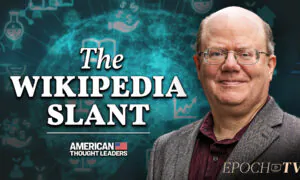
[RUSH TRANSCRIPT BELOW] Larry Sanger is the co-founder of Wikipedia and coined the name “Wikipedia’ in 2001. He established many of Wikipedia’s founding policies, including the original neutrality guidelines, before he left in 2002.
Since then, he has become a vocal critic of Wikipedia’s growing ideological bias, particularly on politically charged issues.
Sanger says certain outlets are favored as sources while others are blacklisted, creating systemic distortion and exclusion of dissenting views.
Most of Wikipedia’s top editors are anonymous, which means that people have no legal recourse for lies or inaccuracies about them that may be published on Wikipedia’s pages.
In this episode, Sanger breaks down what went wrong with Wikipedia and how it can be reformed.
Sanger has put forward nine theses for reform, including enabling competing articles, restoring original neutrality policies, convening an editorial assembly, and creating transparent rating systems for entries.
But what is the likelihood it will happen? Can—and should—Congress do something about it? And could Elon Musk’s Grokipedia offer a more balanced alternative?
Editor’s Note: The Wikimedia Foundation did not immediately respond to our request for comment.
Views expressed in this video are opinions of the host and the guest, and do not necessarily reflect the views of The Epoch Times.
RUSH TRANSCRIPT
Jan Jekielek:
Larry Sanger, so good to have you back on American Thought Leaders. It’s good to be back. I’ve been following Wikipedia for a long time, you know, longer than 20 years, in fact, which is when I really started with the Epoch Times. And I’ve watched our entry at The Epoch Times change dramatically over those years. At the beginning, it was actually quite reasonable and thoughtful, and I thought it was well-edited. And I was a big backer, frankly, of Wikipedia. I loved the idea, right?
But then, especially as we started to grow, especially as we started to become more influential, I mean, the term, pack of lies, comes to mind. It just turned into this gross distortion, and it created this huge problem for us, which is when, you know, potential readers find out about The Epoch Times, they’ll go to Wikipedia and they’ll read this terrible distortion of reality and might not actually, you know, subscribe when normally if they just, you know, didn’t have that problem, let’s say, it would be something perfectly reasonable for them to look at. So I want to get at, I don’t want to focus on The Epoch Times specifically, but I suspect it’s not just us, okay? Well, what happened?
Larry Sanger:
It’s definitely not just you. I’ve talked to a half a dozen other media sources over the last couple of weeks, and most of them have complaints of your sort. I’m an advisor of BitChute, the video platform, and they have complaints. Any sort of media platform or public figure, for that matter, that has a reputation that affects their reach and influence in the world is going to be basically bad-mouthed by Wikipedia, pretty predictably, I would say.
So why? It’s a good question. There are a lot of different reasons why. What I’ve always said is that Wikipedia is one of the institutions that the left marched through. We talked about the march through the institutions, and I think that definitely happened. It was already happening in 2001 in the first year. But I think another more perhaps illuminating and timely aspect of the question is, well, isn’t there something big that has happened since Trump came into office the first time?
The answer is the mainstream media in general, and I lump Wikipedia in with it, really kind of went off the deep end. It took what was originally just the Fox News format and then the MSNBC format, and that was adopted by everyone, you know. And as a result, Wikipedia just aped that. And because in those new formats journalists’ pretensions of objectivity are out the window, that essentially is what happened with Wikipedia as well. Wikipedia’s neutrality policy says, or at least used to say, that on issues of controversy, it should be impossible to tell what position the authors of the article hold.
That’s no longer the case in practice, for sure. And the policy page called, neutral point of view, has been, in subtle ways, rewritten so that it forbids what’s called false balance, which just means basically it’s required now, even for the sake of neutrality, that they take a side when one side is clearly wrong in somebody’s opinion.
Mr. Jekielek:
That doesn’t sound like neutrality.
Mr. Sanger:
No.
Mr. Jekielek:
It’s sort of like an inversion of the word, in fact, what you’re just describing, right?
Mr. Sanger:
It is.
Mr. Jekielek:
So you described this as the march through the institutions, but when did you— you mentioned back in 2001 you were already seeing some kind of issue— but when did this all really become a problem? Because I mean, there are some pages on Wikipedia that I’ve seen within the last couple of years. I really don’t go there that often anymore because of this exact issue.
But there are some pages I remember at least a couple of years ago, which were pretty neutral, but they were pages that were of no particular political import from the perspective of the gas people, as you describe them, right, globalist, academic, secular, progressive [GASP]. This is what you describe as the viewpoint of Wikipedia today. If it doesn’t have to do with that very much, or it’s not particularly influential, it might be neutral, might be left alone. But anything that does have political import from these perspectives, would you say that’s accurate?
Mr. Sanger:
For sure.
Mr. Jekielek:
And quickly back to my question, when did you really start to see this shift from neutrality into something much more politicized? When was it that that became a big issue for you?
Mr. Sanger:
To be quite honest, I was noticing shifts practically from the beginning. It didn’t become really obvious to everyone until I think maybe the last five years. But I was noticing Wikipedia taking definite stands, for example, on global warming. I thought that was surprising and not in keeping with the neutrality policy as early as, I think, 2005 or 2006, when it was taking what was at that time called a scientific point of view. I’m not saying the scientific point of view is bad. I think it’s good. It’s just that it’s not neutral. And what is mainstream science may not actually be the truth, as the history of science shows.
That is one of the main reasons why a good encyclopedia will canvas all of the different views on a subject. Now, I said back in 2010 or 2012 that the sort of bias that Wikipedia shows is very similar to that of the New York Times or BBC, very sort of establishment center-Left. But I noticed shortly after Trump came into office that, again, as the mainstream media became sort of explicitly biased, so did Wikipedia. And it became, if anything, worse, perhaps especially after January 6.
So I ended up writing a series of blog posts about Wikipedia’s bias, which I was surprised that it did this, actually. So three blog posts in 2020, 2021, and I think 2023, in which I basically gave a lot of examples. And apparently, this was news to people. I was surprised that it was news. I thought everybody knew this. And even now, people are still sort of waking up to the reality that Wikipedia does, on many pages, not all of them, but on many pages act as essentially propaganda.
Mr. Jekielek:
You know, in a very similar way, it’s very interesting, so, I mean, basically, you lump Wikipedia in with legacy news sources that have this, you know, whatever perspective the legacy news sources have, which is often a very similar perspective across, you know, a whole range of issues. Wikipedia just fits neatly in there and maybe in a more extreme way. That’s what you’re saying.
Mr. Sanger:
Yes. Well, it reflects those sources because basically by policy on Wikipedia, editors are supposed to cite secondary sources, what they call secondary sources. So not books, not tweets, but summations thereof, especially from the news media. Wikipedia now has a page, a list of what they call perennial sources, and it functions as a blacklist. And according to this list, you simply may not cite, may not use as sources of Wikipedia articles anything that has been branded as Right-wing.
So there’s a color coding of different media sources. The New York Times, of course, is green, which means you can cite The New York Times. In fact, you don’t even have to say that the source is from The New York Times in the text of the article. You can just speak in Wikipedia’s own voice and then use The New York Times as a footnote.
Mr. Jekielek:
As if it were a fact.
Mr. Sanger:
As if it were a fact.
Mr. Jekielek:
That is deeply disturbing. But yes, please continue.
Mr. Sanger:
Right. Anything that is colored yellow, which means essentially caution, and red, which means it’s a no-go, you may not cite this for any purposes except perhaps characterizing facts about the source. Those things, if you actually attempt to use such sources, that actually might be grounds for your being dismissed from the project. That’s how strongly they feel about it.
Mr. Jekielek:
And just explain to me a little bit what you mean about this march through the institutions.
Mr. Sanger:
As I recall, one of the Left-wing theorists explicitly stated as a goal that we, those on the left, attempting to effect revolutionary change, need to execute a march through the institutions, as Marx, if I’m not mistaken, and essentially capture education, government, of course, but especially education, the media, churches, and so forth. So each of these institutions has been, to a greater or lesser extent, systematically, carefully, and strategically infiltrated by the Left. Well, Wikipedia is one of those, insofar as Wikipedia represents what we are all expected to believe, at least from an establishment point of view. It is one of the controlling, I guess you could say, one of the controlling institutions of modern civilization. I’m sorry to say.
Mr. Jekielek:
Something that just comes to my mind is a Wikipedia entry about Philip Roth and some of his writing. And I don’t know if you’re familiar with this example.
Mr. Sanger:
I can tell the story.
Mr. Jekielek:
Okay, please do.
Mr. Sanger:
Sure. So Philip Roth, a famous American novelist, wrote The Human Stain. And he actually contacted me and was complaining, as a number of famous people have done over the years, and basically bemoaning the fact that he had weighed in on the Wikipedia article and said, I am Philip Roth, and the origin story of this particular character from The Human Stain is such-and-such. I forget the precise details.
He was a friend of his in any event, and not what was speculated by the New York Times at some previous date. So he was correcting the record, and he was an authoritative person to do so. So in the end, what he ended up doing was he ended up writing an article for, I think it was the New Yorker. I think it was the New Yorker.
Mr. Jekielek:
Or the Spectator. I can’t remember, but maybe it’s the New Yorker.
Mr. Sanger:
Maybe. And that, in which he told the story, and he also talked about the problems with Wikipedia, and that could then be used by Wikipedia as a source. So there’s something really ridiculous about that.
Mr. Jekielek:
But the bottom line is they went with the New York Times characterization and not the actual primary sources. I mean, that’s the kicker here, isn’t it?
Mr. Sanger:
Yes. I’m not personally sure of the details in that case, but yes, this is very much on brand for Wikipedia now. Wikipedia has a tendency to emphasize secondary sources over primary sources, which, as a former academic, I find to be absurd. If you’re in the business of writing an encyclopedia article summing up knowledge, then you ought to be able to do so from primary sources yourself and just deal with the problems of interpretation that come up. But they essentially offload those problems to the editors of secondary sources.
And that just illustrates a broader problem, which is a kind of fetish that they have about very nitpicky applications of their own specialized rules and in ways that are ultimately unreasonable. So it has become a very sort of irrational bureaucracy in that regard. A lot of people have complained about this problem.
Mr. Jekielek:
So in the past when we spoke, it seemed to me like you believed that Wikipedia cannot be reformed. But now you have come up with nine theses, which you, nailing to the virtual door of Wikipedia, I suppose, suggest to me that you think it might still be reformed. Tell me about that.
Mr. Sanger:
I think it’s possible. I think that the reform would not come from the people who like the system, obviously. It would require an influx of people who agree with the theses. But that’s possible. You know, thousands of people who hear about this, especially as part of this campaign that I have started, might actually descend upon Wikipedia and, you know, get some cred in the Wikipedia system. They have every right to do so. It is an open project. It is not limited to the Left in any way, shape, or form.
So, and in addition, of course, the supposed adults in the room, the board of trustees of the Wikimedia Foundation, have certain obligations, I think, that they can execute and impose their high-level decisions on the Wikipedia community. For example, just for example, they could declare that there will be an editorial assembly that actually formalizes the adoption of rules instead of doing what they have done, which is very anarchical and not entirely legitimate, according to many observers.
Mr. Jekielek:
And not as transparent, I think. That’s also what you’re saying, right?
Mr. Sanger:
Well, because the participants in Wikipedia are mostly anonymous. You don’t know how many accounts are controlled by a single individual or a single organization that pretends to be essentially organic, but it’s not. I think there’s a lot of astroturfing going on on Wikipedia, a lot of money that is being plowed into it through PR firms especially.
Mr. Jekielek:
And it’s just, but it’s hard to even assess that because aside from the outcomes.
Mr. Sanger:
If you want any chance of reforming Wikipedia, then it’s absolutely necessary to have some sort of body that has been legitimized that can actually meet face-to-face and debate on behalf of the participants in Wikipedia. Obviously, the people on Wikipedia can continue to debate in their usual way, but again, it’s sort of a black box what’s really going on because if there’s a lot of stuff that’s being organized behind the scenes, it is not all transparent. But a face-to-face assembly would have a kind of legitimacy that the current proceedings do not, and would also make it possible then for more ambitious sorts of reforms, needed reforms, that simply could not be made under the current ways of proceeding.
Mr. Jekielek:
So transparency is central. I think this has been a theme of the last however many years, that with the lack of transparency around decision making, rationale, a lot of bad things can happen. A lot of bad policy can be instituted. One of the things that I think your second thesis is to enable competing articles. And I like that. That’s a great one, right?
Because at least you can have another perspective, which hopefully would be as easily findable. Because that’s the other part, right? It’s one thing if one article is shown as the be-all and end-all, and then there’s a little tiny footnote with a second competing article. But that would actually be something that would be quite helpful in itself.
Mr. Sanger:
Right. People can look on LarrySanger.org. There’s a link to the nine theses there. So we’re talking about Theses 2, Enable Competing Articles. And there’s a long essay to go with each of these. So the idea is that articles would be, anyone could start an article on a topic that already has an article. It’d be a competing article, but it wouldn’t immediately go live. It would be in a draft namespace, which many different people could look at.
Articles would be moved to the main namespace when they meet objective criteria. Perhaps, as I explained in another of the theses, number seven, they would be promoted when they are rated in a certain way, whether by AI or by public rating or some other objective things like number of edits and number of contributors and things like that.
And then the idea is the author would determine who works on the article. Generally speaking, we might encourage people to allow anyone who wants to, except perhaps people from a list that the original article starter would want left off because they were causing problems. And essentially, if you want an article to be truly competitive, if it’s just another completely open article, then that new article could be squatted on by the same old people, if you see what I’m saying. The idea is that each article would be started with its own framework.
So right now, as we were saying before, Wikipedia has what I describe as GASP. This isn’t necessarily bad. I’m not saying it’s bad. I’m just saying that it is a framework. So that’s globalist, academic, that’s fine, secular, and progressive. And the combination of these things marks out Wikipedia’s operative editorial framework as being very narrow.
Essentially, the narrow approach of Western elitists, essentially, and leaving everybody else out. So there are many other frameworks that one could work with them, like just an unbiased American political framework would openly invite both Republicans and Democrats to work together using explicitly stating that it’s possible to use sources from what are characterized as the far-Right and the far-Left, maybe not the absolutely insane ones, but right, we’ll have some standards and the Overton window would be opened deliberately pretty wide and that’s an example of a framework you state that out front, and you say if you want to contribute to the article, then you’re going follow these basic ground rules.
Wikipedia could do this. This is the proposal. I think it’s not likely that they will, but they could. And the fascinating thing to me, to just contemplate, is that if this were available, I can imagine people starting frameworks explaining things from the Chinese Communist point of view, the Indian Hindu point of view, the French intellectual point of view, and a million others.
Mr. Jekielek:
Well, so a few things would happen. One is Wikipedia would grow quite a bit, right? And second, you could explore these different viewpoints overtly as opposed to being sort of stuck in the only framework which is allowed.
Mr. Sanger:
Yes, I would say there’s a difference here between framework and what Wikipedia calls a point of view, though, in the way that I’m using the word. I want to say that Wikipedia strives by its own lights to be neutral. I don’t think it does a very good job. It could do a lot better, but it does strive to be neutral by its own lights. And I would say that that would be true or should be true of all of the other frameworks. In other words, you don’t have a blank check, an open license to share whatever biases you like in the article. Not at all, right?
So one of the things that means, for example, is that if a point is controversial, the views expressed in the article have to be attributed to their owners, and there has to be some acknowledgment that there are others who disagree. But even within those sorts of broad neutrality guidelines, it’s still possible for different, call them, takes on neutrality from different points of view. Again, a British national writing about gun control, but by his lights, neutrally, will sound very different from an American national.
Mr. Jekielek:
So this makes a ton of sense to me, right? You’re always striving for neutrality, but you accept that we all inherently have some sort of inherent biases, some particular viewpoints on the world, and that’s going to inform how we actually do things. But all the while striving for neutrality. That’s different than saying we’re going to create something biased.
Mr. Sanger:
That’s right. And of course, one of the options here is Thesis 4, Revive the original neutrality policy. I like that one. There doesn’t have to be competing articles. In fact, if you adopt Thesis 4, that sort of renders two unnecessary. So Thesis 2, again, is, Enable competing articles, and Thesis 4 is, Revive the original neutrality policy. So the idea is that if Wikipedia continues to have just one article per topic but goes back to representing the broad landscape of discourse on controversial issues, then that actually scratches the itch. It actually does properly give the user the tools they need to make up their minds for themselves, which is the function of neutrality.
Mr. Jekielek:
Well, so one of the problems that we have, and I don’t know exactly how to address this, is there’s this, well, let’s just say with certain approaches to the world, right, notably what I would call the Leftist approach, right, the communist approach especially, is to paint anything that isn’t within the boundaries of my worldview as being beyond the pale, to be something that deserves to be slandered, and frankly, not given any acceptance at all, right?
This is, you know, I’m thinking about Herbert Marcuse’s repressive tolerance right now, to justify that in the cultural sphere, right, which seems to have been adopted by a number of people. So I don’t know how, knowing that that’s the case, and it’s not just that group that functions this way, but it’s antithetical to kind of, I don’t know, liberalism or a world where a plurality of viewpoints is generally considered valuable. And we don’t just say that everyone is either Hitler or Mao or something like that. That isn’t part of our team, right?
Mr. Sanger:
Exactly, yes. Obviously, back in the 1940s and 50s, with the whole discourse by Karl Popper, for example, and others of the open society, this was very clear to people. And for a couple of generations, the ideal of free speech was really much bound up with the idea of being tolerant of a very wide variety of points of view. And so the way I put it is I think that you can’t really have a robust variety of perspectives on an issue, get the full range of facts, then your opinions are easily guided, manipulated by people.
And again, this was just obvious when I was growing up, you know, and somehow we have forgotten, somehow forgotten all of this in the last 15 years. It’s only been that recent too. The whole idea of free speech and neutrality, for that matter, being somehow a Right-wing cause is ludicrous, of course. And that started only like 10 to 15 years ago.
Mr. Jekielek:
Well, and so when I read your nine theses, okay, I see, you know, you’re harking back to transparency, to free speech. These, I mean, this is infused, but really what you’re saying is that, you know, the ideological viewpoint that tends to dominate Wikipedia or perhaps the leadership right now would actually have to change.
Mr. Sanger:
Yes.
Mr. Jekielek:
Or the enactment of that viewpoint or something.
Mr. Sanger:
There’s a couple of different ways that it could happen. I mean, it could be an act of God and, you know, the leadership of the Wikimedia Foundation might simply decide, you know what, Sanger actually is onto something here with the idea of an editorial assembly. That’s a good idea. Let’s start that. And they could start that by themselves, right? They can impose it from above and there’s nothing wrong with them doing that. They own the platform, first of all, and there is no way that such a thing is going to bubble up from the bottom. It just couldn’t. It actually has to.
That’s the sort of thing that I should have started when I was getting Wikipedia going. I realized this only a few years after I left, that I should have established some sort of editorial governance apparatus, and it has lacked one ever since. And if it doesn’t come from, you know, the Wikimedia Foundation, maybe Jimmy Wales could get behind it, although he, again, alone is not enough. That’s one way.
The other way is Congress and the general public can raise a hue and cry and bring real pressure to bear, which might cause the rank and file of Wikipedians to change their tune. And I think that is very much a reasonable approach at this time for us to take. I think that it’s high time that we talk back to Wikipedia, you know, in an organized way.
Mr. Jekielek:
So are you saying you want to lead such an effort now?
Mr. Sanger:
As we were saying, I could organize a letter of protest. I’m sure there are a lot of people who have been bad-mouthed by Wikipedia who would sign such a letter. We can send it to the Wikimedia Foundation and to Congress and the White House and other governments around the world, perhaps. I don’t know. I’m not saying that I want to, you know, use the power of government to impose anything on Wikipedia.
I don’t want to do that at all. I still have many libertarian bones in my body. That actually makes me uncomfortable. But some of the worst problems with Wikipedia today that would cause somebody like you to sign such a letter of protest are actually creations of the law, which I can explain if you like.
Mr. Jekielek:
Yes, no, please do.
Mr. Sanger:
The Communications Decency Act in the 1990s was very reasonable. It set up a legal framework where people who ran open forums on the internet couldn’t be sued for the conversations that happened on the forum. If there was some libel they weren’t responsible for that and if, well, for example, there was a violation of copyright law they could just get a takedown request and then it would be taken down, problem solved. So this was covered in what’s called Section 230. This is the famous Section 230. I know a lot of people understand this already, but for those who don’t understand it, I think it does need to be explained.
So what this means, though, is that Wikipedia has a system in place in which it’s very wealthy, right? So it has money to solve problems as necessary. And yet, right, the platform sources content that is anonymous. In other words, you don’t have to announce your identity. I’m not saying that you should have to on Wikipedia, but it is anonymously generated content, and such content is presented as part of an encyclopedia. Factual and neutral, they use that term.
And yet, on top of all of that, it’s actually received by a lot of the public as being reasonably reliable. You know, even if you’re aware of Wikipedia having problems, if it says it in black and white there on Wikipedia, that actually makes you, you know, take pause. And the platform refuses to identify key content decision-makers. 85 percent of the 62 most powerful editorial participants in Wikipedia, for lack of a good general covering term, the Power 62, 85 percent of them are anonymous.
These are the most, or at least they represent the most powerful accounts on Wikipedia. There aren’t that many really powerful accounts on Wikipedia. And 85 percent of them are anonymous. So you can’t sue them. You can’t sue the Wikimedia Foundation. So if there is a real tort, the legal term meaning grounds for harm, which is grounds for a lawsuit, there is no one available to sue, so there is no legal recourse.
The reason that I dwell on this is that people have come to me, dozens of people over the years, some of them reasonably famous, like Philip Roth, John Siegenthaler, and various others, all complaining, look, Wikipedia is saying these false things that are materially harming my reputation, making it harder for me to be elected, or sell my product, and there’s nothing I can do about it.
It is a real problem, and I don’t like being the person who inflicted this situation on the world. But ultimately, as I say, it’s a creation of Section 230. So there could be a carve-out, if necessary. I don’t want there to be, right? But a carve-out, meaning a deliberate, targeted exception for a reasonably narrow, but still generalized category of platform.
So FOSTA-SESTA [Fight Online Sex Trafficking-Stop Enabling Sex Traffickers Act] has a particular carve-out for Section 230. So I know we’re getting into the weeds, but this is actually important. So the FOSTA-SESTA law basically serves as a precedent, an exception where websites can be taken down if they engage in human trafficking, right? Even if the people who run the website aren’t doing human trafficking, if it’s being organized on the website, they can still be sued for that. And I think that’s unfortunate, but it seems to be necessary.
So in the same way, if the law, if the combination of the law and the irresponsibility of the Wikimedia Foundation has created a situation where Wikipedia is functionally an engine of defamation, and again, if Wikipedia refuses to do anything about the problem adamantly, they’ve proven that they’re not going to do anything about the problem, then I think, I hate to say it, but I think Congress would have to act. And it could. I sure hope it would be written in a way that would not be a threat to free speech online.
Mr. Jekielek:
Or use the threat of that to actually enact some reforms. That would be another route.
Mr. Sanger:
Right. And this is not the only possible idea. There are a lot of creative people in and around government. Well, not very many, but there are some.
Mr. Jekielek:
So one of your theses is letting the public rate articles, in general, of course, sounds like a good idea, but there’s also this opportunity. You mentioned astroturfing. And just for the benefit of our audience, for people that might not be familiar with the term, we’re talking about contrived attempts to influence rating systems or basically there’s a kind of a single party that is looking to, you know, or a few parties that are looking to create a certain sort of sense or certain narrative, but they make it look like it’s a whole bunch of individuals, like it’s a grassroots effort. So the moment you do that, though, you’re opening the door to this, aren’t you? Like, the moment that you say, let the public rate, right? Or this, I don’t know the answer to this, by the way, right, but I know that a heck of a lot of astroturfing happens.
Mr. Sanger:
Yes, I agree. And it’s a serious problem, or more generally, gamification. But yes, I can easily imagine how any such system would immediately be seized upon and analyzed to figure out some way to make it work for basically one ideological position. I think the thing that would be necessary in this case is to basically secure one person, one vote, and the other option, of course, is to leave it all up to AI and make sure that the AI is entirely open source, which means everyone can view the source code. And I’m not really sure what the best solution is, but I present both of them in essay number seven.
I would say that any system which is completely open and where anyone can just make an account with an email address is not going to be very good at representing public opinion because the presumption will be that it will be gamed. And I can easily imagine how Media Matters or the Russians or the Chinese Communist Party would run a lot of bots and just put a bunch of false data in there. And they might do that. People who are fans of the current system might do that just in order to sort of crash such a rating system. Unfortunately, what that means is that there has to be somewhat, I would say, expensive and time-consuming measures taken to ensure that it is just like one person, one vote.
Mr. Jekielek:
Well, so let’s talk about AI. You know, Elon Musk has said that he has a solution to all this problem: Grokopedia. Okay. What’s your take?
Mr. Sanger:
I don’t know what Grokopedia is going to be like. I can tell you what I think of Grok right now. Generally, if you ask Grok questions about politics or anything, any sort of litigated science issue, whether it be global warming, COVID, vaccines in general, or MAHA, it takes a pretty Left-wing point of view or establishment point of view. I know enough about AI to be able to say fairly confidently that they, A, know that that is taking place, and B, they could fix it by changing the internal prompts that are used.
So, they, I think, have designed the Grok chatbot to reflect the kind of bias that it shows now. I don’t know why they have done this, and it’s not what you would expect given Elon Musk’s reputation, but it’s a fact, in my opinion. Okay, I think it’s a fact. So, maybe they’ll surprise me, and Grokopedia will not have a similarly Left-wing bias, but we’ll have to see, won’t we?
Mr. Jekielek:
You know, and perhaps, you know, it’s interesting that you say this, because perhaps I’m just so used to seeing in a whole lot of sources very, I would say, even extreme bias. Grok doesn’t come across that way to me. I mean, I actually use several systems. I use, for the benefit of our audience, Perplexity. I use Grok for research, right? And this is extremely helpful and I cross-check between them.
Sometimes they agree, sometimes they don’t. I find it to be much more neutral than a whole lot of other sources. And that’s useful to me. But so that I haven’t noticed it as strongly, or perhaps I’m just, like, you know, happy that something exists that’s not, you know, that far down the road, if you will, okay? And maybe I should be more vigilant, right?
Mr. Sanger:
I know what you’re saying, and perhaps it isn’t as pronounced as some, but I’m not saying that it’s biased on every topic. We might have been searching different topics, but generally speaking, when you ask it to give feedback, for example, on a given thread on X, the former Twitter, it generally does just reflect what you would see in the New York Times. And if you are specifically asking a question, maybe it knows you; your experience might be different. So, I really don’t know what it’s going to look like. I might be very pleasantly surprised that Grokopedia actually is neutral. Elon Musk says that it’s going to be neutral. We’ll see.
Mr. Jekielek:
So this, I mean, given that there is, you know, Grokopedia imminent, given that Grokopedia is going to be imminently deployed as we’re being promised, I mean, you can kind of imagine every LLM [large language model] now, right, and any one of these language models doing the same thing, right? So you almost think there could be some kind of competition among, you know, people who have, or let’s call it stakeholders in particular areas. I mean, look, the area that I’ve been looking at, because I’m writing a book on the topic right now, is the forced organ harvesting industry in China.
And I’m constantly pleasantly surprised, given the very poor way this has been presented over the last 20 years since we’ve known that it’s real, how well these different language models, or at least the ones that I’ve tried, including Grok, reflect the reality that we know. And it’s a particularly charged issue. So that’s my viewpoint. So I would be one of these stakeholders that could look in and say, okay, how does this compare across all these different Grokopedia, Opentopia, I don’t know, right? I don’t know what. So it does present very interesting possibilities, but it also presents huge opportunities for massive abuse, as I think you’re kind of suggesting.
Mr. Sanger:
Right. Well, it’s interesting to reflect on what’s going to happen to human-written encyclopedias. I think competition to write the best encyclopedia by AI would be really interesting. I myself have talked to people who have used AIs to draft encyclopedia articles. It can be done. The articles are often surprisingly not that bad. And once you figure out the prompt to use, you can do this yourself with Grok. In fact, that’s one that I have tried myself. Well, for that matter, I guess Grok and ChatGPT and Claude to evaluate different articles and collect sources.
So it’s very clear to me that it can be done and the results can be reasonably good, but the bottom line is it’s hard to do well. And this is the conclusion that a lot of people have come to. And it’s certainly what Wikipedians will tell you. I mean, some of the first people to look into this Wikipedia, which I think is fair if they want to take that approach. I think that’s fine. But the point is that it does require human input to be really reliable at this point. So, in other words, they are not hallucination-free yet.
Mr. Jekielek:
So the bottom line, if you’re The Epoch Times or some other stakeholder whose Wikipedia page is a gross distortion of reality, what can and should you do right now?
Mr. Sanger:
I’m going to set up a letter of protest. I don’t think I’ll call it a petition; probably a letter of protest. And I’m going to try to circulate this around to a lot of prominent people who have been wronged in various ways by Wikipedia. I think that will help. But at this point, it seems to be increasingly necessary to make some noise at Congress, which is now gone. The Oversight Committee is investigating foreign influence on Wikipedia, and this bears on the more general problems of Wikipedia being, as I say, an engine of defamation.
I am not trying to get Wikipedia to be generally regulated. That would just be a disaster. Of course not. That’s not what I’m trying to do. I simply want it to be possible to sue somebody if there has not been any satisfaction from the Wikipedia fold, right? Where there is a tort, there must be a defendant. That’s my idea.
So I think, and for that matter, speaking directly to the Wikimedia Foundation, making your feelings known, especially if you’re a prominent person, you know, if you’re a congressman or senator, obviously your voice counts for more. You will be listened to more by the adults in the room at the Wikimedia Foundation. There’s one other thing that I want to sort of inject into the conversation here that bears on this question of like the stakeholders, and that is that some of the stakeholders already know what’s going on.
Because if you want the Wikipedia article about your enterprise or about yourself affecting your reputation to read a certain way, then you know that you actually have to pay to basically have your article read a certain way. Sometimes, maybe not all the time, but like if there’s a problem, you can get it fixed, but you’re going to have to pay like five or $10,000 or something to some PR firm that will, with a reasonably good chance of success, be able to effect changes. So there are gatekeepers, back-channel gatekeepers that are controlling things.
I’m not saying that this is something that, no, the government should not be trying to control this. That would be far worse than the situation we have right now. But I do think for legal matters concerning foreign affairs, you know, and matters of state, like Congress is investigating now, but also torts, we need to understand what the hell is going on behind the scenes better.
And then the other thing that doesn’t really concern the stakeholders, that the other thing that needs to be done is, I think over the next few weeks and months, we need to have a season of participation by the people who have been left out of Wikipedia. If we descend en masse to Wikipedia, You have to behave yourself, or they will just get rid of you, and you won’t have anything. You don’t have a leg to stand on in the system.
But if you behave yourself, follow the rules, and ask an LLM for help about how to craft this so that your contribution is acceptable to Wikipedia and your talk page comments have to be just so, or again, you will be booted in short order. That actually goes back to Thesis 8, End Indefinite Blocking, which is a real big problem.
Mr. Jekielek:
But just let me get this right. You’re suggesting that people who have problem pages, maybe you have given up long ago on trying to actually deal with them because it was impossible, come back to it?
Mr. Sanger:
Well, yes, those people, but also everybody else, all of their allies, right? There’s nothing wrong with doing that. Now, you can’t organize such things in public. That’s called canvassing, right? So don’t do that.
Mr. Jekielek:
Aren’t you canvassing right now, but maybe very broadly?
Mr. Sanger:
Well, that’s entirely legitimate. Wikipedians do that. Wikipedians organize that and pay for it using the Wikimedia Foundation. That’s just, I’m simply encouraging more participation. I can even do that and say I want more centrists and libertarians and Republicans and conservatives, and religious people; religious Hindus, and Jews, and Christians, and Falun Gong.
They should all be able to participate. Why not? The people who are there might not like it, but they know that they can’t prevent you. They’re not supposed to, and they will not be able to. The system is not so far gone that they can simply get rid of you on the grounds that, oh well, this is just an obvious Republican, or something.
Mr. Jekielek:
So Larry, as a final thought, for the best case scenario, what happens?
Mr. Sanger:
The best case scenario would be the Wikimedia Foundation convenes an editorial constitutional convention meeting face-to-face in New York City or London or wherever, and in addition, that they just outright adopt a few of the nine theses. For example, the Wikimedia Foundation could decide on its own recognizance that if you want to occupy certain positions of editorial authority on Wikipedia, then you must reveal your identity. And then the Wikimedia Foundation would indemnify such people and also help protect such people as necessary.
I don’t think a lot of protection per se is going to be necessary any more than you or I need protection. I’ve been the subject of all kinds of attacks over the years, but nobody’s beaten me up yet. I don’t expect that to happen with Wikipedians. And are they really so cowardly that they can’t take real-world responsibility for the exercises of power that they have? That’s a thing that the Wikimedia Foundation could do. That’s one of the things that, in the best case scenario, would happen.
Also, there are a number of different theses that, to me, actually have a surprising amount of support. Like Theses 5, a humorous rule that I came up with called, ignore all rules. Way back in the day, just a few weeks into the project, I said to the new people who were nervous about editing each other’s articles, if rules make you nervous and not desirous of participating, then just ignore them and go about your business. That’s pretty much how I put it.
And that was since made into a kind of rule that is used by insiders to exert control over the newbies. So it’s, again, entirely inverted. And there is quite a bit of support for overturning that. It’s very possible that maybe that one and maybe a few others will be overturned from within the system. That would be great. I am not expecting it, but it’s not outside of the realm of possibility.
Another part of the best case scenario is that the public really does respond, and actually take real meaningful action. Signing this letter of protest and similar letters and making your voice known to the various powers that be that govern Wikipedia at various levels. Again, there’s the legal institutional owners of the platform at the Wikimedia Foundation, and then there’s the Power 62 accounts.
You can talk back to them. Why the hell not? Those people are powerful. They might deny it, but they can’t. It’s entirely possible that with pressure brought to bear, they can realize that there is a problem here, that Wikipedia really does need some reform.
And they might not use these nine theses as a template for change. They might find ways that are more palatable to them but which are still responsible ways to improve the system, make it a better citizen of the world, so to speak. I’d be all in favor of that. You don’t have to take my ideas and use them. So that sums up the way it might actually happen.
Mr. Jekielek:
Larry Sanger, it’s such a pleasure to have you on the show.
Mr. Sanger:
Thank you. It’s always a pleasure to talk to you.
Note: The Wikimedia Foundation did not immediately respond to our request for comment.
This interview has been partially edited for clarity and brevity.