Live chat
June 5, 2025
American Thought Leaders
Live chat
 Expand
Expand
 Expand
[RUSH TRANSCRIPT BELOW] “When we are dispersed and we interact with other human beings only online, and the algorithms feed back our preferences and desires to us, what it effectively does is kind-of isolate us in these multiple sub caves.”
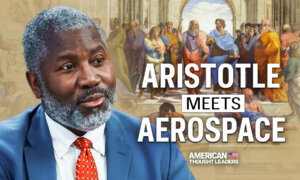
Jacob Howland is the provost of the University of Austin, a new, private liberal arts university that is pushing back against censorship and politically popular narratives in higher education.
As dean of the Intellectual Foundations program, Howland gives students a comprehensive education in the Western tradition, emphasizing both “Athens and Jerusalem,” he says.
“After communism fell, it’s as if the historical amnesia had removed the capacity of those who were still around to reckon with the past,” he says. “There are inexhaustible resources in the tradition, and if we’re going to find our way forward, we’ve got to understand the past.”
Views expressed in this video are opinions of the host and the guest and do not necessarily reflect the views of The Epoch Times.
RUSH TRANSCRIPT
Jan Jekielek:
Jacob Howland, such a pleasure to have you on American Thought Leaders.
Jacob Howland:
It’s great to be here, Jan. Thank you.
Mr. Jekielek:
A lot of people are wondering what’s happening in America right now. Many Americans, frankly, but also Canadians. I am having people call me saying, “Hey, what is Trump doing? What are they doing over there?” Europeans, I mean, everywhere. What’s your take?
Mr. Howland:
Well, I have a lot to say about this. Before the election, I felt there was a kind of doom coming at us. And I’ve been trying to think about sort of the way to represent this and why I felt that. I think it started in 2020 with Covid. Everybody was told to get behind their locked doors. You know, you can’t go to church. You can’t congregate in certain numbers. You’re going to be reported. There was this atmosphere of intimidation.
I knew a number of older people, especially, who thought that anyone who hadn’t had the vaccine was actually killing other people. Of course, we learned later that that was false. And there was this kind of isolation. Of course, we learned later that that was false. And there was this kind of isolation and atomization.
The sort of image I came up with there is that of the cave in the Republic where everyone is sort of watching these images. And I realized that when we are dispersed and we interact with other human beings only online and the algorithms feed back our own preferences and desires to us, what it effectively does is kind of isolate us in these multiple sub-caves. I mean, the good thing about, at least in ancient Athens, if ancient Athens was like a cave, everybody was in the same cave and looking at the same images and so forth.
But then I had another idea about this, and it really is informed by Dante. I was reading The Inferno. And you know in the Inferno you have these nine circles of hell. And the problem is that everybody’s in their own circle. So all the damned souls are in their own circle and they just walk around. In some cases, they’re actually rooted to the ground like the suicides. But no one’s getting out of that circle and they’re only relating to other people who are like them or maybe they’re antagonists, like the hoarders and the spenders, who are in one circle and they’re sort of pushing against each other.
So Dante and Virgil came down and they were able to travel through these levels and sort of, but this sense of isolation, it felt like everyone was frozen. People weren’t going anywhere. They weren’t developing. And at the same time, Americans were becoming passive. First of all, we were sort of addicted to our social media feeds. And second, we were sort of physically restricted during Covid.
And then there’s also the ideological component, right? Which is you can’t say these things you can’t. So there was a sense in which motion was restricted. And then as we approached the 2024 election, I realized, look, you’ve got Dianne Feinstein in a wheelchair. You’ve got Mitch McConnell having episodes of being frozen. You’ve got John Fetterman, who’s actually changed a lot.But at the time, you know, he was having very big psychological problems.
And so I wrote an article for Unheard called something like “America Has Become a Zombie State.” And, of course, zombies are these beings that don’t think. They are in crowds. They act in crowds in zombie films. But there’s no community. They don’t connect with each other. So just to go back to Dante, it’s as if we’ve gone all the way down to the ninth circle where everyone is frozen in the ice.
It’s an amazing image. Dante has this brilliant idea that at the center of hell, the very bottom of hell, it’s not fire, which is motion and change. It’s ice. They’re frozen. And Dante sees these figures under the ice just kind of like, you know, whatever posture they’re in for eternity. No one’s talking. And then you have the massive figure of Satan.
And if you calculate it, he’s towering up from the waist, something like a thousand feet. And he’s not speaking either because he’s chewing on these traitors, Brutus and Judas and Cassius. And he’s represented like this windmill, like a big machine. And I thought, you know, that’s an image of the state. And he has three faces and six eyes and he can surveil everywhere. And what he’s looking at is this frozen valley of the damned and no one’s moving.
But then Dante and Virgil break through the ice and they go through it and they realize that their entire perspective has been inverted because Satan is actually upside down. The story is that he came from the other side of the world and smashed down to the center and half of his body is on the other side of the ice. So they broke through the ice and now they’re properly oriented because they’re going to go out and they’re going to climb purgatory and then they’re going to ascend to heaven.
So putting all this stuff together, it’s as if we’ve replaced frozenness and submission and a kind of passivity for a kind of chaos. We don’t really know what’s happening. But a new vista has been opened up to us. And at the same time, things have turned. It’s been like an orthogonal transformation of 180 degrees. And then we’re moving in another direction.
And I take heart from that because it seems to me that so many elements of our lives have been opened up since Trump’s election. Maybe there’s a possibility in Dante for a kind of ascent as opposed to a sort of continuing descent. Maybe there’s a possibility for transcendence. With this election, I feel that kind of hopefulness, but also a sense that, I mean, nobody really knows where we’re going. But to me, it feels like an epical transformation. Now, I haven’t answered your question as to what’s going on in America, but I have told you what I feel about these recent events and what they might portend.
Mr. Jekielek:
Well, the Covid years made me think a lot about Hannah Arendt’s work and specifically how the atomization of a society is required to institute a totalitarian type of governance, or how those things go hand in hand, or perhaps even unintentionally an atomized society will trend in that direction. And that atomization seems to be shifting somehow. I mean, it really does, actually. It’s palpable, isn’t it?
Mr. Howland:
Well, I think part of it is that we’ve all been sort of faking it. In particular, the imposition of a new vocabulary. Men can’t be called men if they want to be called women. The appropriation of words like justice turns into social justice. The kind of general sense that, you know, if you’re not speaking this language, you’re not on the right side. And certainly in universities and elsewhere, the data suggests that many, many people have bitten their tongues. They’re not talking to each other, and they’re not going to be honest. It’s as if there’s a kind of preference cascade.
It’s as if once Trump was elected, people felt free to say what they actually believe and to say things like, “I’m a patriot. I care about the United States of America. We need borders. Men aren’t women.” It’s as if all this ice has broken up and now everything’s flowing. Lying to oneself and to others is a characteristic of totalitarian societies. I think that’s a very serious problem. So when people get used to that, they just fall into it. Because the opportunity cost is too high in a lot of contexts to say, “This is what I really believe.” But now that’s gone. The opportunity cost has been greatly diminished.
Mr. Jekielek:
You’re making me think about something that I speak with, I’ve spoken with people about often, and just how fundamentally different it is to live in a totalitarian society. And I was thinking about the society that my parents came from, communist Poland, but there are much more grave manifestations even than that. But basically, you and I, it’s very difficult for us to have, because we don’t know each other that well yet, to have a normal conversation.
Because I know in the back of my mind that you’re incentivized to report on me. And it’s very quite possible that you will, even if you say niceties and so forth. So there’s always this kind of veneer, and you have to be incredibly careful with any close relationships; those are the hardest thing to create. It’s the family, and that’s it. I mean, almost. And that’s very just difficult to fathom in a free society where just none of that really is an issue.
Mr. Howland:
Yes, for sure. There’s a great book by Vasily Grossman called Life and Fate. I consider it the best novel of the 20th century. It’s the 20th-century War and Peace because the subject of the novel is the Nazi invasion of the USSR, and it focuses on the Battle of Stalingrad. And in this book, there are several scenes where friends will begin to feel comfortable with each other, and then they will open up,and they will speak the truth, or at least they will articulate their own actual views.
So they might say something about Stalin, right? And they’re elated, and then they walk away, and they think, “What have I done? I just said these things to this guy. And if he betrays me, I’m doomed.” So there’s this kind of weird oscillation. And in that book, by the way, it’s very interesting. The freest human beings in the Soviet Union in this book are a group of Soviet soldiers in Stalingrad who have now been surrounded by the Nazi forces.
And they realize that they’re doomed, and so a commissar goes to this location and they make it clear that they despise this guy, and he’s just unbelievably upset, you know, like nobody talks badly to a commissar. And the very next scene, he wakes up in a hospital and he says, “I want to report this guy, this guy, and this guy.” They say, “Oh, well, that’s not necessary. They’re all dead.” So the interesting thing is that the only people who are truly, truly free are those who are liberated by the knowledge that they’re going to die.
So why is this relevant to what I was just talking about, about the pre-Trump days? We have to come up with some kind of way to refer to this epic transition. Like one way to look at totalitarian societies is you’re on a train and the train starts out and you get to a station, you get the next station, you get the next station, and when you get all the way to the end of the line, you have the death camps or you have the Gulag.
The Soviets have a word for people in the camps who have died before they’ve already physically died. And there’s an equivalent word in the Nazi camps. In the Nazi camps, they call them Muselmann, which means Muslims, right? Which I think is because of submission, but nobody really knows why. In Russian, it’s Dohodyaga. And a Dohodyaga is literally someone who has come to the end of the line. And the understanding was like, they have come to the end of the line of communism, right?
And the problem is I really felt like we were on that train and we’d passed a couple of stations. And if you keep going this way, I mean, the water’s freezing and we’re eventually going to be in that horrible stasis of complete inability to move psychologically or physically. And that was terrifying.
Mr. Jekielek:
And if I may, without a whole lot of people realizing that that might be the trajectory in the first place, that’s the part that I find both fascinating and incredibly disturbing.
Mr. Howland:
Yes, I mean, look, I think part of the reason it’s not obvious is because we have forgotten, in particular the Soviet experience. I mean, the fact is, of course, a lot of people don’t know about the Holocaust either. And I put those together because fascism and communism are ultimately inseparable. There’s a big mistake that political theorists or political scientists make. They say that communism is on the far Left, right? And then, you know, you’ve got liberal democracy, and you get all the way over here, and then you have fascism. But the correct characterization is fascism and communism are the same thing. They’re totalitarianism.
For example, Darkness at Noon, of course, is this great novel about this poor guy. He doesn’t know if he’s in a Nazi jail or if he’s in a Soviet jail by the end of his days because it’s the same experience. I think that’s the right way to look at it, but to understand the characteristics of a totalitarian society, I think it’s necessary to understand that we were on this road or that we could be on this road. And so what are those characteristics? Forgetfulness of the past, right?
So what’s been happening, for example, in universities, but also now since 2020 and the whole George Floyd thing, is the removal of statues. In museums, you know, you now have these explanations about what you’re looking at. You’re looking at landscapes, but actually they’re racist somehow, right? And also, curriculum in K-12 education really has become highly ideological.
And so insofar as the past is taught, it’s sort of filtered through this steel mesh of ideology. So there’s a forgetfulness of the past. And frankly, I mean, for historical reasons, there wasn’t really any reckoning with communism. And I think there are deep reasons for that.
For one thing, everybody in the Soviet Union was implicated. Everybody has a memory of at least one or two events that they deeply regret. Because for example, if you’re my friend and you’re arrested, and I have any kind of prudence at all, I’m going to deny that I even knew you. I’m not going to speak to your wife. I’m not going to acknowledge that I had an association with you and so forth.
If I’m taken into Lubyanka prison or Lefortovo, the main prisons in Moscow, and I’m interrogated, I very likely might make up accusations against friends just to try to give the interrogator what he wants. So everyone’s implicated in some act of commission or omission; nobody wants to investigate all this stuff.
Mr. Jekielek:
And if I might add, the thing that I’ve realized as I’ve been inadvertently studying this in depth is the system is geared to create that reality, to implicate everybody, because then that whatever moral high ground you had has now been reduced, and you’re so much easier to control.
Mr. Howland:
That’s exactly right. It’s like the mafia. You become a full-fledged mafia member after you’ve killed somebody, and that’s how they’ve got you. They have the goods on you. And then, of course, after communism fell, it’s as if the historical amnesia had removed the capacity of those who were still around to reckon with the past. Now, I don’t mean everybody.
But for example, when I was in Romania in 1997, I toured the palace that Nicolae Ceausescu built, a horrible communist dictator. Of course, he was executed in 1989. He leveled the central area of Bucharest, destroyed a beautiful neighborhood that I had seen in 1991, and he built a 4 million, almost 4 million square foot palace. Just to give some people some context, the Pentagon is the largest building in the world, and it’s 6 million square feet.
I went on a tour there, and instead of talking about any of that history, or Ceausescu, or the fact that the oldest neighborhood with beautiful onion dome churches and houses was destroyed, the young tour guide said, well, we have 487 rooms or something, and we have X number of gold fixtures. It’s this weird inability to confront the question of how did we get here? And I think that’s a fundamental question for individuals, for families, for tribes, for nations, for societies. Where have we been and where are we going? That question shows up in the Dialogues of Plato and in the Bible. So I know it’s important because those are the two roots of the West.
Mr. Jekielek:
My good friend and our columnist, Jeffrey Tucker, has been looking at the question of Covid as soon as these shelter-in-place policies came in. His view was civilization as we know it is over. I’m being a little bit melodramatic, but something like that. Today, he’s watching the aftermath of those years and asking himself, why are we not having a reckoning? In fact, he’s had a recent piece about this. And I think the root is in a similar place to what you’ve talked about. But part of it is also that people kind of need to move on. If you don’t interrogate it at all, obviously that’s a problem because then you’re doomed to repeat it, right?
I have some very unpopular views about how Poland emerged out of communism. I’m saying unpopular with people on both sides of the aisle, so to speak, in terms of views. Poland emerged out of communism incredibly well, relative to everybody. There are different theories about why that might be, but I think maybe they hit that sweet spot of the Institute of National Remembrance giving everyone their dossier should they want it. People realized that a quarter of the country were informants, for example. That was one of the realizations.
But most people that were involved in the system were just simply, okay, let’s move on. They made the Communist Party and the Nazi Party illegal, by the way. That’s interesting. You couldn’t hold your head high and say, yes, I was a communist. But mostly, people had to move on with their lives and became politicians, or in some cases, they sold themselves businesses and became very affluent, even though they were basically commissars before in 1989. And somehow the society just kind of moved on.
Mr. Howland:
Yes, that’s a natural human impulse. I watched the film Finding Manny about your father-in-law, and it was very typical. You know, your father said that after the Holocaust he just wanted to live, he wanted to move on. A survivor I know who went through various camps and so forth, she came out of the Holocaust. She was probably 12 years old, 13 years old, something like that, and she just wanted to grow her hair and date boys. And she didn’t think about it until the 1970s. There’s a sense in which hope and a kind of opening of things changes your attitude so that, I mean, now I’m sort of waiting and saying like, what’s coming? Things are not settled enough to sort of take a position and say, you know, unless you’re somebody who thinks you can prognosticate and tell me what the future is going to be.
So I think that our lives and our history go in these ways, right? We’re sort of obsessed with a problem and it’s eating at us and we think about it and we think about it. And then a door opens and the grass is green and the sun is shining. And those motives are not present anymore. And now you just kind of want to enjoy being liberated from these fears and from these concerns. So yes, I think that’s totally normal.
Mr. Jekielek:
You just reminded me of something that Manny says in the film. There are these young German children asking him in this forum, “Do you hold us accountable, or do you think the Germans are guilty?” I forget exactly what they’re saying. That’s the idea. He says, “Well, no, I treat every person as an individual.” This idea of collective guilt is something that I hadn’t really thought much about until the Covid years.
And let’s call it the woke approach to the world and identity-oriented responsibility, I suppose, right? Tell me what you think about that, about this juxtaposition. Because I feel like we’re constantly facing that in different manifestations. Like, do we focus on individual responsibility and accountability? Is there such a thing as a collective?
Mr. Howland:
There is a sense in which all Americans, with rare exceptions, I’m sort of speaking of the general American citizen, are collectively guilty for Covid. Why? Because we didn’t push back. I mean, some people did. Some people did. They said, I’m not going to take the vaccine. But the penalties were too big. If you don’t take the vaccine, you can’t fly on a plane. Can’t fly on a plane, you can’t go visit your dying father or something like that. So it’s a real thing. Only individuals can be held morally responsible for the choices they make. Because when we talk about collective guilt, I think we’re thinking about 10,000 individuals who made the same choice, and it was a bad choice.
I came up with this idea when I was reading Vasily Grossman’s, Life and Fate, which is a book about a central character who is a physicist. He’s a Jewish physicist. And Grossman knows a lot about science, and so it just sort of suggested itself to me. I came up with this idea of quantum politics, and let me explain what I mean. The Soviets practiced what I call quantum politics. What is that? When you see a reflection in a mirror, the light’s coming this way, and you see it. How does that work?
Now, explained quantumly, you’ve got these photons or waves—I don’t care how we characterize them; let’s just say photons—and they’re going toward the glass, okay? You can predict that anytime you see a mirror, things are going to be reflected in the way that I learned in physics, right? Angle of incidence, angle of reflection, same thing, blah, blah, blah. But it turns out that with any individual photon, you don’t know what it’s going to do, because some photons will go straight through that mirror. Some photons will hit the mirror and go straight back where they came from. They can go off in all directions. They’re totally unpredictable.
But I can guarantee you, just because of the laws of probability, that mirrors are going to work the way they work because most photons will bounce back in this predictable way. So is there a collective guilt of photons? I mean, you know, you could sort of say that, but the Soviets practiced quantum politics because they knew. If I say to you, here are the penalties for certain forms of behavior, most people are going to behave as they predict. If I put a gun to people’s heads and say, declare your fealty to Stalin, most people are going to do that. That also would increase the, you know, fidelity. So they understood very well how to get the results that they wanted.
Now, of course, the other thing they did is that they deemed certain classes to be guilty. And actually, that expanded and expanded, not just classes, but peoples, Kalmyks, Tatars, you know, all these people have moved up—Poles, for God’s sake. I mean, they took loads of Poles after they invaded Poland and just, you know, sent them into the Soviet Union and sent them to the camps. And I think that is, frankly, a feature of modern life. And it’s an ugly feature of American life still, which is assigning people to particular groups, which frankly are largely arbitrary, and then assigning them guilt on that basis.
What would be the use of a notion of collective guilt? I think it’s reasonable to say to the Germans, let’s say, most of you didn’t push back at all and didn’t do anything. Some of you saved Jews, some of you didn’t. Some of you died fighting the Germans, some of you didn’t, fighting the Nazis or whatever. But the real point is to get individuals to start thinking about that. And that’s very hard because our default setting, and I don’t exclude myself at all, is to sort of go with the flow and to be cautious when there’s a cost for sticking your head up above the ground.
Mr. Jekielek:
Something that I’ve been thinking a lot about since we spoke before, and I watched some of your past interviews, notably one with Jonathan Pageau, is just the concept of this moral intuition. I think this is kind of universally present in whatever society where there’s this kind of, let’s call it incentive structure set up. The people that buck that, like, for example, let’s say in Poland, where they decide, okay, I’m going to shelter these Jews just because, and I know there’s a death penalty, but you know what, I’ve got to do it, right? So there’s this kind of, and in most cases that I’m aware of there, and also in a much less grave situation, like for example, making the choice to go against a particular policy, an oppressive policy, but not, you know, death is not the outcome for that reason.
People just felt like they couldn’t live with themselves if they did not do it. And that’s interesting. Is that courage? I’ve been asking myself, is that actually courage? Because there are people that are very courageous and they step up in situations, but then there’s this thing where it’s just, there’s this moral inability to go the other way.
Mr. Howland:
It’s so interesting, you know. I think of Natan Sharansky. And, of course, he was a dissident, and he was jailed in the Soviet Union. And he spoke of the liberation he felt when he finally spoke out, when he finally said what he believed. In Grossman’s book, Life and Fate, this character denounces somebody, right? And then he experiences regret, and he realizes that he had given up the only thing that was truly precious, which was his soul. Grossman himself, by the way, signed a document denouncing Jewish doctors.
Stalin had this so-called doctor’s plot, and these doctors were supposedly poisoning Soviet officials, and so he was going to hang them in the public square. And by the way, according to both Grossman and Solzhenitsyn, the plot was to hang them in the public square, then drive the Jews of the Soviet Union across the country to the Far East, where there were already barracks set up. I think there were three and a half million Jews, and then to commit a second Holocaust. And only the death of Stalin stopped that. But Solzhenitsyn is very clear. This is the thing that matters. It’s your soul. It’s not your body.
Now, it’s very easy for me to talk about this. I have no confidence that I would have behaved in the way that Natan Sharansky did or that I wouldn’t have signed the document to save my skin. And finally, I’ll say this other thing. There are two great books by Nadezhda Mandelstam. One is called Hope Against Hope, and another is called Hope Abandoned. And in Hope Abandoned, which is the longer book, and it’s a kind of memoir of her experience under the Soviets, she speaks about a young woman who was threatened with torture if she would just give up her friends.
And the way she talks about it is, I just couldn’t do it. Like, I physically couldn’t do it. I couldn’t say the words. I think your question is really interesting. Is that courage? Is it courage when it’s simply not within the realm of possibility that you could act in another way? Now, those people are very unusual, but I think the central point here is that you always have a choice. I really don’t buy it if somebody says, they held a gun to my head, I had to do this. Because you can always choose to be shot.
Having said that, though, I just want to reiterate, you know, I have no illusions that, I mean, I wouldn’t say, okay, I don’t want to be killed. That’s terrible. That’s awful. So the question of guilt becomes really difficult. I mean, are we asking human beings, is it sort of like asking a dog to walk on its hind legs? For most people, it is.
Mr. Jekielek:
I’ve had this reflection on myself. I think it’s one thing when it’s just you that’s implicated. Yes. It’s another question when someone says, well, you know, my associate over there is just actually hanging out with your wife right now. So is that still your choice, sir?
Mr. Howland:
Exactly.
Mr. Jekielek:
Right. That would, that it’s a different calculation.
Mr. Howland:
This is exactly it. And there are very few people who are really completely and totally alone. That is kind of liberating. But yes, I mean, the farmer with a family who hides Jews in his house—did his children say that was a good idea? But do they even know about it? The pressures that those kinds of decisions put on human beings are absolutely enormous.
Mr. Jekielek:
But we’re also right to valorize them, right? This is what I’m thinking about, right? You know, it’s an animating feature of my life, actually, facing someone who basically did this. I was a biologist in another of my previous incarnations, right? I got very ill. I recovered. And in the process, I kind of promised that I would give my life to service, so to speak, if I recover. You know, you kind of do this sort of thing. You play this. I was an agnostic. I just thought, well, if on the off chance, I’ll make the deal. Right.
And I remember the moment I figured out what that would be. Right. Because there was this postdoc at the university that I was at, whose mother had escaped from China. She was a Falun Gong practitioner. And she had basically been tortured. And through translation, the story was being told to me. And the woman is telling me, they gave me a piece of paper to sign. And it was basically, I renounce my faith. There were three things, but that was the idea. And this woman is telling me, and I remember thinking, and this goes back to what we talked about earlier about living in a free society.
I was thinking to myself, I remember, there’s no justice in this. What do you mean you can sign a piece of paper and you can go home, but otherwise you get tortured? And then the whole understanding that my parents had been trying to inculcate into me as a kid, I knew communism was bad in theory, but suddenly I got it. I got what it was, that this was the system manifest. And I said, aha, I have to help these people. I have to expose this system for what it is.
Mr. Howland:
Yes. The signing of a piece of paper. So the Soviets did the same thing. And what’s really curious about it is Karl Marx, of course, he has this criticism of Hegel and criticism of bourgeois liberal democracy. And his claim is that everyone is equal in what he calls the heaven of law. But in society, they’re not. Although we’re all sort of in principle protected and in principle we’re equal, the social conditions are very different and some people are oppressed and so forth.
But in the Soviet Union, everyone had to sign. So they were scrupulous about saying, well, Jan has been sentenced to 10 years without communication, which is the Soviet way of saying, you’re going to die. You go to the camps. You’re not coming back. But here we have his confession. Now, the fact is the confession is extracted because democracies, the Soviet Union did, which is everyone’s equal in the heaven of law, right? And so you can read these memoirs and people who are in internal exile will go off to some little town and they can’t be employed.
Why can’t they be employed? Because everybody knows that the government has sent these people here, that they’ve been convicted of a crime and this is their punishment and they’re not going to employ them. Then if they go to the office where they have to check in four times a month or something and say, I can’t get any work, they say, everyone in the Soviet Union is free to work wherever they wish. And so there’s this kind of complete disconnect. I think there was something like that in the United States too, and there may still be. You have these legal protections, you have these things, but then we find out that actually the law is not applied to certain favored groups or certain favored individuals, but it is applied in other cases. And that kind of bifurcation produces this sort of schizophrenia in society.
Mr. Jekielek:
I mean, rule of law, I mean, of course, in theory, and how beautiful and rare and precious a concept that is, as opposed to, let’s call it tribal application of law, right? If you’re on my team, all good. If you’re on the other team, well, sorry, right? Again, collective question of collective guilt, I suppose, just by virtue of the fact that you’re not on the team. But it’s such a foundational concept of, I guess, justice, right? A way to try to achieve justice, right, for people.
Mr. Howland:
And justice is so difficult because the philosophers have this term stochastic, right? So medicine is stochastic. What does that mean? There’s no guarantees. It’s a kind of probabilistic thing. So let’s say you’re a carpenter and I ask you to build a bookshelf and you produce a bad bookshelf, right? If you’re actually a carpenter, you can produce a good bookshelf 100% of the time. If you’re a really good heart surgeon, you might be able to help people with their heart conditions that are surgically treatable 40% of the time, 50% of the time.
Law is like this because it makes mistakes. Not only that, let’s say that my brother is murdered, God forbid, and they catch the perpetrator and the perpetrator is sentenced to 30 years in jail or something like this. Nobody’s happy because I can never bring my loved one back. It’s the best the law can do. And I think that we’ve forgotten that.
I mean, when we talk about justice, all we can do is find approximations that will get us closer to what perfect justice would look like. And that is turned into a weapon sometimes against the law, because it’s very easy to take potshots at it and say, well, why did this happen? Why did that happen? But darn it, it’s the best thing we’ve got. I mean, what is the alternative? The Hatfields and the McCoys? Or just the Führerprinzip, which means that Hitler is the law. Well, that obviously has problems.
We have a very great tradition, which is under attack. I’m talking about the Western tradition. And it’s under attack from many quarters. And I kind of would like to know what the alternative is. I think people are quick to judge the tradition. A discussion with people who have decided to embrace what Roger Scruton calls the culture of repudiation, they will be able endlessly to point out mistakes and flaws and injustices that have been committed by Western governments and individuals.
But the fact is, I think we need to understand the tradition before we judge it. I said earlier, this question of where we’ve been and where we’re going is really fundamental. If we want to deal with the crises of our time, we have to understand where we are. We have to understand how we got to where we are if we’re going to have any chance to find our way into the trackless future, to figure out where we’re going. And that means that the whole Western tradition has to be studied. Let’s do that first. And I think that a lot of the things we’re talking about are already there at the beginning of the tradition.
So we’ve been discussing people who show courage or simply can’t bring themselves to engage in injustice, let alone evil. That goes back to the Bible. I mean it does go back to Socrates as well, but it goes back to this notion that we’re made in the image of God, that we’re precious, that we need to be open to others, that we need to care about others. And then of course the law and the kind of abstract thinking, that goes back to the ancient Greek philosophers. So you’ve got Athens and Jerusalem and what’s interesting is, I mean, this is the way they were designated by Leo Strauss. I think it’s pretty good.
And then later you have Rome, by the way, which is sort of the confluence of these two things because Rome, you know, the Romans both embrace the philosophy of the Greeks and imitate the Greeks and copy their statues and learn Greek and, you know, develop grammar to study Greek, Greek and stuff like this. But they also ultimately embrace Christianity. But these two things are fundamentally important.
And one way to look at what happens with totalitarianism is there’s a kind of embrace of just the Athens part. And I should say, when I refer to Athens, I’m also referring to the Greek poets and so forth. But let’s just take philosophy and the promise of reason. I think a fundamental point is that reason and inquiry and science are all wonderful human tools, but they must be exercised in the light of Jerusalem, so to speak.
Athens is only productive when it’s aware of the alternative and when it’s aware of the teachings of the Bible about humility and about how little we know and about there being an ultimate reality. So what happens if you just have pure reason, a belief in the power of reason? And incidentally, of course, what happens is that the fascists and the communists think that they can sort of take the biblical story of which promises an afterlife and immanentize it and produce it, right?
Now, the danger of that is that, well, if you’re going to have a paradise on earth and it’s going to be a political product, it has to conform to the time and the place and the conditions and it’s produced by human beings. It’s not organic. And this creates all kinds of crazy distortions.
But what happens if you have someone, if you’ve got someone on the other side, biblically informed, who utterly rejects reason, who utterly rejects human reflection and investigation? You get religious extremism. So it’s sort of like, pick your flavor if you separate these things. Would you like totalitarianism, where people are immiserated because human beings think they can construct a happy society? Or would you like Islamism, right?
And I think that’s our problem today, is that we need to get back. I mean, we were sort of going in this direction of government going to have top-down solutions. We’re going to tell you what to think. We’re going to take care of you. We’re going to give you your vocabulary. We’re going to tell you how you can live. We’re going to control everything, without a sense that there’s something above the political. There’s something higher. There’s a higher reality. It’s moral. It’s spiritual. And now that’s one of the windows that’s been opened since Trump’s election. We can start thinking about those things.
Mr. Jekielek:
We’ve come full circle, I see. Why don’t we actually talk? You actually teach this stuff, right? And actually have a whole faculty that is involved in teaching this stuff. So just briefly tell me about what you’re doing now at the University of Austin, but also how you got here to be having all these very compelling thoughts about the world.
Mr. Howland:
Well, so I’ll talk about the University of Austin. Look, I designed the intellectual foundations at the University of Austin. And what is that? It’s one of three elements of our curriculum. In the freshman and sophomore years, students take roughly two-thirds of their courses in intellectual foundations. And the idea is that these will provide foundations for any future work you do.
So when I was asked to design this, it’s like putting together, you know, 15 courses. And at the time, it was very clear to me that our institutions were broken. You know, the news media is supposed to report news not to serve as an arm of government propaganda. The CIA and the FBI are supposed to protect Americans, not spy on them. Universities are supposed to educate and not indoctrinate, etc.
And I decided that what’s wrong is a lack of sound judgment, you know, a lack of being able to see things whole. Institutions had forgotten what their purpose was. And what we needed to do is educate students who were capable of repairing these institutions. So how do we do that?
The only way I could think of was, look, get students to connect multiple disciplines in a coherent way. Give students, what I was talking about earlier, a sense of where we’ve come from and where we’re going in the West. So the intellectual foundations have a kind of historical arc.
We organize these courses around fundamental questions, like the first term, freshman ticket course, chaos and civilization. What is civilization? Where did it come from? And it turns out that the Greek poets and the Hebrew scripture both begin with chaos. They have very different accounts of how the chaos is ordered, right?
Or, of course, at the beginning of politics, what is politics? What is law? Why do we need it? And so equipping them with these capabilities. We have courses in quantitative reasoning and statistics and probability and physical science and biological science. But we follow through every time we’re looking at these fundamental issues.
In the first year, we’ve got a biblical text, so we have Exodus and the beginning of politics, and we have Herodotus and Thucydides, of course, and Christianity and Islam. And finally, we get to modernity. But the idea here is, I’m reminded of a saying by John Henry Newman in the idea of the university. He says that the point of a university is to form individuals who can make an instinctive, just estimate of things as they pass before us. That’s the idea.
And to do that, and that’s a goal that obviously is unattainable by any human being, but you can move closer toward it. You really have to have a sense of where we’ve been and where we’re going. So when we get to the second year, we have a course on modernity and its discontents. We have a course on ideological experiments of the 20th century.
We have a course on the uses and abuses of technology. And I should say, by the way, technology, that’s sort of the outgrowth of what I was saying, Athens, right? In other words, this is a rational project. How to understand the abuses of technology? Well, that would require a philosophical anthropology, by which I mean a basic understanding of what it means to be a human being, of what human flourishing is, of what the human good might be. And we’re going to need that understanding, which has got to be informed by the biblical sources as well as Greek philosophical sources like Socrates.
When we face things like AI, how do we avoid the abuse of AI? Well, we got to understand what a human being is. That was my conception of how to put together these intellectual foundations. How did I get to it? Well, you know, I was lucky. I had good teachers and I studied ancient philosophy and I was at the University of Tulsa and they decided right after I got tenure to put together the philosophy department with the religion department. So I wanted to get to know my colleagues and we started reading Kierkegaard and I said, I’m going to write a book on Kierkegaard.
So I wrote a book on Kierkegaard and Socrates. And then I got into studying the Talmud and I wrote a book on Plato and the Talmud. And then I got interested in literary things and I’ve written a bunch of literary articles about everything from Beowulf to Jorge Luis Borges to Dostoevsky. And things started to sort of come together in some ways.
Mr. Jekielek:
Clearly, you’re very interested in existential questions.
Mr. Howland:
Yes, I am indeed. I think that’s really part of my background too. It’s interesting. On my mother’s side, my grandfather was the first member of his family born in the United States in 1911. His older brother had lost his eye in a pogrom, so they came from White Russia. I didn’t really have much of a Jewish identity when I was a kid because my father was not Jewish. And, in fact, Howland, we came over on the Mayflower. It’s so bizarre. A guy named John Howland actually fell off the darn boat. So I had these sort of two sides.
It was frankly through my intellectual engagement with religious matters that I ultimately joined a synagogue. I’m not particularly observant, but I’m very interested in intellectual tradition. And I saw that like, okay, here you have the Platonic dialogues and they’re all privilege questions and you can read them and they don’t get answers a lot of the time. You know, they sort of end in aporia, right, perplexity.
And then you’ve got the Talmud and it’s four centuries long. And if you’re talking about the Babylonian Talmud, because there’s two of them, this is 2.5 million words, they’re brought together like rabbis from centuries apart. And it’s totally fictional, right? They’re putting them together. But again, questions are at the center and they don’t answer them. And then I realized that the Talmud was like the Platonic Dialogues.
And I spoke to a couple of very well-known Jewish scholars. One was Jacob Neusner, who actually published a thousand books. I’m not making this up. They had an article in the New York Times about him. And he said, oh, you should write a book about this. And then I spoke to another post-Holocaust theologian named Rabbi Irving Greenberg, and he said, you should write a book about this. My problem was, I didn’t know any Hebrew. I hadn’t had any study. So I managed to hire someone to teach Hebrew at the University of Tulsa and audited the classes and finally wrote this book.
And I realized that Jerusalem is folded into Athens and Athens is folded into Jerusalem the following way. So you know the story about Socrates, and the Delphic Oracle, and the Apology. His friend goes to the Delphic Oracle and says, is there anyone wiser than Socrates? And the answer is no. And Socrates says, well, that’s, I started thinking like, well, surely I’m not wise. And the question, and he goes around and he realizes he’s wiser than others. The question he’s confronting after he hears that is, what is wisdom and who is Socrates? And in the Apology, he says, without any argument, he says, it’s impossible for God to utter a falsehood. That’s faith. It’s faith in the revelation of Delphi, the shortest revelation in history.
And then the rabbis, there’s a wonderful book called Rational Rabbis by a guy named Menachem Fisch. And the introduction is 40 pages on Karl Popper’s theory of falsification because rabbinical debate is on the horizon of biblical revelation, but they’re trying to arrive at their best understanding of the world. And it’s essentially a philosophical endeavor in the sense that you’ve got to give arguments and you’ve got to construct a way, by the way, to connect your point of view with the Bible, because that is sort of the horizon of all understanding.
Mr. Jekielek:
That’s the revelation.
Mr. Howland:
Yes, exactly. So these things are all there. They’re all there already. And then if we sort of fast forward to today, I would say we see it in, for example, Henry Adams. So Henry Adams writes The Education of Henry Adams. Amazing book. And he describes our society as having transitioned from what he calls the virgin to what he calls the dynamo.
So the virgin prevails for centuries and centuries and millennia. And the virgin is accessed by your heart and love and promises salvation in the afterlife. The dynamo, and he went to Harvard College in 1858. In that last 50 years of his life, roughly, I mean, you’ve got telegraph, telephone, and airplanes were invented before he died. You’ve got steamships. You’ve got the discovery of radioactivity. You’ve got, you know, amazing scientific advances.
You have the Civil War. You have 1848, blah, blah, blah. He says the dynamo is mechanical, complex, material, and promises salvation in this life. So right there is the separation. Because, I mean, there’s a sense in which we can put the dynamo together with the virgin, so to speak, right? Because if we just go to the dynamo side, then we’re in trouble.
And the last thing I’ll say is Adams was famous for calculating that our human capacity to control nature doubles every 10 years. He did that by calculating coal production, okay? So the claim is that there’s this acceleration. Now, the rate of acceleration is constant, but if you think about it, at some point, the curve becomes really steep. So if you look at today, AI, you know, is changing things so rapidly.
And Adam’s concern was that once things begin to change too rapidly, human beings can’t catch up. They’re too dislocated. He even thought that the telegraph might destroy society, you know. But I mean, now we’re at a point where it’s just astronomically fast. And so what could sort of ground us in a society that is so technologically moving so quickly and also ideologically? Well, something like the virgin, so to speak.
In other words, if you could find your north, south, east, west, you know, you’re not going to do it by just looking into your own soul and saying, what do I desire? You’re not going to do it by looking at technological advancement and saying, well, how should, what should I use? You know, how can I use these things? You’re going to need some kind of true north. And that, I think, you know, we’ve got to go back to fundamental human values and a sense of transcendence. So it’s a way of saying there’s really nothing new under the sun in a sense because these issues have always been in play. They were identified by the ancients.
Mr. Jekielek:
And, you know, one of the characteristics of the Covid years, and I’ve had this discussion with many people, was there was a tendency for people who had very strong faith or religious grounding to kind of persevere through the whole situation better. So again, not an absolute statement, but kind of a rule of thumb. Well, I’m definitely going to have to have you back to talk about technology.
Mr. Howland:
Well, it’s an exciting time. I’m really glad we’re having this conversation. I think that we need to draw on our intellectual capital to understand what is happening today. And I think that’s the way forward. I think we need to do that. And that means we can sort of put that forgetfulness aside. What is old is not bad. What is old is our resource.
Any great growth of the future must spring from the soil of the past, a thesis that I could prove by pointing to great musicians, artists, and authors. When I teach the Bible, I ask kids, you know, how many of you want to be authors? Oh, their hands go up. Okay. All the big stories are in the Bible, all the great stories, right? So you’re going to want to study this. I mean, there are inexhaustible resources in the tradition. And if we’re going to find our way forward, we’ve got to understand the path.
Mr. Jekielek:
Jacob Howland, it’s such a pleasure to have you on the show.
Mr. Howland:
Thank you so much, Jan. It’s a great pleasure talking to you.