
October 26, 2024
American Thought Leaders
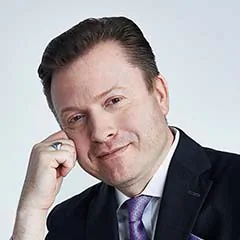
Why We Need Legislation to Reduce the Risk of Lab-Generated Pathogens: Dr. Bryce Nickels
[RUSH TRANSCRIPT BELOW]
“We have a problem, just generally, that the scientific community is not actually set up to protect the public from the risk of accidents in labs.”
Dr. Bryce Nickels is a professor of genetics at Rutgers University and the co-founder of Biosafety Now, an organization that aims to reduce the public threat of lab-generated pandemics.
“Like any person that’s trying to pull the wool over anyone’s eyes, occasionally, what you’ll do is you’ll say things that are technically correct, but it’s used to deceive. And that’s what’s been going on for this use of the term ‘gain-of-function,'” says Dr. Nickels.
In this episode, we discuss the Risky Research Review Act—legislation that, if passed, would establish an independent review board to assess whether the benefits of gain-of-function research outweigh the risks and determine whether that research should be done in the first place.
“They believe that what they’re doing is so important that it’s okay to lie,” says Nickels, referring to how scientific and government leaders hid critical information about the origins of COVID from the public. “We want to make there be incentives to tell the truth, not to hide the truth.”
Views expressed in this video are opinions of the host and the guest, and do not necessarily reflect the views of The Epoch Times.
*Big thanks to our sponsor for this episode Patriot Gold Group. Check them out here: https://ept.ms/3sr5LhH
RUSH TRANSCRIPT
Jan Jekielek:
Dr. Bryce Nickels, such a pleasure to have you on American Thought Leaders.
Dr. Bryce Nickels:
Thank you. I’m very excited to talk to you today.
Mr. Jekielek:
We were recently on a panel together, and you came out as a huge proponent of Senator Rand Paul’s and Senator Peter’s Risky Research Review Act. Please tell us what it is and why you’re such a supporter.
Dr. Nickels:
The Risky Research Review Act is a historic piece of legislation that would for the first time establish an independent review board, part of the executive branch, that would be responsible for doing risk assessment of high-risk research that’s going up for federal funding. The reason why that’s extremely important is because right now there has not been any independent risk benefit assessment for research that is high risk. Risk-benefit assessment is a question of whether or not the research should be done or not.
It’s different from biosafety and biosecurity because those refer to the procedures and processes that you need to have in place. If you perform the research, you make sure that you don’t have an accidental or deliberate escape of some pathogen from a lab. We’re literally talking about whether or not an experiment should be done. That’s a strange thought to some people because they want to just immediately go to biosafety. But it’s referring to, can it be done safely, not whether or not it should be done in the first place.
Mr. Jekielek:
More specifically, what are the classes of research that fit into this?
Dr. Nickels:
It’s a very small subset of all life science research that would involve very high-risk pathogens, that if you modify them, could become much more dangerous and cause a pandemic. They’re referred to as potential pandemic pathogens. The bill right now has a very specific list of pathogens that qualify for review under this legislation and that’s really important because it limits the scope of the bill to a very very small subset of research and it gets rid of one of the key concerns which has been key concerns of researchers that if you have this board that it will slow the progress of all life science research that’s not the case there’s only maybe a few dozen projects that would qualify for review under this legislation. And so it will provide protection to the public without any slowing down of essential research.
Mr. Jekielek:
Dr. Nickels, please tell us about yourself. Politicians come up with all sorts of legislation for all sorts of reasons. You’re putting your reputation on the line with this bill. I want to understand where you’re coming from here.
Dr. Nickels:
To be fair, you can’t really put much on the line if you’re putting my reputation on the line. I’m a professor of genetics at Rutgers University. Two years ago I co-founded a non-profit organization called Biosafety Now, along with a colleague of mine at Rutgers, Richard Ebright, and another collaborator of mine at Cold Spring Harbor Laboratory, Justin Kinney, who had to leave the organization this past January. The mission of our nonprofit is to reduce the threat of lab-generated pandemics to the public, fundamentally. That’s our main mission.
But we also are looking for accountability. Where did Covid come from? Even Anthony Fauci himself says we can’t rule out that it came from a lab. Fauci and many virologists think that it came from nature. But even if there was a one percent chance that it came from a lab, the fact that it killed millions of people and caused trillions of dollars of economic damage should provide some pause that we should do what we can to prevent that from happening again, even if it was a small chance.
Now, personally, I think it’s a much greater than 0.1 percent chance. I think it’s the most likely explanation for the pandemic. But throwing that all aside, a bill like this is a very nice piece of legislation to just finally do something to, you know, address the concerns that the public has had about the pandemic being caused by research. Because if you look at the polling, it’s close to 60 percent of the public think that the Covid pandemic was caused by lab research. And what’s astonishing is that the pandemic broke out four-and-a-half years ago. There’s been literally no change in the regulatory landscape for this type of extremely high-risk research. That’s just negligent.
Finally, this bill is a massive step forward because it will do something that’s never been done before, which should be supported by everybody simply just to say, if I’m doing something that could cause massive harm, maybe that should be looked at by somebody other than me to make the decision about whether I should proceed. Many people have kind of moved on from the origin question, and that’s kind of absurd given that the conference that we had yesterday, you know, was based on the things that happened downstream of the pandemic.
Mr. Jekielek:
I’m really curious about your actual research because you got interested in this because you have an understanding of genetics and understanding of viruses.
Dr. Nickels:
I do basic research. I study bacteria. I study aspects of what’s called the central dogma of molecular biology. This is the way in which DNA is converted into RNA. There’s nothing relevant about my research that supports this bill. What is relevant is the fact that I have a PhD and I run a lab that’s funded by the NIH. I have some understanding about the impact this bill will have on life science research, which is minimal.
I made a point yesterday on the panel about that we’re all still working with limited information. It’s not just information that’s hidden by China. It’s also information hidden by the U.S. that should not be hidden by people in the US. Everybody in the U.S. that has some connection to the research that might have caused the pandemic, they have not been fully transparent. They have not been forthcoming with government officials that are trying to investigate this.
There is a concern, of course, that because the U.S. government likely has culpability at some level. There’s only so much that the U.S. government wants to dig into before they try to start spinning their wheels and say, we can’t make any more progress. Since we’re having a discussion trying to figure something out, and we don’t have all the information. It’s hard even for me personally to try to weigh probabilities. But I had I think I said yesterday the biggest sign to me that this is a lab accident is a fact that the virology community as a whole seems to be hell-bent on making the public convinced that it’s not a lab accident publishing laughably terrible papers.
When we have documentation of private conversations that the virologists were having when they were putting these papers out and they’re stating things in private that contradict papers that they’re publishing at the same time. That’s a problem. It’s a bigger problem, too, that there’s been no call within the scientific community to say that’s wrong or that we should go back and say, those should be retracted, or you need to apologize for this. What’s fascinating is instead the excuse is, that’s just the way science occurs. That’s just the process of science today.
To which I would say, that’s messed up. As a member of the public, you should be outraged that somebody would be admitting that the scientific enterprise itself is corrupted and that the journal publication process is corrupted, the peer review process is corrupted, and that there isn’t really an expectation for scientists to wholeheartedly believe information that they put in a scientific paper. That’s disgraceful.
You can look at the track record of the people who have been publishing these papers that are supportive of a natural origin. The first paper that came out is this thing called, The proximal origin of SARS-CoV-2, which was published in March of 2020. What started that paper was a conference call on February 1st where the core author group of that paper was on a conference call with several virologists, many of whom were big proponents of this gain-of-function research of concern. One of the big proponents is Ron Fouchier from Erasmus University. He laid out the case for the way virologists should handle this moving forward, which was that if this came from a lab, this is going to be bad for our research programs and therefore we should do everything we can to make it clear this didn’t come from a lab.
It’s very simple. There’s no incentive for the scientific community to investigate this as a lab leak at all. So we have a problem just generally that the scientific community is not actually set up to protect the public from the risk of accidents in labs. At a minimum, that should call for serious questioning about regulation of these activities, but also perhaps establishment of systems that are in fact designed to detect and deal with, you know, if there is a potential lab accident, for example. Is there an incentive to do that?
Of course not, because if there is a lab accident in a community, the university or the public, you know, the private company is going to have a massive liability for causing harm to the public. So what’s baked into that system is one where we do research, we ask for money, saying that we’re going to save all your lives with this research, and if anything goes wrong, we really should cover it up because if we admit to the public that we had an accident, we’re not going to get our money. It’s laid out in those emails, and it’s not just laid out in those emails. You see it in the op-eds that the virologists even published to this day. It’s sort of a strange thing that they think that it’s okay for them to lie, essentially lie to the public, because if they didn’t, it would be bad for their future careers.
Mr. Jekielek:
Maybe they believe that the research really is important and in the public interest, so they want to keep being able to do that.
Dr. Nickels:
Right. We would say they have a God complex. They believe that what they’re doing is so important that it’s okay to lie. It is this idea of a noble lie. Do you believe in noble lies or am I putting you on the spot?
Mr. Jekielek:
I can tell you that in the last few, I hadn’t thought much about noble lies, but in the last few years, I’ve been thinking a lot about noble lies and concerned about their use.
Dr. Nickels:
If somebody is coming to your house and they’re looking for somebody to kill that person, and that person is hiding somewhere in your house, I think it’s okay to not say, oh, they’re upstairs. I would agree that that’s an appropriate time to lie.
Mr. Jekielek:
If you really believe that this research is in the public interest, you might believe that if you’re unable to do it, the public will be harmed. Hence you justify the noble lie, right?
Dr. Nickels:
You would need to demonstrate that it had any benefit, which it has not had, right? So any molecular biology lab is going to do gain-of-function research, but they’re not doing it on a pathogen that could kill everybody. If you’re doing it on something like Ebola or on a coronavirus, that’s different. That’s a different category. That’s why I said that this is really important for the public to understand.
This bill and everything about this discussion is a small fraction of all life science research. This makes it even more remarkable that the scientific community has gathered around and protected this very tiny piece of the larger life science research. Scientists should be precise with language. But like any person that’s trying to pull the wool over anyone’s eyes. Occasionally, you’ll say things that are technically correct but it’s used to deceive. That’s what’s been going on for this use of the term gain-of-function.
My lab does a lot of gain-of-function research, but we’re doing it on E. coli bacteria which is not a pathogen. We do it on a non-pathogenic form of bacteria. The research which you would consider gain-of-function is not going to lead to that bacteria causing disease causing a pandemic. That is research that’s very common across all of life sciences. It accounts for about 99.99 percent of gain-of-function research at large.
So this 0.01 percent is the type of research that occurs on a very specific group of viruses, which have the possibility, if they are mutated, of killing more people and transmitting between people better. And that’s the research we’re talking about. When the virology community talks about gain of function and talks about the benefits of gain of function, they are talking about the benefits of the 99.99 percent of gain of function that doesn’t fall under the 0.01 percent that we’re talking about, which has had no effect on developing vaccines or therapeutics. That’s just demonstrably true.
When Vincent Racaniello, a virologist who’s a big proponent of gain-of-function research, was asked directly in an article that David Zwieg wrote for The Free Press about a year-and-a half-ago, Racaniello couldn’t answer this question. He did not give an example. David really wanted to know, what’s the example? Every reporter that covers this issue is like, well, what is the example of a situation where this small fraction of research contributed to the development of a vaccine or therapeutic, and they’re given an example that falls over there, not here.
Mr. Jekielek:
So there really is no example.
Dr. Nickels:
No, I’m waiting for one. Now that we have a bill, we can say, all right, give us an example of the type of research that you think is useful, that has shown value in generating a vaccine or therapeutic. Now, we can just say, let’s run an exercise using this bill to see if that would have passed through this committee. And the answer will be yes. The committee would say, you can proceed with this experiment because it’s not presenting an existential threat to humanity. The nice thing about this bill too is it allows us to take the examples of gain-of-function that supposedly created these amazing discoveries that help humanity and see if they would pass the test. The ones that actually benefited humanity would. The ones that they’re trying to protect wouldn’t.
Mr. Jekielek:
There’s been a huge loss of trust in experts over the last few years. But you’re basically saying you want a panel of nine experts to make these decisions. How is the public to trust these nine experts?
Dr. Nickels:
I love that question. We all agree that most people sort of are genuinely good people, but you have a lot of corrupt institutions because the incentives within these institutions create situations where good people make bad decisions. This is the type of thing where you’re actually creating a system that will work, where good people will make good decisions because of the way this is structured. If everybody is corrupt, then nothing’s going to work.
We all have the potential to do really, really bad things if we’re put into situations where the incentives are to do bad things. This is a committee that removes the incentives to make bad decisions because of the reporting, for one. The panel will be known to the public. The decisions will be known to the public. You always need to be critical. You always should be holding people accountable and making sure that they know you’re watching. If and when this passes, right, if it’s not me, it’ll be somebody else that is monitoring this panel to make sure that the decisions that come out of it look like they are done on the up and up.
The Senator Paul office had a bill with a lot of stuff that was modified in this amended version, so much so that it actually passed out of the Committee on Homeland Security and Government Affairs with a near-unanimous bipartisan vote. It was eight to one. There was one dissenting vote, a senator here in California. Maybe that senator accidentally said no, but she meant to say yes. We tried to call her office to get a comment and we have not received a reply.
But the point is that if you believe that we should work together across political divide, if you believe that there was a possibility, however small, that there was a research-related incident that led to a pandemic, if you believe that people should not be able to decide to do whatever the hell they want with really dangerous pathogens, you should support this. If a lawmaker doesn’t support this, that lawmaker needs to explain exactly why they voted against this simple common sense thing to just independently review. Also, going back to my central point, this bill is not about the researcher. This bill is about public safety, so to hell with what researchers want.
What does the public want? This is publicly funded research. It’s literally just a very minor thing for a few grants to go through an extra layer of review that will make the public sleep better at night. Unless I’m missing something, it’s possible I’m missing something. I don’t see any problems with the bill in its current form. I also see a bill that was highly amended in response to prior criticisms, which I thought was great.
I thought it was really cool how this bill is something that now is different because it got input from people that opposed it. So that’s why I say I don’t see how people can oppose it now, because it is very, very specific in its scope, limited to a very, very small amount of research and only subjecting it to a panel to look at it, to just give it an additional layer of scrutiny to say, okay, this research, the potential benefits outweigh the potential risks to this research.
Mr. Jekielek:
A number of guests on the show would say if it has passed out of the Senate, that’s a good sign that it’s not terribly controversial.
Dr. Nickels:
There’s huge bipartisan support for it. Maybe it’s just me being paranoid thinking that there’s a lot of people that are going to try to tank it because of what i’ve seen in the space since I entered it look I’m not a lobbyist I’m just a concerned citizen in this case trust is established through being open transparency and right now we don’t even have reporting of where labs are so the public doesn’t know where biolabs are in their communities it’s not something that there is mandated reporting so not only do they not know where the labs are but they don’t know what like what pathogens are being worked on in those labs so that’s the next thing i’d like to to try to work on to try to get support for basically public transparency reporting of of where the labs are and what’s
in the labs.
Mr. Jekielek:
Please give us a history of this type of research.
Dr. Nickels:
All of this goes back to Dick Cheney and the Bush administration in the wake of the 9/11 terror attacks. It was coupled with the anthrax mailings that occurred in the U.S. shortly after 9/11, that were in response to the hysteria that occurred after having two terrorist attacks. It was a crazy time.
Mr. Jekielek:
It was a crazy time for everyone.
Dr. Nickels:
Yes, so it seems so odd. The fact is, a couple weeks after 9-11, anthrax started being mailed all across the U.S. Of course, the public has got to be scared. That was used as justification to say, well, we need to ramp up our biodefense capabilities. We need to be prepared for a biological weapons attack in the U.S. This research is biodefense, but the gain-of-function component is creating new agents that can be used as bioweapons. They moved it into the NIH and they anointed Anthony Fauci as the head of U.S. biodefense.
If you look at the amount of money that was poured into the NIAID, which is the National Institute of Allergy and Infectious Disease that Anthony Fauci was the head of for several decades, you can see like in 2002 and beyond, you had billions and billions of dollars poured into this U.S. biodefense network that included building new high containment biolabs funding research. Anybody that was doing this high-risk research was sought after so that they could give them money to do research projects right so by throwing money so once you dangle money you create a group of scientists that are simply used to doing that type of research. So they dangled money to academic scientists to do high risk research. Those scientists had labs where they trained PhD students who were basically doing bioweapons research, but thinking it was normal science.
Mr. Jekielek:
It could be both, right? You hear the term dual use.
Dr. Nickels:
It could be both. But when you’re in a lab as a grad student, I don’t think a lot of them want to think, I’m doing something that has a military application. I don’t know what it’s like for virology students in labs that are doing experiments that are dual use. I don’t know if they actually think, this could have military applications. I don’t know. But you did create this whole ecosystem of researchers like professors, PhD students, postdocs, all trained in an area that is very high-risk.
I mentioned Richard Ebright, who was instrumental in getting me involved in these issues. In 2004, he got about 750 scientists to sign a letter
that the U.S. increase in biodefense spending was coming at the cost of research in basic science that was more valuable. This letter led to Richard getting profiled in The New York Times as a hero. It’s an article called I Beg to Differ. It is one lonely scientist’s stand against this Dick Cheney-fueled biodefense boom. Anthony Fauci’s role in biodefense occurred as a consequence of decisions made by Dick Cheney and George Bush. So in 2004, he sent that letter. Remember it was 750 scientists, including three Nobel Prize winners. Fauci brushed it aside and said, they don’t know what they’re talking about. 750 scientists signed that letter, and it was brushed aside by one person.
Mr. Jekielek:
A pivotal moment was in 2010 when the augmented avian influenza was published.
Dr. Nickels:
That occurred around 2011, 2012. Before that was the concern I raised on the panel yesterday about the reconstruction of the 1918 Spanish flu. I began by saying hey audience members I know it’s late in the day, but I’d like you to participate in a vote. Is it a good idea to take something that killed 20 to 50 million people and then no longer exists on the planet and to just make it again? People just laughed. They laughed because it’s absurd.
Then I said, do you think that if somebody wanted to do that, that person should have some oversight? Should we allow that person to make their case? Shouldn’t somebody else, you know, an independent body assess whether that person should be allowed to resurrect a virus that killed 20 to 50 million people. The resurrecting of that virus in 2005 was the first thing that made people ask, how did these people make this decision to reconstruct this deadly virus?
The next event that signaled, we need to do something on the regulatory landscape was the incident that you’re mentioning. They took the H5N1 virus and they tried to figure out a way they could get it to transmit more effectively through air between ferrets. This was experimentation that involved Ron Fouchier and Yoshihiro Kawaoka, who has a lab in Wisconsin. Actually, Kawaoka was involved in the research reconstruction of the 1918 pandemic strain.
One of the things that led to that controversy was the fact that when Ron Fouchier first presented it at a Malta conference, he got up and said something to the effect of, I did something really stupid. I wish I could remember the quote. But he got up in front of everybody and was bragging about having done an experiment that was really high-risk and really stupid as a way of getting interest. So you had a situation where there had to be some damage control done. That’s when they started having discussions about the research and whether or not the mutations that led to it being more transmissible between ferrets should even be reported to the public.
Was it a danger? Was that information in and of itself a danger? We heard at the CDC there was mishandling of anthrax samples, at which point the Obama administration said enough is enough. Now if you’re a conspiratorial thinker, it turns out that was around the same time of the Ebola outbreak in Africa. People are suspicious that it might have also been caused by a lab accident, although I’m not claiming that to be the case.
I’m just saying that there were suspicions that that and still to this day are suspicions that that came out of a lab so around so in 2014 the the government said if you’re working with these high-risk pathogens you should stop doing that. Out of that pause there were some deliberations. Then there was this framework that came out of that in 2017 called the P3CO, named because the person that wrote it was a Star Wars fan.
That was the framework that is still actually in place to this day about high-risk research.
Again, we’re talking about bio-risk management. It’s the evaluation of should the project be performed, not can the project be done safely, which is another thing that the virology community likes to conflate because it’s difficult to separate the two. P3CO is what we’re talking about. Like the replacement for the P3CO is what we’re talking about right now. That’s where this risky research review act comes in.
The White House announced a policy to replace the P3CO in May, earlier this year, that would be implemented in May of next year. Members of Biosafety Now came out very, very strongly against it, because it’s still a policy that allows for the researchers to make the decisions about whether or not this research is too high risk.
Mr. Jekielek:
Basically a self-policing policy.
Dr. Nickels:
Self-policing, yes. Since P3CO has been in effect since 2017, it has reviewed a total of four proposals. That already tells you that mechanism was flawed, because it missed dozens of proposals that should have been reviewed under that framework. I could go into why but I don’t think it really is. It matters that what really matters is the fact that from 2017 to this day only four research projects were ever reviewed under this P3CO framework.
How much discussion of gain-of-function research has there been? There’s been hundreds and hundreds of hours of discussion and volumes of text written and meeting upon meetings, four projects were reviewed under that framework, which means that there’s a lot of other research that was missed. That’s why it’s like a historic time, because we have the ability to finally put in place an independent body to assess whether or not certain research should not proceed.
People who have been very strong against gain-of-function research on high-risk pathogens, mysteriously have come out in opposition to this bill. The people who are paid to do this, the biosafety professionals, are failing the public in a way that I couldn’t appreciate until I got involved in this. The fact that any biosafety professional who has been very, very strong on opposing, you know, or saying we need to very carefully regulate gain of function, blah, blah, blah. For them to oppose this bill, I was astonished.
The reason is they are viewing the effect on the research, not the public. When we’re talking about laws that are on biosafety, biosecurity, bio-risk management, the first stakeholder there, the customer there is the public, not the researcher. The point is if you hear somebody talk about these legislation, if they lead with the effect on the scientists, that tells you everything you need to know. Lead with the public. Start with the public first, and then go back and talk about the scientists.
Mr. Jekielek:
Many people who have been on this program would say that we live in a very safety-oriented society. In fact, perhaps too safety-oriented. But the picture that you’re painting, at least in this area, seems to be the opposite. If that’s true, if we do live in an overly safe society, this is curious. You’ve already made the case that safety hasn’t been the primary concern in this area. Would you agree that that’s unusual in our society, and why would that be?
Dr. Nickels:
What’s really unusual about this particular issue is the people that are trying to get legislation to fix it are the ones that are probably most in lockstep with what you just said, that we overregulate, the government’s too big. Senator Rand Paul is the champion of this bill. Senator Bob Hall in Texas, is very much into limited government. But he wanted to ban gain of function because he thinks it’s an individual liberty issue. He thinks that this is affecting people’s ability to live their lives because you could look at the people that are promoting the legislation who would agree with you wholeheartedly that we have the minimal government we need.
Mr. Jekielek:
Please tell us what Biosafety Now is currently up to, aside from championing this bill.
Dr. Nickels:
Right now, Biosafety Now is focused on trying to get the public to engage with this risky research review act. And as I said, we’re also going to be interested in looking to get public transparency measures. In October there should be a film that will be, you know, many members of Biosafety Now are involved in. It’s a documentary that is going to be hopefully a call to
action for the public to really do something. The hope would be that Biosafety Now could go from this sort of like little, you know, running on fumes like to something that could actually operate at scale. Because we really have a systemic issue in the sciences about its culture.
The culture has to change, if somebody is on stage saying that that’s just the way science works. The journals are corrupt. The peer review system is corrupt. We have to like, you know, fudge data to get grants. That’s not OK. So it has to be a cultural change within all of academia. That’s a huge, massive thing to do. A lot of people at the conference recognize this as well. We want to incentivize the truth. We want to make there be incentives to tell the truth, not to hide the truth.
Mr. Jekielek:
And then to apply appropriate safety or cost-benefit analysis.
Dr. Nickels:
Biosafety is one of many things that we need to address. There’s science communication and science funding. There’s animal welfare, and the effects on the environment, that type of thing. We’re going to start a foundation called Biosafety Now Foundation. It’s going to be something that we’ll be able to do a lot more because we will hopefully be able to fund not just, you know, a nonprofit working on biosafety, but we’ll have something in an academic institution like a science policy center will have research archival hub and a media component trying to create this ecosystem that works to address issues and communicate to the public.
The name of the film is Thank You, Dr. Fauci made by Jenner Furst. He is a distinguished documentary filmmaker, twice nominated for an Emmy, and has won four Peabody Awards. He’s made some very influential films, including The Pharmacist, and The Murdaugh Murders. He made a film about Trayvon Martin. He is making a film that I believe will have an impact, because it will resonate with people and help them understand that there are imminent threats to their safety if we don’t do something about this.
Mr. Jekielek:
Where can people find out more about Biosafety Now and the Risky Research Review Act?
Dr. Nickels:
We have a petition that is simply to get the Risky Research Review Act to the floor for a vote. That’s it, just for a vote. That can be found on change.org. But you can find links to the petition on our website and on our Substack page. Please follow us on X. There’s a lot of things that are going to happen quickly. The election is coming up too, but I don’t know how that’s going to change the landscape of this issue. But it will be very interesting to see what will happen in this space after the election.
I don’t know where the film is going to be shown. I believe it will be online on a website where people can watch it. But there will be a massive media campaign, and we’ll certainly be pushing for as many people as possible to see it across the world. This is a global issue. This isn’t just a U.S. issue. Even though today I am just an American Thought Leader, I hope that by the next time we talk this issue will have gone global.
Mr. Jekielek:
Dr. Bryce Nickels, it’s such a pleasure to have you on the show.
Dr. Nickels:
Thank you very much for having me. I appreciate the time and I hope we can do this again.
Read More
Popular

Related Videos
American Thought Leaders
American Thought Leaders
American Thought Leaders
American Thought Leaders
American Thought Leaders
American Thought Leaders

American Thought Leaders

American Thought Leaders
American Thought Leaders
American Thought Leaders

American Thought Leaders

American Thought Leaders
American Thought Leaders
American Thought Leaders