
Commentary
The mayors of large cities in the West these days seem often to be more concerned with global problems such as climate change, and even the reform of human nature, than with more local challenges. It seems to be a pathology of modern officialdom, elected or otherwise, to be unable to stick to the relatively humble tasks it is called upon to perform. Instead, it develops a kind of savior complex. The world is not so much these officials’ oyster as their responsibility.
Charles Dickens satirized this tendency a century and three-quarters ago in the character of Mrs. Jellyby in his novel “Bleak House.” Mrs. Jellyby is a woman of the most charitable feelings, who is so concerned with the condition of humanity that she can see “nothing nearer than Africa,” and thereby neglects her own children.
But what in Dickens’s time was an individual quirk has now become an entire social tendency, at least of the educated and semi-educated classes. Doing good in minute particulars, as William Blake put it, does not satisfy their egos or their magnificent intellects.
For example, London, like other cities, seems to have had a large increase in homelessness of late years. This, perhaps, is not surprising, since it has been allowed by successive governments to act as a magnet for untold numbers of migrants who either claim public benefits or work in low-paid, unskilled jobs, legally or illegally. Half of public housing available in London is taken up by people not born in the country, and the city is probably not alone in this.
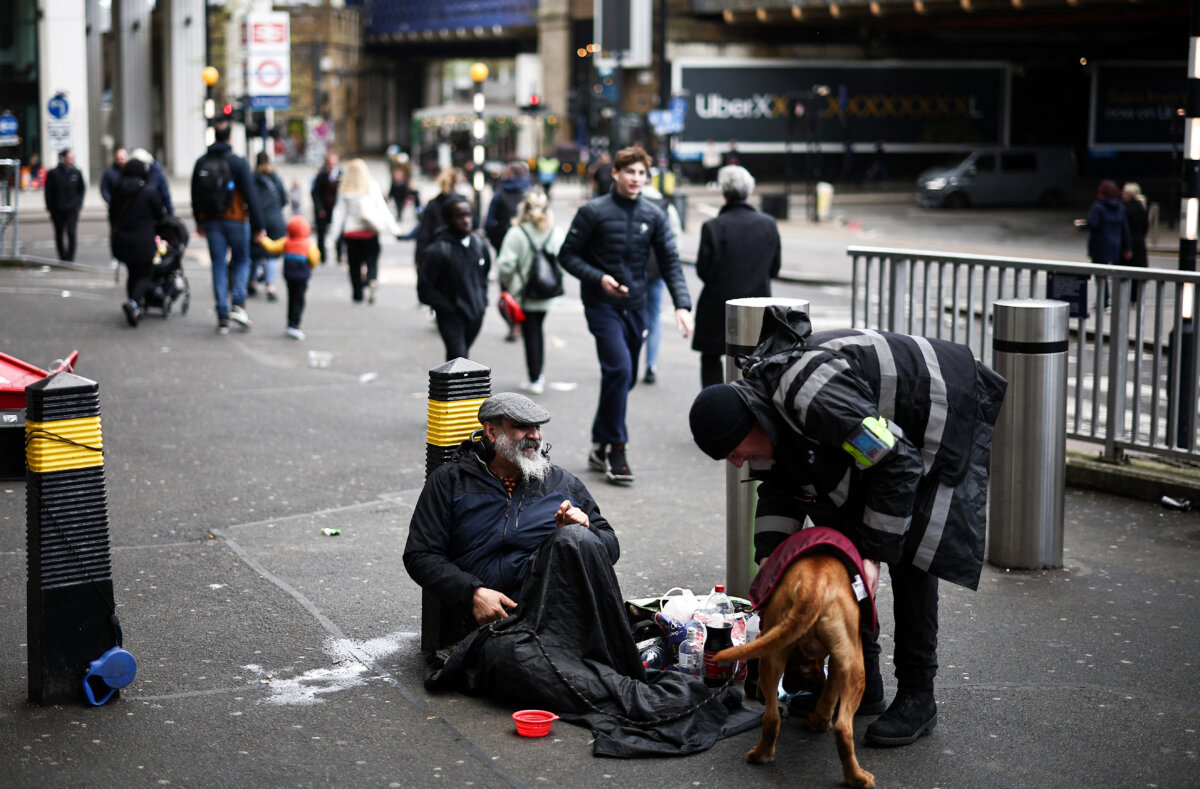
Quite a number of the mad have been decanted onto the streets to live in cardboard boxes and sleeping bags. Walking down a busy and fashionable street recently where the smallest apartment is so expensive that it is unaffordable even for people with excellent jobs but no capital, I came across at least five people muttering gibberish to themselves, or to their hallucinated interlocutors, in their temporary homes of rags, dirty sleeping bags, cardboard boxes, plastic bottles, and the remains of past meals.
My emotions on witnessing such degradation are mixed and unstable, veering between pity, fear, and irritation. There is no doubt that the condition of these people is pitiable: None of us would exchange places with them. Their psychotic state might have been the result of their drug-taking, or greatly exacerbated by it, or they might be deteriorated alcoholics; but still they are human beings, and yet we walk past them as if they were mere objects.
They create an atmosphere of insecurity even in the midst of crowds. Few of them, no doubt, are actually dangerous, or will ever commit murder, but they often appear menacing, and we are not very surprised when one of them does actually kill or injure somebody, seemingly at random, because of his madness. It does not in the least assuage our anxieties that such people are more often the victims of violence than the perpetrators of it. They contribute to an unpleasant feeling that the city is barely under control, that anything could happen at any moment. No merely statistical argument about the dangerousness of each individual homeless person relieves us of that feeling.
Compassion for the individual soon gives way to irritation that our gigantic state apparatus, both in its central and local forms, seems unable to deal with this problem that, after all, is not of vast scale. The public authorities seem powerless, paralyzed—outwitted, one might say—by a few madmen.
What could those authorities, bloated but weak, like an oedematous leg, say in their own defense? They might say that they had nowhere to put these people, but if so, why not? Because they have closed them down, first on the grounds that conditions in them were abominable (which was usually true), and second that it was against the human rights of the ill to confine or treat them against their will.
The upshot has been that the whole population is now subjected to a disturbing and even frightening spectacle every day, and that disorder is the new social, or antisocial, norm. If it is permitted for people to make their homes on the streets, leaving their detritus behind them, drinking and taking drugs, alarming people by their gestures and their mad vociferations, what is not permitted? And the sight of thousands of people passing these unfortunates as if they were not there is the very image of a callous society—callousness brought about, and even made necessary, by supposed compassion.
Perverted compassion is common in our society, with unfortunate consequences. While waiting for a train from London to Paris recently, I was approached in the station by a youngish man who might have served as an extra in a film about a concentration camp. I recognized the type immediately from my time as a doctor in a prison. He was sallow-skinned, emaciated, malnourished, and his teeth were well on the way to falling out. He asked me for some money so that he could find a bed for the night.
“What drugs do you take?” I asked him.
It was as if I had given him an electric shock. He began at once on a self-exculpatory narrative that explained his resort to drugs. He had not been allowed to see his 3-month-old baby daughter and had started to take drugs as a result. This narrative almost certainly reversed the chronology of events, but even if true, was feeble in the extreme. He spoke of himself as if he were a specimen, an inanimate object responding as, say, a ball hitting a wall.
There is, of course, a natural tendency for all of us to exculpate ourselves: Whenever we are justly accused of having done something wrong, our first inclination is to find excuses, and no one is so unimaginative that he cannot find them. But a still, small voice tells us that we are not telling ourselves or others the truth, that we are in fact culpable.
However, our society is one that encourages excuse-finding, and this has communicated itself to such people as the drug addict in the station. He had been taught by our culture to regard his own decision to take drugs as a kind of mechanical response to circumstances, like the said ball hitting a wall; and then, if he enters the world of “treatment,” to regard himself as ill, such that there is a technical solution to his problems that is the responsibility of others to supply.
Many people, especially those concerned with such problems, would regard speaking the truth to such as he as lacking in compassion, as censorious, when the reverse is the case. To say that the truth will set you free is an exaggeration. The truth is a necessary, but not sufficient, condition of liberation. But to disguise from people their own part in the production of their lives is to dehumanize them and to imprison them in their present circumstances. There are times and places in which circumstances are a complete straitjacket, but most of us do not live in such times and places. To teach people that they are trapped in this way is both cruel and dishonest.
Views expressed in this article are the opinions of the author and do not necessarily reflect the views of The Epoch Times.
 Friends Read Free
Copy
Facebook
Tweet
Friends Read Free
Copy
Facebook
Tweet