
Commentary
As part of Chinese Communist Party (CCP) leader Mao Zedong’s ideological war on the Chinese people during the Cultural Revolution (1966–1976), the slogan “women hold up half the sky” was frequently repeated by CCP functionaries. The slogan was intended to convey the communist theory that women were equal to men in their contributions to society and that, under the CCP’s rule, men and women should have equal roles in cultural, social, economic, diplomatic, and political spheres.
How has that worked out over the years? Let us examine the topic.
On the Global Scene
As with many other fronts in its ongoing information warfare campaign, the CCP exported the “women hold up half the sky” slogan to the United Nations to demonstrate Chinese leadership and subtly undermine international bodies: in this instance, the Commission on the Status of Women. This commission was established in 1946 and focused on “the promotion of gender equality and the empowerment of women” worldwide, according to the commission’s website.
Since 1946, there have been four major U.N. conferences on women and six five-year reviews convened thereafter. In October, China hosted the Global Leaders’ Meeting on Women, convened to commemorate the 30th anniversary of the Fourth World Conference on Women held in Beijing. That 1995 conference produced an agenda for women’s empowerment that is “now considered the key global policy document on gender equality,” according to the U.N. website.
Chinese leader Xi Jinping gave a keynote speech at the October meeting titled “Carrying Forward the Spirit of the Beijing World Conference on Women and Promoting the New and Accelerated Process for Women’s All-Round Development,” according to Chinese state media Global Times.
Xi even repeated Mao’s slogan during his speech! He urged attendees to “join in fostering an enabling environment for women’s growth and development, cultivating powerful momentum for the high-quality development of women’s [causes], developing governance frameworks to protect women’s rights and interests, and writing a new chapter in promoting global cooperation on women.”
Isn’t it odd that these items dovetail and reinforce Xi’s four global initiatives (governance, development, security, and civilization)?
That Global Times article claims that over the years, China has promoted “international gender equality” by training more than 200,000 women from more than 180 countries and regions through “small but beautiful” public welfare projects and other unspecified activities.
What about on the home front? Surely China has “led by example” in promoting gender equality at home?
In short, not so much.
On the Domestic Scene
Xi’s public pronouncements on gender equality have generally aligned with Mao’s slogan and toed the CCP line on women’s rights. For example, in one of his first major speeches after becoming leader of the Chinese communist regime, at the 11th National Women’s Congress in 2013, Xi stated: “Equality between men and women is a basic state policy. … Women should fully participate in economic and social development, enjoying equal rights in employment, education, and political affairs.”
State media outlet China Daily claims that Xi regularly “pays high attention to promoting gender equality and well-rounded development of women,” and that he has attended a number of women’s congresses and meetings over the years.
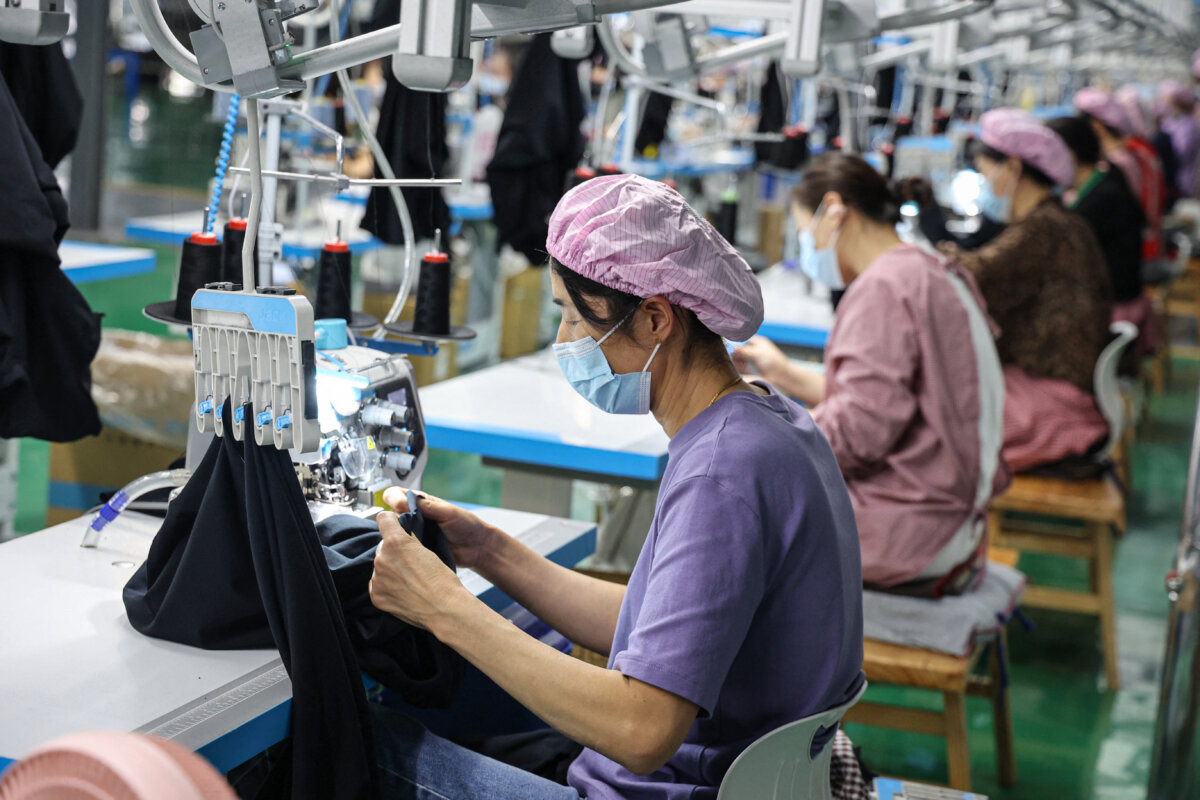
However, it would appear that Xi’s lofty rhetoric on gender equality has not yet translated to structural changes within the CCP. In his October speech to the Global Leaders’ Meeting on Women, he repeated the “women hold up half the sky” slogan but limited its scope to “economic and social development.” Perhaps that was a reference to the fact that 43 percent of Chinese women are in the domestic workforce.
But wouldn’t holding up half the sky also apply to CCP leadership roles? Therein lies the problem and hypocrisy of communist ideology (a definition of terms, communist-style, like always).
Since the 20th National Congress of the CCP in October 2022, there have been zero women in the 24-member Politburo. Before 2022, this had not been the case for 25 years. And of the 205 full members of the 20th Central Committee of the CCP, only 11 are women.
So much for Xi’s gender equality rhetoric. The current situation can be attributed to his cultural emphasis on traditional gender roles in Chinese society since becoming the CCP’s leader, as well as to the CCP’s tendency to funnel the few women in leadership into soft portfolios such as health, education, and women’s affairs.
Toward that end, the most senior female CCP official is Chen Yiqin (born 1959), currently a state councilor and president of the All-China Women’s Federation. She made news in 2020 when she was appointed as the Communist Party secretary of Guizhou Province. With that appointment, she became the first female provincial Party secretary of the Bai ethnic minority and one of only a few women to ever hold the top provincial post since the founding of the People’s Republic of China in 1949.
The provincial Party secretary role is ministerial-level, and although it’s a traditional stepping stone to the Politburo, that hasn’t happened. She was “elevated” to her current billet almost as a consolation prize, since, aside from the health and education portfolios, women have traditionally not been selected for genuine leadership roles in the Politburo because of their lack of military experience (a key criterion for promotion). Under the CCP’s rule, China appears to have a “glass ceiling,” too.
Other leadership statistics indicate that the CCP has not delivered on its gender equality rhetoric:
- Women hold only two of the 31 provincial Party secretary positions.
- There are no women among the Politburo Standing Committee’s seven members.
- There are only about 22 women among the Central Committee’s 171 alternate members.
- Only 790 (26.5 percent) of the 2,977 members of the 14th National People’s Congress are women. This is China’s rubber-stamp legislature and is considered to be the world’s largest legislative body, indirectly “elected” by provincial people’s congresses.
- Only 486 (22.4 percent) of the 2,169 members of the Chinese People’s Political Consultative Conference are women. Note that this is China’s top political advisory body.
Now that is gender equality with CCP characteristics!
Concluding Thoughts
CCP leaders such as Xi have parroted Mao’s “women hold up half the sky” slogan for years, paying lip service to gender equality but keeping women out of senior leadership roles except for those in lesser portfolios such as health care and education. The recently completed Fourth Plenary Session of the 20th Central Committee of the CCP would have been a good opportunity to promote a few women to senior leadership positions, but that didn’t happen.
Women bore the brunt of the CCP’s one-child policy, which was implemented between 1979 and 2015, as more than 330 million abortions were conducted in China through 2013. And who knows how many baby girls were aborted or abandoned after birth in favor of sons under that draconian policy over the years? The number is certainly in the millions. Women apparently had little to no influence in this debacle, given their underrepresentation in the top levels of CCP leadership.
Beijing’s boasts and big pronouncements on promoting gender equality around the world at U.N. conferences on women and other international meetings should fall on deaf ears, given the state of gender equality in communist China and the fractional representation of women in CCP leadership positions.
Views expressed in this article are the opinions of the author and do not necessarily reflect the views of The Epoch Times.
 Friends Read Free
Copy
Facebook
Tweet
Friends Read Free
Copy
Facebook
Tweet