
Commentary
In the opaque corridors of Zhongnanhai, loyalty has always been a primary currency. But as of January, even that currency appears to have suffered a devaluation.
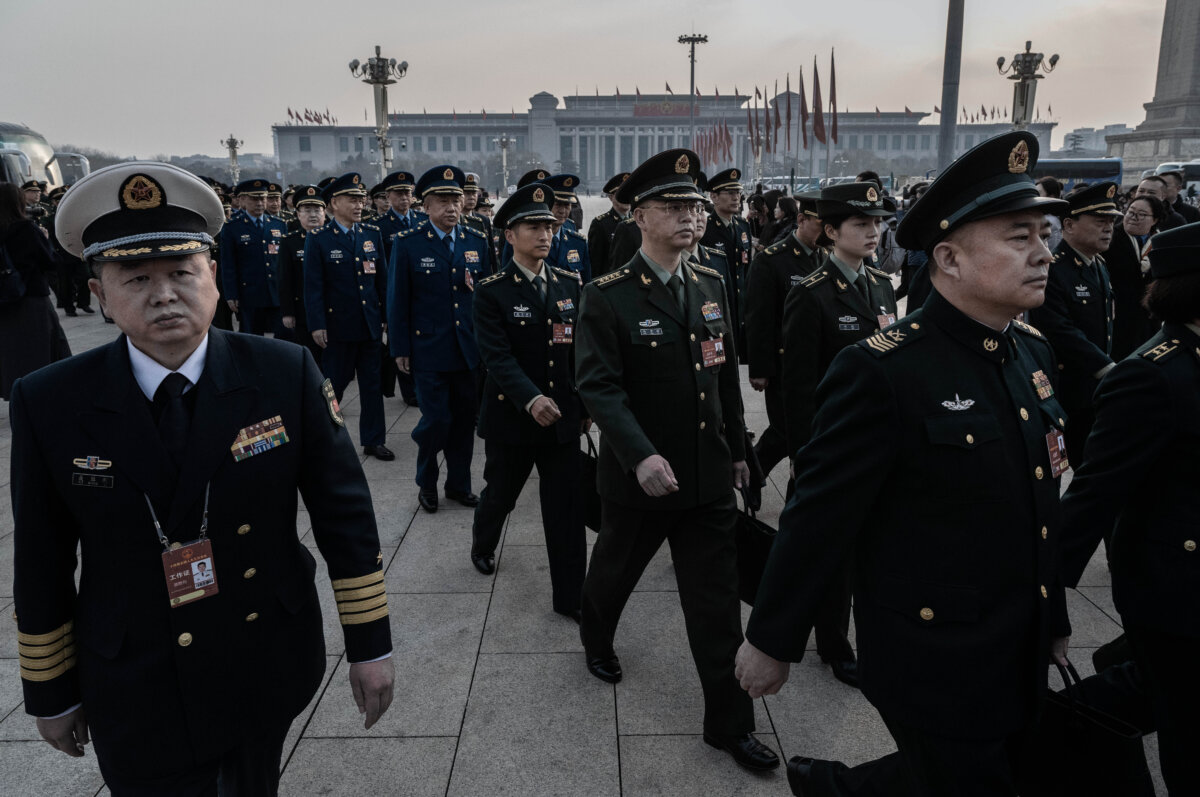
The recent investigations into Gen. Zhang Youxia, the senior vice chairman of the Central Military Commission, and Liu Zhenli, the People’s Liberation Army’s top operational mind, represent more than just another anti-corruption drive. They signal the final stage of a decade-long “vertical coup” that has hollowed out one of the world’s largest militaries, at the very moment its commander-in-chief demands it be ready for war.
The Architecture of Isolation
To understand the current purge, one must look back to the structural “flinch” of the Hu Jintao era. Hu faced a party so rot-filled that it seemed unreformable without dissolution—a risk he was unwilling to take. He prioritized consensus, resulting in a “Decade of Stagnation” in which power leaked to local fiefdoms and corruption became the system’s fuel.
Chinese Communist Party leader Xi Jinping inherited this bind but charged in the opposite direction. Since 2012, he has framed centralization as the only antidote to a Soviet-style collapse. Initially viewed as a reformer, he alienated hard-liners.
However, around 2018, this pragmatism hardened into what can only be described as “abstract Communism”—a state of perpetual ideological struggle in which professionalism is viewed as a form of hidden betrayal. By now, reformers were disillusioned, and although hard-liners could identify ideologically, they remained wary because Xi had targeted them recently.
By purging his own handpicked “war Cabinet”—a group that was seven-strong in 2022 and is now reduced to just Xi and a single disciplinary enforcer—Xi has successfully created a “faction of one.” He has traded the seeming stability of collective leadership for absolute silence.
The Malicious Compliance Trap
The primary risk of such absolute power is not just paranoia, but sensory deprivation. When reporting bad news is conflated with disloyalty, the bureaucracy defaults to a “Potemkin” mode of reporting. This institutionalized lying is a direct legacy of the SARS and COVID-19 cover-ups, during which officials learned that reality must always be edited to suit the “core.”
In the military, this has manifested as “malicious compliance.” Mid-level officers follow Xi’s radical ideological orders so rigidly that they effectively sabotage combat power. They purge experienced technicians to prove their “red” credentials, leaving advanced hardware in the hands of political loyalists who cannot operate it.
Recent revelations of systemic failure—missile fuel tanks filled with water and silo lids that do not function—are the natural result of this environment. Commanders are not necessarily treasonous; they are simply surviving. In a system in which a beautiful lie is the only path to promotion, the military that Xi sees on his dashboard could be a work of fiction.
The Miscalculation Risk
This brings the Taiwan question into a dangerous new phase. Rationally, an invasion is suicidal. China faces a “closing window” of demographic decline, an arming of the First Island Chain led by Japan and the Philippines, and a United States that has authorized record-breaking asymmetric defense packages for Taipei. In case of invasion, fence-sitting countries would be forced into a binary choice, and perhaps not many would choose to be the next meal of a ravenous Chinese Communist Party.
However, rationality requires accurate data and clear eyes. The ghost of the Hamas miscalculation on Oct. 7, 2023, looms large here. Like the leaders in Gaza who believed their own narrative of an imploding enemy, Xi may mistake regional arms buildup as a bluff and “gray-zone” successes as proof of dominance.
If Xi’s filtered reports tell him that the United States is a paper tiger and the People’s Liberation Army is “purified” and ready, he may pull a trigger that is not actually connected to a functioning gun. The paradox of 2026 is that China is perhaps becoming more dangerous externally precisely because it is becoming more dysfunctional internally.
In “The Prince,” Niccolò Machiavelli, who was not known for excessive charity, offered a timeless warning on the “loyalty trap” that currently haunts the Chinese high command:
“There is no other way of guarding oneself from flatterers except letting men understand that to tell you the truth does not offend you; but when everyone may tell you the truth, respect for you abates.”
To solve this, Machiavelli argues a wise leader must choose a few trusted men and give them “the liberty of speaking the truth to him.” This does not seem to be the advice that Xi has heeded.
Conclusion: Clinging to the Stake
There is a Chinese folk proverb about a thief who pulls out a wooden stake while the other thief leads away the donkey that was tied to the stake. Xi’s predecessors—Mao Zedong, Deng Xiaoping, Jiang Zemin, and Hu—took the “prizes” of absolute power and growth but left behind the systemic flaws of inequality, unspeakable acts, declining demographics, and an unreformable structure.
Xi is now the one left clinging desperately to the stake—the fading tether of absolute Party authority. He refuses to let go, convinced that tighter control is the only way to avoid the day of reckoning. But when that day arrives, he will be the only one standing there to pay for the accumulated crimes of the system.
Views expressed in this article are the opinions of the author and do not necessarily reflect the views of The Epoch Times.
 Friends Read Free
Copy
Facebook
Tweet
Friends Read Free
Copy
Facebook
Tweet