
Commentary
America is the most connected nation in history, and one of the loneliest. We have sorted ourselves into camps, curated our feeds, and turned our neighbors into abstractions. In all that noise, we have nearly stopped asking the one question that might quiet it: not who we are, but who we came from. Not as a nation, but as families, people, and bloodlines that cross every border we have drawn among ourselves.
Recently, at a Philadelphia Society gathering, several of us fell into the kind of conversation that organization tends to produce—about the Federalist Papers, the men who wrote them, and the almost improbable genius of the American founding. At some point, I turned to the man beside me and said, almost casually, “You know, you’re probably related to some of these people.” He looked at me the way people look at someone who has said something preposterous, and replied: “Related to the Founders? How would I even begin to find that out?”
I pulled out my phone and showed him how to find exactly which founding-era figures appear in his family tree and precisely how they connect to him, complete with sources and documents, and entirely free. He was initially speechless, and then he started asking questions that I couldn’t answer fast enough.
What struck me was not the discovery itself. I have been doing genealogy research for 25 years, tracing my Norwegian and Ulster Scot lines through parish records, ship manifests, and census documents going back centuries. I am used to finding things that surprise people. What struck me was the fact that this man who is well-educated, deeply knowledgeable about American history, and genuinely interested in the founding had no idea that any of this was now possible. And I realized that he was not alone.
There is a generation of Americans who think of genealogy research the way it used to be: a post-retirement hobby that requires drives to far-flung courthouses and libraries, microfilm scrolling, and letter writing to archives. That world is gone. Today, billions of genealogical records are online, with artificial intelligence rapidly transcribing handwritten documents. The major platforms have quietly built tools that would have seemed like science fiction to genealogists of a generation ago. And almost nobody outside the genealogy community seems to know it.
According to Ancestry.com research, approximately 183 million Americans (60 percent of the entire country) have at least one ancestor who was living in America during the Revolutionary War. Remarkably, most of those 183 million Americans have no idea that they carry a direct line (of about 10 generations) to the people who witnessed the founding.
Now is the time to find that connection. The tool that surprised my Philadelphia Society friend is FamilySearch.org’s Famous Relatives function, which reveals connections to founding-era leaders, including George Washington, Thomas Jefferson, John Adams, James Madison, James Monroe, and John Quincy Adams. Separate tabs show inventors and scientists, entertainers and artists, trailblazers, and athletes. The trees are already there, built by millions of researchers over decades and now connected. Your job is simply to show up, enter what you know, and let the platform find where your line intersects with history.
I came to genealogy through my Ulster Scot ancestry, which accounts for nearly half of my family heritage. Often overlooked, the 250,000 Ulster Scots who crossed the Atlantic from the province of Ulster in northern Ireland between 1717 and 1775 were among the most consequential groups in American history as the first great settlers of the American frontier and some of the Revolution’s most fervent fighters.
This is my heritage. There is a very good chance that some version of your heritage—whether your people came from Ireland, England, Germany, Africa, or somewhere else entirely—is equally woven into the fabric of America’s founding. Every group that was here in 1776 has a story worth finding.
We are living through a moment of profound national division. We argue bitterly about what America is, what it was, what it should become. We have sorted ourselves into camps that seem to share less and less common ground.
Genealogy is not a political answer to that problem. But it may be a human one. It reaches past the arguments we have rehearsed a thousand times and finds something older and harder to dismiss: the quiet recognition that the country we are fighting over was built by people who were, in many cases, ancestors we share.
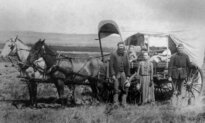
When you discover that your ancestor farmed land in colonial Virginia, or crossed the Blue Ridge with a rifle and a Bible, or built a forge in Pennsylvania, or prayed in a congregation that still stands in Massachusetts, then something shifts. The country stops being an abstraction and becomes a place that your people touched, shaped, and survived. The founding stops being mythology and becomes biography. And biography, unlike ideology, tends to pull people toward one another rather than apart.
Here is how to begin, starting today, for free. FamilySearch.org is the world’s largest free genealogy database, with billions of records going back centuries. Once you have built a basic family tree, use the Famous Relatives feature to connect to historical figures across American history. The digitized, free National Archives holds the pension files and compiled military records of Revolutionary War soldiers on both sides.
USGenWeb.org is a volunteer-run network of county-level resources across every state, and is free to search with no log-in required. The Library of Congress’s ChroniclingAmerica.loc.gov offers freely searchable historical newspapers. The starting point is simpler than you think: What do you know about your grandparents?
On July 4, 2026, America turns 250 years old. One hundred eighty-three million of us are connected, by blood, to the people who were here when it all began. These farmers, soldiers, ministers, merchants, frontier women, and Founding Fathers survived things we cannot imagine and were part of a chain of life that ends, for now, with you. At a moment when we seem to agree on very little, genealogy reminds us that we share more than we know. Their names are waiting in the records. And when you find them, you may find something else: that the person sitting across from you at Thanksgiving, or across the aisle in church, or across the divide in your mind shares them, too.
Views expressed in this article are the opinions of the author and do not necessarily reflect the views of The Epoch Times.
 Friends Read Free
Copy
Facebook
Tweet
Friends Read Free
Copy
Facebook
Tweet