
Commentary
After announcing that a question regarding provincial independence would appear on a referendum ballot in Alberta on Oct. 19, Premier Danielle Smith emphasized that she is “fiercely” loyal to Alberta, as well as to Canada. So why would a person dedicated to maintaining national unity put a question on a referendum ballot that could lead to the separation of a province?
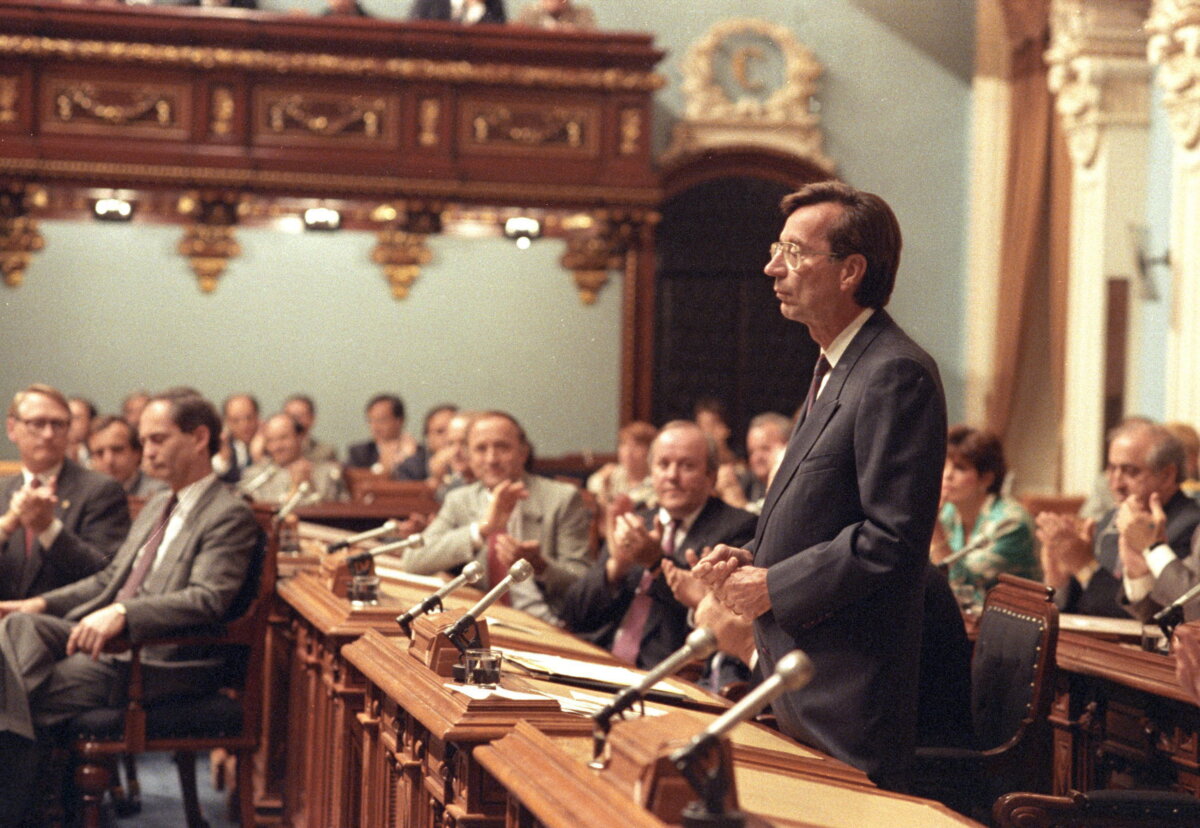
Premier Smith is painted into a political corner, and her position isn’t unprecedented. In fact, it’s much like what former Quebec Premier Robert Bourassa faced at the beginning of the 1990s.
Secessionism in Quebec reached new highs after the failure of the Meech Lake Accord to amend the constitution. The accord would have conferred distinct society upon Quebec and offered enhanced authority to provinces, including over immigration, and given a provincial veto authority over constitutional changes. Manitoba and Newfoundland refused to ratify the accord, and many Quebecers saw it as a rejection by English Canada of what they felt were modest proposals. The opposition Parti Québécois began surging in the polls as they offered an independence referendum in their platform.
Liberal Premier Bourassa needed to find a way to mollify the secessionists, and he did so by signing off on a commission report that called for holding an independence referendum in Quebec by October 1992. He went further and enshrined it into law within the legislature shortly after. Bourassa later felt that the newly proposed Charlottetown Accord would lead to constitutional changes and deferred the independence referendum in favour of the accord.
Smith is trying to maintain a very similar balancing act. While there isn’t majority support for provincial sovereignty throughout Alberta, polls do indicate a majority of members within her own party support independence. If Smith doesn’t allow some form of independence referendum, her position as party leader may be at risk. But if she were to embrace an overt stance in support of separation, her party could be split and she could lose the next general election.
The premier had hoped that if an independence referendum was invoked through petitioning under Alberta’s citizens’ initiative legislation, it would offer a balance, and she could distance herself from the referendum since it wasn’t government-initiated. But with the Court of King’s Bench shutting down the citizens’ initiative effort based on a requirement for indigenous consultation, Smith became cornered. Thousands of volunteers who had petitioned for a referendum and were enraged over the ruling could dedicate their energy to taking down the premier from within the UCP. Smith had the authority as premier to call a referendum, but if it were a binary choice on independence or federalism, it would run afoul of the same consultation requirement the citizens’ initiative did and end up mired in the courts.
In her televised address to the province, Smith offered a convoluted question she hopes may satisfy independence advocates while avoiding another court injunction against the process.
It reads: “Should Alberta remain a province of Canada or should the Government of Alberta commence the legal process required under the Canadian Constitution to hold a binding provincial referendum on whether or not Alberta should separate from Canada?”
The question doesn’t lend itself to a yes or no answer, so it will presumably have “a” and “b” check boxes.
The first part of the question is based on a federalist petition for a referendum, which was presented by former Deputy Premier Thomas Lukaszuk with over 400,000 signatures on it. The second part offers independence supporters a way to vote to continue to move toward a binding referendum down the road.
Some independence supporters are furious and see the question as a deferral on the part of the premier. Federalists, in the meantime, are upset as they see the question as being a de facto move toward separation, though the results of the referendum won’t be binding. In her effort to split the baby, has Smith managed to maintain a sustainable middle ground for herself?
Smith may have bought herself some time, but she will need a victory somewhere to save her political skin in the long run.
Much will depend on her success or failure in negotiating a pipeline with Prime Minister Carney. While the concerns of the independence movement are deeper than just oil and gas development, the coastal pipeline access question has become a symbol of the relationship between Alberta and Ottawa. If it truly appears that a deal is finally cut and a pipeline will be constructed, independence support will be deflated. If the negotiations fail, demands for a binding independence referendum will intensify.
Bourassa put all his chips on the Charlottetown Accord rather than an independence referendum. After the accord collapsed, separatism surged and he lost the next election to the Parti Québécois, which led to the 1995 Quebec sovereignty referendum.
Premier Smith is hoping her risky political gambit can spare her the same fate as Bourassa, who faced a similar challenge a generation ago.
Views expressed in this article are the opinions of the author and do not necessarily reflect the views of The Epoch Times.
 Friends Read Free
Copy
Facebook
Tweet
Friends Read Free
Copy
Facebook
Tweet