
Commentary
Perhaps the most popular cliché attributed to older military leaders is that they tend to fight “yesterday’s wars” rather than tomorrow’s. But it’s now harder than ever to know what to do to prepare for imminent and future conflicts.
The pace of change is such that the gap between yesterday’s, today’s, and tomorrow’s wars has become blurred. Significantly, the Russia–Ukraine war, still unfinished, may have caused the greatest recent learning and technology breakpoints, which are transforming warfare, even though the Ukrainian and Russian use of unmanned military vehicles and munitions was foretold in earlier—and still largely ignored—conflicts in Ethiopia.
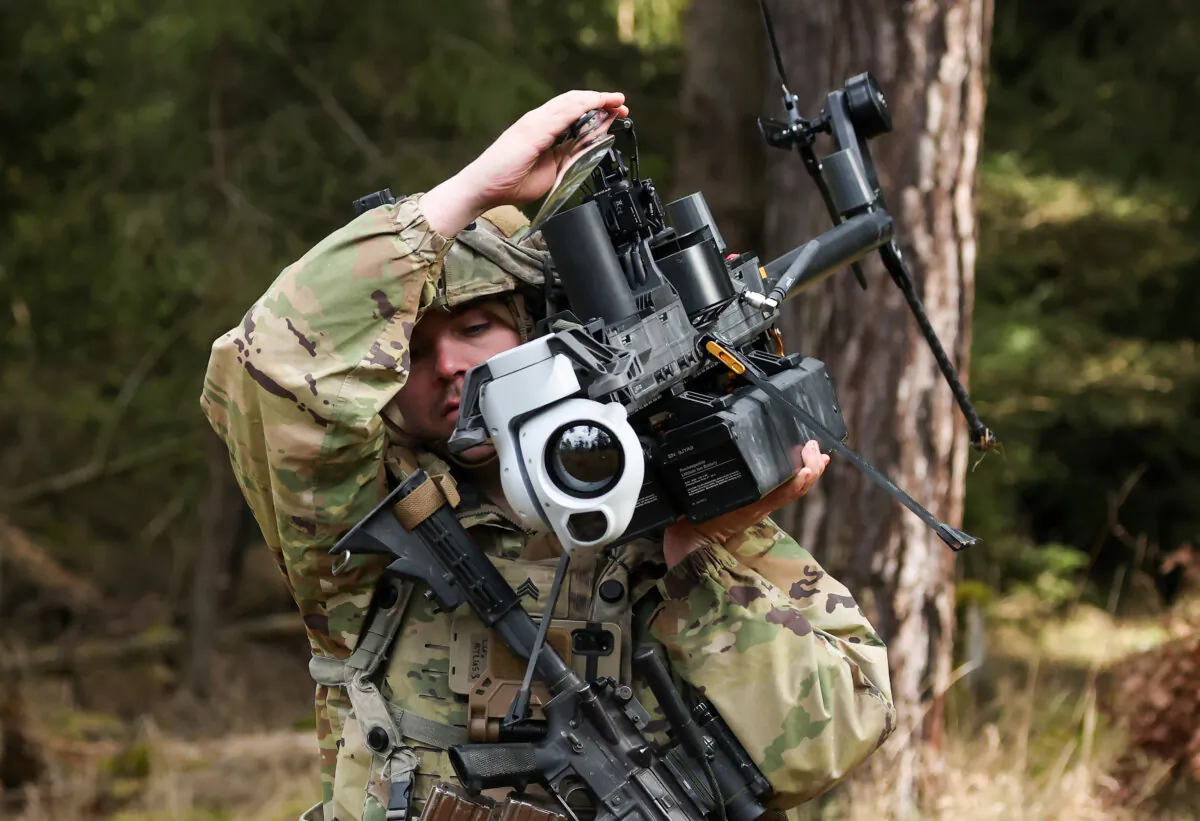
It was the Russia–Ukraine conflict that possibly transformed the mindset of military operators away from the need for humans to not only control the trigger for kinetic strikes but also to be physically present at the scene of impact.
The transformation occurred not only because of budgetary considerations and constraints on the provision of highly-trained manpower but also—as usual—because of the fact that offensive systems became substantially cheaper and easier to produce and field than defensive systems. And these offensive systems were unmanned and included loitering munitions, often with some artificial intelligence benefits of independent discretionary targeting.
A significant build-up to the transition was with the wars against Israel, where largely Iranian proxies attempted (but did not succeed) to overwhelm Israel’s layered air defense systems (Iron Dome, David’s Sling, and Arrow 3) against swarming attacks by relatively low-cost offensive systems, including unmanned aerial vehicles (UAVs or “drones,” ballistic missiles, and rockets of widely divergent capabilities and characteristics). Those attacks comprehensively failed, but not without proving that there was a saturation level beyond which the target state could not guarantee comprehensive immunity.
Indeed, Iran could not guarantee that it could achieve some level of success—even minor—in penetrating Israeli defenses until it moved by necessity from proxy attacks to direct attacks and used much more expensive attack weapons. But overall, the Israeli–Iranian conflict phase called the 12-Day War of June 13, 2025, to June 24, 2025, saw some definition begin to appear in the offense–defense cost equation. Certainly, that phase of the conflict left Israel with supremacy, but it showed that the process of defense had become enormously dependent on preparation and economic depth.
Moreover, the slogging competition between Russia and Ukraine in 2022–2025 showed that conventional and directly confronting forces could reach a stalemate when both used offensive capabilities of comparable cheapness. At that point, the successful state was the one that could demonstrate the greater strategic depth and capacity to keep the supply chain going. And that process also led to significant doctrinal improvements in countermeasures for the cheaper, unmanned swarming weapons. Israeli armored forces, too, significantly reduced drone effectiveness by physical and electronic countermeasures on their tanks in Gaza and elsewhere.
Saturation or swarming has always been a significant tactical capability, expressed in different ways. The Japanese attempts at kamikaze (suicide manned aircraft) in World War II were a strategic failure and waste of irreplaceable pilots, but showed that unmanned, expendable aerial weapons could provide a formidable defense and, ultimately, offense. And that process has now been accelerated to include a major commitment to unmanned ground and naval (including undersea) weapons.
Many senior operational U.S. Air Force officers only three years ago dismissed the need for unmanned collaborative combat aircraft as being needed only by “poor air-forces,” such as Australia, which pioneered many UAV capabilities from the Jindivik jet-powered target drone in 1952, the Ikara ship-borne anti-submarine missile (1959–1960), and so on. Today, the United States has embraced the need for collaborative combat aircraft and their ground and maritime counterparts.
Today, manned and unmanned systems work in harmony.
Yesterday, we had the philosophy that “the bomber will always get through” to the belief that “the missile will always get through,” and now we realize that nothing is guaranteed in the longer term. But, significantly in this context, the belief that “nuclear weapons will always get through” or “will always prevail” has remained since 1945. That’s an inordinate period in human warfare development. And while conventionally delivered nuclear weapons still have an ability to overcome missile defenses, it is only possible against a heavily defended target if mass numbers can overwhelm defenses, and this means that the cost of offense escalates dramatically beyond the cost of defense.
Of course, when unconventionally delivered nuclear weapons (disguised placement of the weapon within a target area) can occur, the cost-benefit argument still applies but is more in favor of offense. What can the weapon do to decisively change the conflict? When the psychological impact dissipates with the next news cycle, the nuclear weapon is only a large explosive, so the target must be commensurate with the cost of the offensive weapon and its delivery.
So where is “tomorrow’s war” for which we must all prepare?
Future wars and future opportunities can only be discerned and prepared for by forward-looking intelligence assessments. And what we are fighting now is the reality that while certain conflicts can induce rapid adoption of new technologies and doctrines, as well as force the creation of new countermeasures, nothing is inducing commensurate creativity in the assessment of developing threats, or “over-the-horizon” situations.
Without adequately creative, contextual strategic threat assessments, we are still fighting “yesterday’s wars” against “yesterday’s foes,” albeit with new military capabilities.
Views expressed in this article are the opinions of the author and do not necessarily reflect the views of The Epoch Times.
 Friends Read Free
Copy
Facebook
Tweet
Friends Read Free
Copy
Facebook
Tweet