
Commentary
The S&P 500 and Nasdaq Composite closed at fresh record highs on Oct. 6. Just days later, the mood on Wall Street began to shift dramatically. The week of Oct. 12–16 proved particularly brutal for technology investors, as renewed inflation concerns, lofty AI valuations, and mounting pressure on semiconductor stocks triggered a sharp sell-off. By Oct. 16, the Nasdaq had suffered its worst weekly performance since June, a stark reminder of how quickly market euphoria can turn into fear.
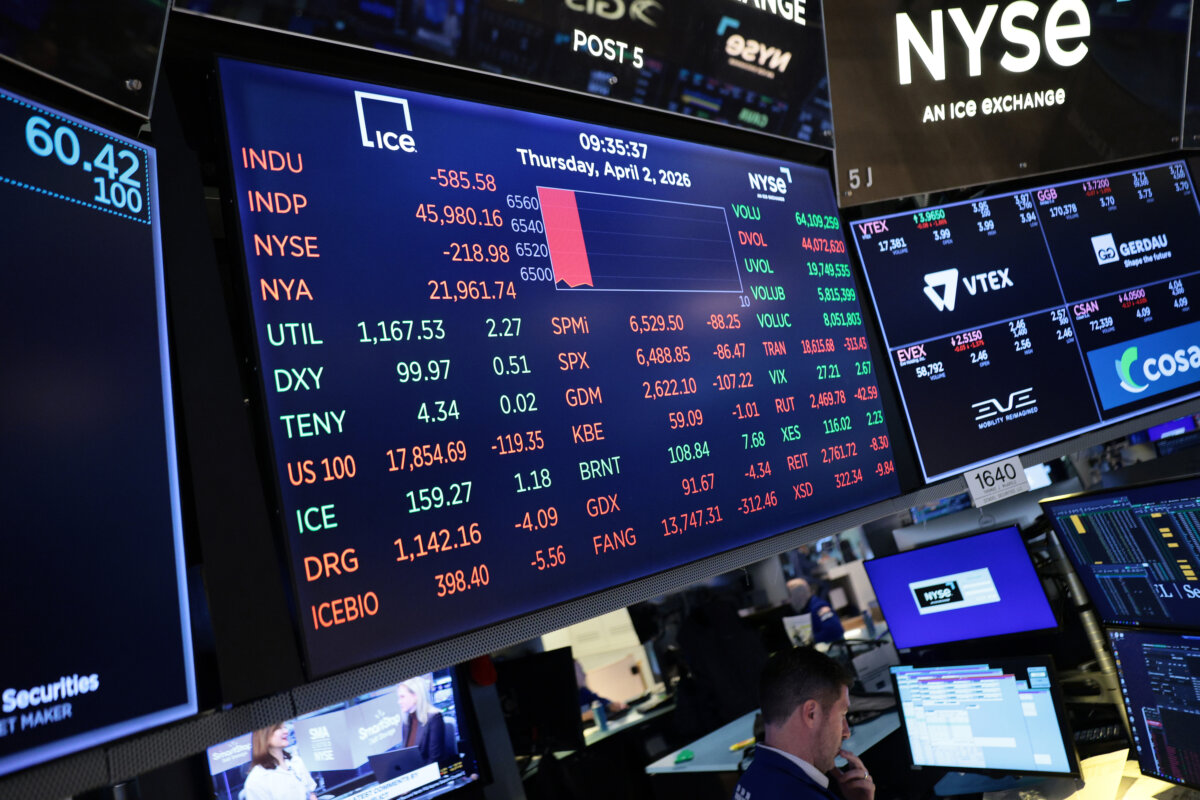
The Nasdaq Composite plunged 572.99 points, or 2.1 percent, to 26,140.03 on Friday. The Dow fell 175.28 points, or 0.3 percent, to 52,002.41, while the S&P 500 dropped 84.62 points, or 1.1 percent. For the week, the Nasdaq lost 4.5 percent and the S&P 500 declined 1.9 percent—both their worst weekly performances since June. The Dow, by contrast, gained 0.7 percent for the week.
October: From Record Highs to Market Turbulence
Technology and semiconductor stocks were particularly hard hit. Investors questioned whether the enormous sums being invested in artificial intelligence infrastructure would generate sufficient returns to justify elevated valuations. Renewed inflation concerns and the prospect of higher borrowing costs added to the uncertainty.
October has a special place in financial-market history. The Wall Street Crash of 1929 and Black Monday on Oct. 19, 1987, demonstrate how quickly confidence can collapse. Yet markets can also recover from severe corrections and eventually reach new highs.
For traders, the crucial question is not whether the market will rise or fall tomorrow. It is whether you can withstand the volatility without blowing up your account.
The first rule of professional trading is not simply to make money. It is to preserve enough capital to trade another day.
Even Legends Lose: The Rise and Fall of Jesse Livermore
Jesse Livermore remains one of the most famous speculators in Wall Street history. Although “Reminiscences of a Stock Operator,” written by Edwin Lefèvre, is a fictionalized account, it draws heavily on the world Livermore inhabited and the experiences of traders like him.
Livermore made approximately $100 million by shorting stocks during the 1929 Wall Street Crash, according to Business Insider. Yet his subsequent financial history was far less glorious. In 1934, he filed for bankruptcy, reporting assets of approximately $184,900 against liabilities exceeding $2.25 million. He died by suicide in 1940, aged 63. His death should not be attributed to financial losses alone, but his life illustrates the dangers of financial instability and repeated reversals.
The reported figures suggest an extraordinary swing from enormous wealth to bankruptcy, although they do not establish his exact investment drawdown or net worth at every point. The lesson for modern traders is clear: even extraordinary success does not guarantee lasting financial security. A trader can correctly anticipate a historic crash and still lose a fortune later.
Making money is one skill. Keeping it is another.
When Record Highs Turn Into a Reality Check
A rising market can make almost anyone feel like a genius. When indices continually set records, investors may begin to believe that the rally will continue indefinitely. But high valuations can leave little room for disappointment.
Technology and semiconductor investors are now confronting questions about whether enormous AI infrastructure investments will generate sufficient future earnings to justify current prices. Higher financing costs, inflation concerns, and uncertainty over future spending can all affect sentiment. Friday’s sell-off demonstrated how concentrated the damage can be. Micron Technology fell 5.6 percent and Intel lost 5.8 percent, contributing to pressure on the technology-heavy Nasdaq.
A company can have an excellent long-term future while its stock remains vulnerable to a severe correction. Even if your investment thesis eventually proves correct, an entry price that is too high, excessive leverage, or an unsuitable holding period can produce substantial losses. Never confuse a good story with a good trade. Your entry price, position size, and ability to withstand a downturn matter just as much as your market outlook.
High-Frequency Trading: Speed Is Not a Safety Net
High-frequency trading uses sophisticated computer systems to process market data and submit, modify, or cancel orders at extraordinary speed. Some systems respond to order-book imbalances and short-term price movements. Others focus on market-making, attempting to earn small spreads across large numbers of transactions.
Professional firms may employ position limits, real-time exposure monitoring, and automated kill switches to contain risk. These controls can help prevent an individual error from becoming a much larger problem. However, high-frequency trading is not a magic formula for avoiding losses. Sudden liquidity shortages, technical failures, unexpected events, and flawed models can still cause substantial damage.
Nor should high-frequency trading be confused with longer-term trend following. Both may use algorithms, but their objectives, holding periods, and sources of potential returns differ.
Retail traders do not need to compete with institutional computers on speed. They need to understand execution costs, liquidity, and risk. Speed is an advantage only when the underlying strategy and risk controls are sound.
Don’t Be Naive: Automation Is Not a Money Machine
Today, retail traders have access to automated platforms, algorithmic strategies, and AI-powered tools. It can be tempting to believe that a trading bot will generate effortless profits.
That is a dangerous assumption. Thousands of traders and institutions may watch the same moving averages, momentum indicators, technical patterns, and market signals. When everyone chases the same opportunity, positions can become crowded. If the signal reverses, participants may rush to exit simultaneously, amplifying price movements and losses.
A strategy that looks impressive in historical back-testing may fail in live markets because of transaction costs, slippage, overfitting, or changing market conditions. Automation can improve consistency and reduce some emotional decisions, but it cannot guarantee profits. A flawed algorithm can magnify losses at machine speed. Before automating a strategy, understand why it should work, test it under realistic conditions, and establish strict risk limits.
When everyone follows the same signal, who is left to buy when the buyers have already bought? Technology does not eliminate the need for judgment. It makes sound judgment even more important.
The Good Old Rules: Protect Your Capital and Accept Volatility
If you invest in risky assets, you must accept volatility as part of the bargain. Stocks, options, leveraged products, and concentrated portfolios can experience sudden and severe price movements.
You cannot expect the potential for high returns without accepting the possibility of significant losses. The objective is not to eliminate volatility, but to ensure that it does not destroy your ability to continue trading.
Here are some practical rules:
-
Control position size. Decide how much you can afford to lose before entering a trade. Never let one position threaten your entire account.
-
Plan your exits. Establish the conditions under which you will close a losing position. Remember that stop-loss orders cannot guarantee a particular execution price in a fast-moving market.
-
Respect leverage. Borrowing and options can magnify losses. A short-dated option can expire worthless, and a debit spread can lose its entire initial cost.
-
Avoid revenge trading. Do not increase your position recklessly to recover a loss or chase a stock simply because it is rising rapidly.
-
Keep cash reserves. Separate emergency savings and essential living expenses from trading capital.
-
Diversify appropriately. For some investors, a diversified sector ETF or broad-market index fund may be more suitable than trading individual stocks. Funds can reduce company-specific risk, but sector funds remain exposed to market-wide and sector-wide declines.
Above all, distinguish between a temporary drawdown you can financially withstand and a loss that permanently impairs your capital.
Survive Today to Trade Tomorrow
October’s turbulence reminds us that markets do not move in straight lines. Record highs can be followed by sharp declines. Popular strategies can stop working. Even legendary traders can experience devastating financial reversals. You do not need to predict every market move. You need to understand your positions, control your exposure, and maintain the discipline to act when conditions change.
Resist the temptation to treat every market dip as a bargain or every rally as an invitation to chase. Do not confuse a compelling AI story with a guaranteed investment return, an automated system with a reliable edge, or leverage with intelligence.
The best traders are not those who never lose. They are those who know how much they can afford to lose, when to step aside, and how to preserve their capital for the next opportunity. Protect your capital today so that you can participate in tomorrow’s opportunities.
The Epoch Times copyright © 2026. The views and opinions expressed are those of the authors. They are meant for general informational purposes only and should not be construed or interpreted as a recommendation or solicitation. The Epoch Times does not provide investment, tax, legal, financial planning, estate planning, or any other personal finance advice. The Epoch Times holds no liability for the accuracy or timeliness of the information provided.
Views expressed in this article are the opinions of the author and do not necessarily reflect the views of The Epoch Times.
 Friends Read Free
Copy
Facebook
Tweet
Friends Read Free
Copy
Facebook
Tweet