
Commentary
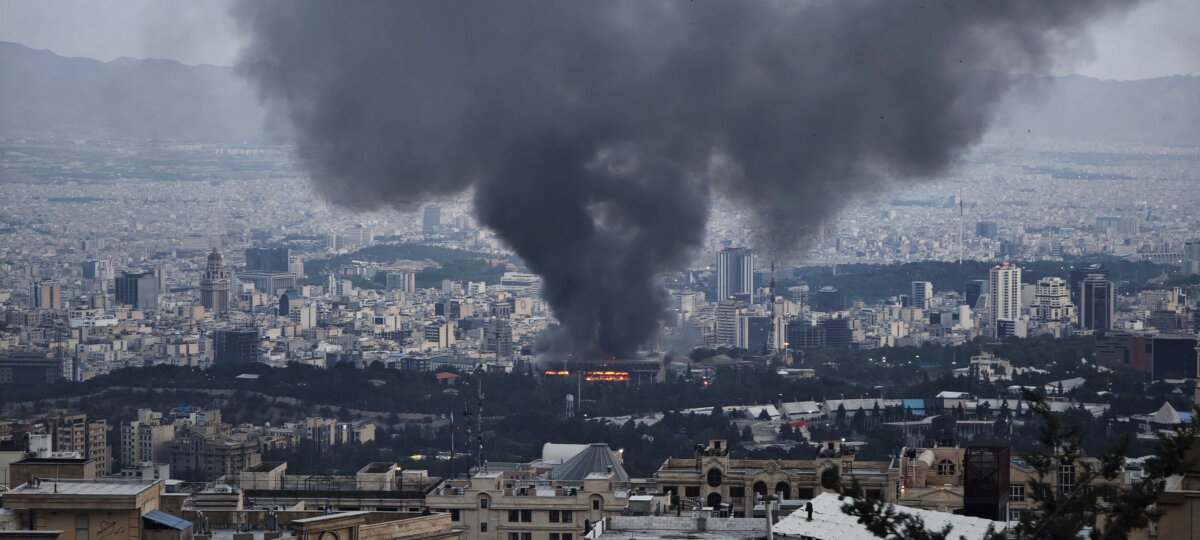
With the Israeli attacks on Iran unfolding, it is worth asking how these events will affect China. Iran is closely aligned with and linked to China in various ways, meaning that changes in Tehran could be felt all the way to Beijing.
China is Iran’s largest trading partner. Iran exports mostly crude oil and imports a variety of manufactured products, electronics, and garments typical of Chinese exports. However, Iran–China ties go well beyond trade.
Iran, an authoritarian theocracy, has partnered with China extensively over the years to increase its surveillance and technological capabilities. For instance, it was Iranian transactions that Huawei Chief Financial Officer Meng Wanzhou admitted to hiding when she allegedly engaged in bank fraud with U.S. banks. Huawei allegedly worked with Iranian authorities to install Huawei gear throughout the country and improve the surveillance and security capabilities of the authoritarian state.
Tehran has also been a stalwart ally of Beijing on various issues. As members of the intergovernmental organization BRICS (Brazil, Russia, India, China, and South Africa), Iran and China have worked closely on a variety of foreign policy issues. Chinese weapons have been discovered among a variety of Iranian clients, including Hamas, Hezbollah, and the Houthis. Just as China is reluctant to provide direct weapons to Russia for its war in Ukraine, Iran has become a significant supplier of drones to Moscow, but relies heavily on Chinese components to feed the voracious Russian demand.
So how will the current conflict affect Iran, China, and the world?
Right now, Israel has avoided targeting Iran’s oil-exporting infrastructure, including the facilities that heavily supply China. Although this has largely kept oil prices and flows stable—not just to China and from Iran but globally—if Israel were to alter its strategy and begin targeting oil facilities, it would rapidly affect China and the global oil market.
If Iran’s manufacturing capabilities are taken out of commission, this could have a major impact on the Russia–Ukraine war. This would have a significantly negative effect on Russian drone capabilities. While China may step in and supply Russia, so far it has been reluctant to provide military capabilities to attack Ukraine. In other words, it could reduce Russian offensive weaponry aimed at Ukraine and drive China into a deeper alliance with Russia, although that seems unlikely.
What will become of the Iran–China partnership in the bigger picture and over the long term? Although events are still unfolding, it seems that even if the current Iranian regime remains in power, it will have been greatly neutered and be unable to play as significant a role in global affairs with China against the West. Its proxy clients in Lebanon, Yemen, Syria, and Hamas have been, if not destroyed, rendered impotent.
If a regime change occurs in Tehran, the foundation of the Iran–China partnership may collapse, potentially leading to a more Western-friendly government replacing the current authoritarian theocracy that collaborates with an authoritarian communist state. At best, a new government would revisit existing alliances and partnerships with countries such as China.
Arguably more important for Beijing, any fundamental shift in the security situation in the Middle East would allow the United States to allocate more defense resources to the Indo-Pacific. Given the Chinese regime’s expansionary saber-rattling and its rhetoric about U.S. involvement in the region, any change to the security status of Iran would be deeply worrying to Beijing. A distracted United States benefits Beijing, and the regime wants to keep it that way.
In the words of the philosopher Yogi Berra, I do not make predictions, especially about the future. Still, it seems reasonable to say Beijing is worried about events unfolding in Iran. Almost any change to the previous status quo would likely not benefit Beijing and would possibly harm its interests. The Chinese regime needs countries that it can align with and that support its authoritarian interests, and any change to that status will be perceived negatively by Beijing.
Views expressed in this article are the opinions of the author and do not necessarily reflect the views of The Epoch Times.
 Friends Read Free
Copy
Facebook
Tweet
Friends Read Free
Copy
Facebook
Tweet