
Commentary
Iran had undergone “regime change” by mid-morning of Feb. 28, 2026. But whether it was “enough regime change” for either the U.S. president or the Iranian people will only be determined over the coming weeks and months.
The key leadership of Iran’s clerical government was killed on the morning of Feb. 28, including Supreme Leader Ayatollah Ali Hoseini-Khamane‘i, his Revolutionary Guard commander, the minister of defense, and other security leaders.
Whether, for example, Ayatollah Khamane‘i’s son, Mojtaba Khamane‘i, 58, will replace his father, and whether other candidates would lead the Islamist government into the future all remains to be seen. More to the point, would President Donald Trump deal with such a new administration and “strike a deal”?
There’s “regime change”—à la Venezuela post–Nicolás Maduro—and then there’s “regime change,” as when the Shah of Iran and his government fell in 1979 to be replaced by a new and repressive form of government, unrepresentative of the population.
The question on the lips of many professional observers, and of the Iranian population, has been: What took it so long for the United States and Israel to make good on their commitment to help overturn Iran’s illegitimate revolutionary clerical government?
Part of the answer lies in the fact that neither Israel nor the United States knew exactly what to do after striking visible military and nuclear targets inside Iran and, to a large extent, still do not know what to do. A land occupation by foreign forces is infeasible, given the vastness and ruggedness of the Iranian landmass. So the “rising” of the local population is all that can be hoped for. But that population, dispersed over the rugged landmass, cannot be easily coalesced into viable groups to seize control of the infrastructure of government.
Nor are they armed or structured to do so.
U.S. and Israeli forces began a major air and missile assault on Iranian military and leadership assets on the morning of Feb. 28, 2026, under a combined operation known as Epic Fury. Israel called its portion of the war Operation Roaring Lion (or Lion’s Roar). For the first time, President Donald Trump called for “regime change”: the end of the mullahs’ revolutionary government that replaced the rule of the Shah in 1979. Months of preparation by the United States and Israel ensured that a logistics tail could support operations against Iran for a protracted period. This was despite the fact that the UK prime minister had denied the United States the right to launch strikes from British bases in the UK, Cyprus, and Diego Garcia. It seemed clear that the United States did, in fact, operate from Diego Garcia, despite the UK prime minister.
By late on Feb. 28, 2026, reports appeared that the “Supreme Leader” of Iran, Ayatollah Ali Hoseini-Khamane‘i, had been killed in the initial airstrikes, a major goal—if confirmed—in undermining the coherence of resistance by the remainder of the Iranian forces, particularly the Iranian Revolutionary Guard Corps (IRGC) and its subordinate militia, the Basij.
Another answer to the question of why it took so long for the United States (in particular) to take such decisive action against the clerics, for many, was the strategic naïveté that caused the Trump administration to “exhaust all opportunities at negotiation” with the clerics to ensure that they would not pursue the development of nuclear weapons. But even that did not hold water: The clerics already had nuclear weapons developed and deployed, possibly since 1991. They also knew that they were useless as war-winning weapons. One Iranian attempted nuclear strike against Israel (or anyone else) would result in the comprehensive destruction of Iran.
Did the delay matter in the long run? Would the mullahs have been better advised to make whatever concessions the United States and Israel would accept, knowing that their code of taqiyya (in Farsi: doroogh e maslahat ameez)—the acceptability of an “acceptable lie” to a nonbeliever—would enable them to promise whatever was required, while putting them under no obligation to honor their word? Were the clerics, in fact, attempting to do that when the United States and Israel terminated the discussions?
The matter became moot with the new military strikes beginning on Feb. 28, 2026. But it could have been resolved sooner and without the loss of so many Iranian civilians by the regime in the weeks leading up to the strikes. Indeed, it could have been resolved much earlier by earlier U.S. presidents who preferred to use agreements with the Iranian mullahs for domestic U.S. political prestige.
The delays since 1979 have had strategic consequences, but by 2021, there were obvious penalties in delaying the removal of the clerics, whose revolution was artificially extended by the need for post-Soviet Russia and the People’s Republic of China (PRC) to keep Iran out of the hands of the United States, Israel, and the West so that they could preserve control of the Eurasian landmass, free from external penetration.
This confirmed Sir Halford Mackinder’s heartland theory, published in his 1904 article, “The Geographical Pivot of History,” in which he posited that the “World-Island” of Eurasia, including the interlinked continents of Africa, Asia, and Europe, represented the core of power. He later summarized this theory in 1919 as: “Who rules East Europe commands the Heartland; who rules the Heartland commands the World-Island; who rules the World-Island commands the world.”
That became particularly important once the Central Asian “stans,” plus Azerbaijan, were freed from the Soviet (and before that, Russian) Empire. Certainly, it was regarded as important for the Russians/Soviets and Chinese to believe that theory. The maritime powers—the United Kingdom, the United States, and Australia—saw advantage in their abilities to contain the heartland powers, Russia and China.
The British and, importantly, President Richard Nixon (1969–74) understood that Mackinder’s theory was a critical factor in geopolitics. The destruction of Nixon’s presidency, heavily orchestrated by Soviet assets in the United States, saw the United States lose access to Iran and Iran itself fall, because of President Jimmy Carter, to the clerics. Had that U.S. access been preserved and the Shah’s government perpetuated, the U.S./West would have had immediate overland access to Central Asia once the Soviet Union collapsed in 1991.
Arguably, Carter’s lack of geostrategic understanding caused the West to lose its critical alliance with Iran for the next 47 years and, therefore, its ability to work with the now-sovereign states of Central Asia to ensure that the Eurasian landmass no longer dominated global strategic power as it had once done. By 2024, or earlier, Russia and the PRC had turned Iran into an invaluable ally, and so had India, partly because of the Moscow-driven International North-South Transport Corridor, which linked India with the Atlantic without having to go through the Suez. The PRC also depended on Iranian oil.
Can President Trump restore the framework that Nixon had carefully prepared, and under which Nixon ensured that both Iran and Saudi Arabia remained strong allies of the U.S./West?
What militates against Trump?
Arguably, the most significant and mostly silent opponents of Trump’s ambition to restore the Nixon legacy are Russia, the PRC, and Türkiye, and possibly—eventually—India. All of these have independent ambitions for strategic power, and strong U.S. dominance of the Persian Gulf region and the land bridge to Central Asia would inhibit these goals. Significantly, the Central Asian states have, since 1991, been looking for a corridor to the outside world, ideally via Iran, which is more stable than the route through Afghanistan and Pakistan.
But that raises a matter for the immediate future: The newly erupting Pakistan–Afghanistan war could be expanded by India to take advantage of Islamabad’s preoccupation with its immediate conflict. This could significantly interfere with U.S. plans for Iran. It is no coincidence that, since 2007, Indian intelligence (particularly RAW) has been engaged in supporting the Islamist Tehrik-i-Taliban Pakistan (TTP), which operates from bases inside Afghanistan.
It is probable that the PRC, with its own civil war now in full function, may be incapable of protecting its interests in Iran, or even in Pakistan. Russia, however, now finds itself again in the “great game” for Central Asia. Türkiye finds itself thwarted, to some degree, in undermining Iran, its great competitor.
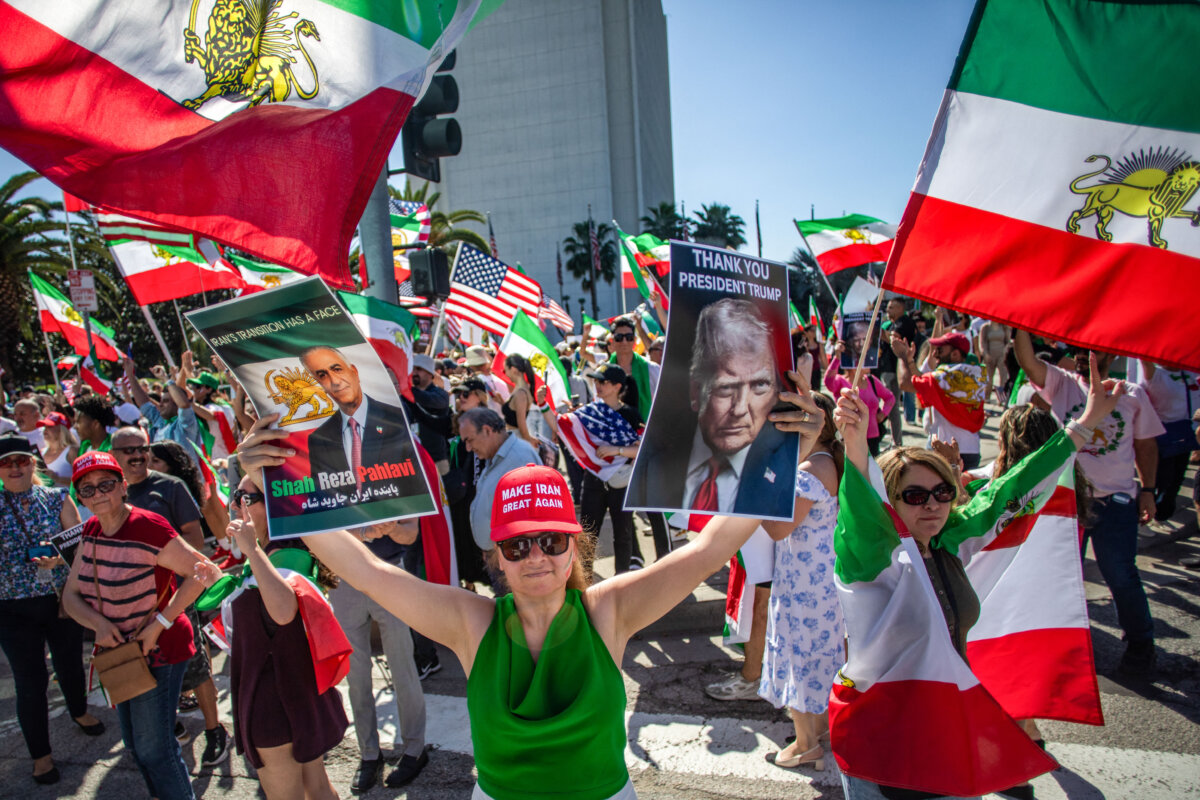
So the “regime change” in Iran could be the start of what Nixon anticipated, or it could mean nothing. It depends on whether Washington will undertake truly long-term measures. This, for domestic Iranian purposes, would dictate that the Shah’s son, Crown Prince Reza, should head an interim government to ensure continuity and legitimacy.
Views expressed in this article are the opinions of the author and do not necessarily reflect the views of The Epoch Times.
 Friends Read Free
Copy
Facebook
Tweet
Friends Read Free
Copy
Facebook
Tweet