
Commentary
Public policy most often goes wrong because good intentions walk into a room full of real-world incentives—and lose. Canada’s Medical Assistance in Dying (MAID) program is perhaps a modern example. When MAID became law in 2016, it was sold as a narrow, tightly controlled act of mercy: only for competent adults facing unbearable, terminal suffering, with death reasonably foreseeable, multiple safeguards, and rare cases. The messaging was that this is about compassion at the very end of life, nothing more.
But once you open a door in public policy, the system decides how far it goes. For example, the U.S. income tax began in 1913 at 7 percent on the richest 1 percent. Today, it touches almost every worker. Welfare programs all over the West had started as emergency safety nets; in some places, they accidentally made full-time work economically irrational.
MAID followed the same well-trodden path, only faster. From terminal illness, it expanded to chronic illness and disability, and it now stands on the threshold of mental-illness-only cases (delayed, for now, until 2027). Documented stories show that some people asking for housing or post-traumatic stress disorder treatment are offered MAID instead.
Narrow Promise That Couldn’t Stay Narrow
The story begins in the courts, not Parliament. In 2015, the Supreme Court of Canada’s Carter decision ruled that banning assisted suicide entirely violated the Canadian Charter of Rights and Freedoms. The court stressed that the exception must remain narrow: only for grievous, irremediable conditions causing enduring, intolerable suffering—almost always terminal.
Parliament’s 2016 Bill C-14 tried to honor that spirit. Death had to be “reasonably foreseeable.” Ministers repeatedly assured Canadians: This is about terminal cancer and amyotrophic lateral sclerosis, not disability, not despair, not a broad social policy. The safeguards looked robust: two independent assessments, waiting periods, written consent, and mental competence required until the final moment. Yet the door was open just a few inches.
In 2019, a single Quebec judge in Truchon v. Canada ruled that requiring foreseeable death was itself unconstitutional. Ottawa declined to appeal. In 2021, Bill C-7 erased the foreseeable death clause completely and created two tracks:
- Track 1: original terminal cases
- Track 2: everyone else whose suffering is deemed intolerable, even if death is decades away
Track 2 brought longer assessments and a requirement to “explore all reasonable alternatives,” but the alternatives often don’t exist.
Wait times for pain clinics run two to four years. Home care budgets are frozen. Affordable, accessible housing is often referred to as a national joke. When the system can’t relieve suffering through care, despite politicians’ constant promises, relieving it through death becomes, unintentionally, the most accessible option. None of this required sinister intent.
What Expansion Looks Like in Real Life
Look past the paperwork and you see the human reality. In non-terminal (Track 2) cases, the top underlying conditions are no longer cancer but neurological diseases, multiple comorbidities, chronic pain, and musculoskeletal disorders. A growing share cite poverty, loneliness, and loss of autonomy alongside—or instead of—medical diagnoses. Some stories are impossible to forget:
- A 51-year-old Ontario, Canada, woman with multiple chemical sensitivities begged for safe housing for two years. Case workers discussed MAID as an option; she accepted and died by MAID in 2022.
- Canadian Armed Forces veterans called Veterans Affairs for post-traumatic stress disorder help and were asked, unprompted, if they had considered MAID. The government apologized, but more veterans came forward with the same experience.
- Clinicians reported patients in long-term care being gently introduced to MAID during “future planning” conversations they never initiated.
The Parliamentary Budget Officer calculated that in 2021 alone, MAID reduced public health spending by roughly $149 million. No minister ever stood up and said, “Let’s save money this way.” However, the number now sits in every budget model, quietly shaping the environment in which choices are made.
When Systems Stop Fighting for Certain Lives
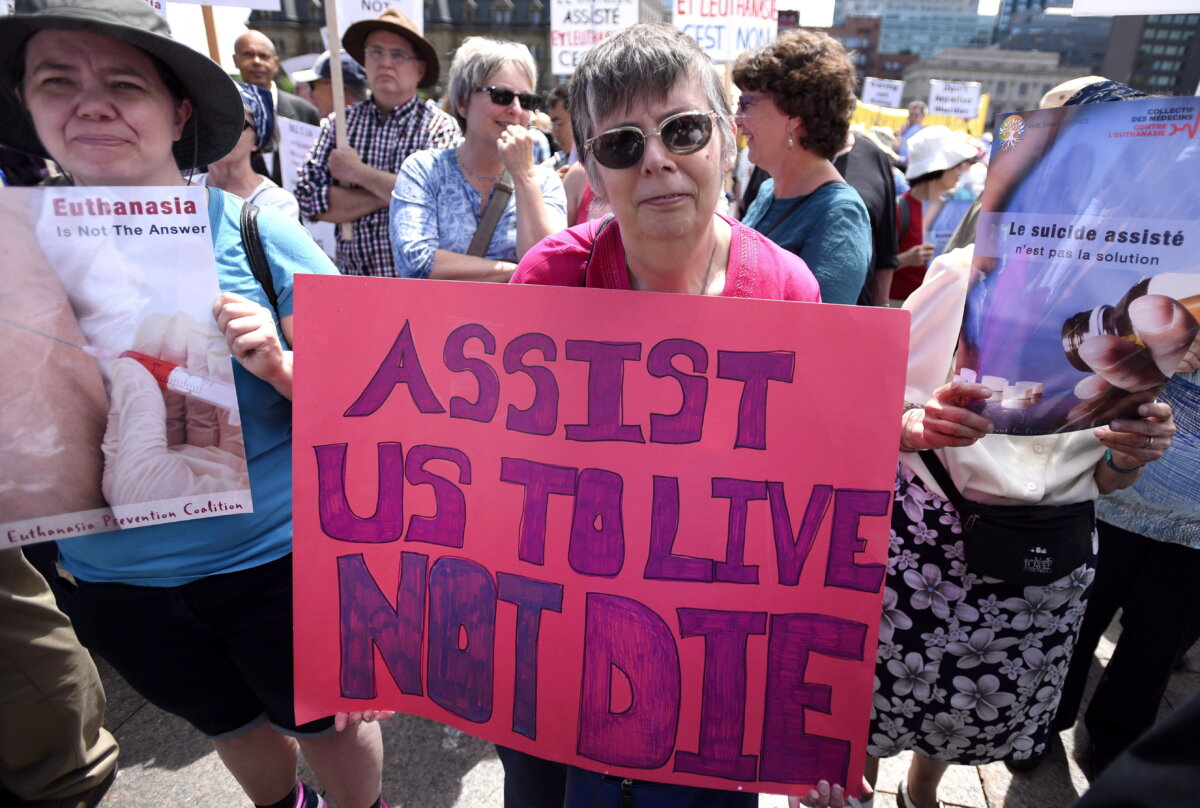
Step back and the larger pattern is unmistakable: Incentives, not intentions, drive outcomes, as economist Thomas Sowell keeps reminding us in his writings. Courts demand equal access to suffering relief. Bureaucracies reward low-resource solutions. Politicians face no electoral cost for underfunding disability supports but face fierce backlash if they restrict a charter “right.”
The result is a quiet hierarchy of whose lives the system keeps fighting for. The people who show up most in Track 2 statistics are the same people whose lives are most expensive to sustain: the severely disabled, the chronically ill, the isolated, the poor.
Disability scholars have a term for what happens next: “soft eugenics.” Not the murderous, coercive eugenics of the 20th century, seeded in the 19th—very few believe that that is occurring, and one hopes that very few involved intend harm. Rather, there is a subtler, structural pattern in which a system under pressure begins to behave as if certain lives are harder to justify supporting when a tidy exit is legally available.
When housing, treatment, and home care are theoretical but MAID is real, the question in the clinic slowly shifts from “How do we help this person live?” to “Why are we requiring them to keep living like this?”
Disability rights advocates are blunt: When death is easier to obtain than support, society has sent a message about whose lives it truly values. They do not see expanded autonomy; they see a two-tier system in which the already-marginalized are gently, politely, incentivized to disappear.
Hippocratic Oath Under Strain
For more than two millennia, physicians have inherited a simple, uncompromising principle, the Hippocratic oath: First, do no harm. So what happens when a society creates a legal pathway that asks physicians to seemingly do that? Perhaps many argue that relieving unbearable suffering is itself a form of healing, and that honoring a patient’s wish can be part of compassionate care. Others may quietly feel the tension but tell themselves that the law has redefined their role and that their duty is to the patient’s autonomy.
But a significant number of clinicians—often the ones who see the consequences up close—struggle with the feeling that they are being asked to cross a line medicine was never meant to cross. Not because doctors wish to cause harm—far from it—but because a system under strain has redefined what counts as harm, what counts as relief, and what counts as care.
This isn’t the first time modern health care has encountered such a tension. During the COVID-19 pandemic, many doctors supported vaccination campaigns wholeheartedly, especially for vulnerable populations. But as more data emerged, particularly about myocarditis and pericarditis risks in young males, some clinicians found themselves questioning whether the institutional directive truly aligned with “do no harm” for every age group.
Moral Landscape
Beneath the policy lies an ancient question every civilization has answered differently: When, if ever, is it right to choose death? Some traditions say “yes” in narrow cases. Stoics praised rational exit when the body becomes a prison. Many today see assisted dying for unbearable terminal illness as a final act of agency. Self-sacrifice for others—soldier, parent, martyr—is almost universally honored.
Most older traditions say almost never. Judaism and Christianity call life sacred, not owned. Confucianism sees suicide as a rupture in the family fabric. Buddhism warns that suicide merely postpones the karmic payment.
Even secular ethics asks the uncomfortable question: When the supports a person needs do not exist, is the choice to die truly autonomous, or is it the system speaking through the patient’s mouth?
These guardrails kept humanity from treating death as a solution to suffering for thousands of years. When modern policy drifts past them, we should at least notice, and ask whether we still believe that every life has inherent self-worth. The choice, at the end of the day, in Canada or elsewhere, is still the individual’s, and so is the responsibility.
Views expressed in this article are the opinions of the author and do not necessarily reflect the views of The Epoch Times.
 Friends Read Free
Copy
Facebook
Tweet
Friends Read Free
Copy
Facebook
Tweet