
Commentary
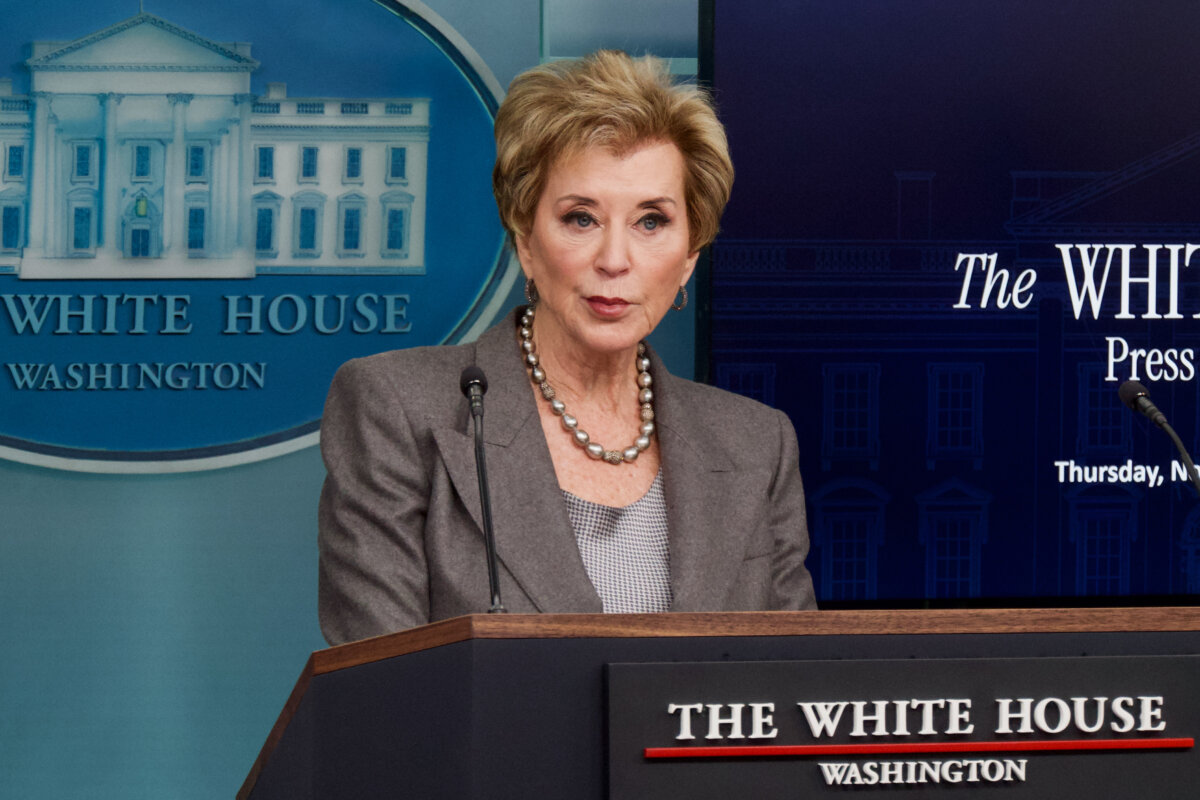
U.S. Secretary of Education Linda McMahon is partially dismantling her own department. This isn’t something cabinet secretaries often do.
Typically, cabinet secretaries look for ways to expand their departments and grow their influence. Instead, McMahon plans to download education policy decision-making to the state level. If she follows through on her plan, she will fulfill a pledge made by President Donald Trump to “facilitate the closure the Department of Education and return education authority to the States.”
The U.S. Department of Education (DOE) was first established as a federal department in 1979 by President Jimmy Carter. Since then, the federal government has intervened in education policy by dangling money transfers to states and imposing additional regulations on schools. While one Republican presidential hopeful after another has pledged to abolish the DOE, Trump might be the first to make good on this promise.
Unsurprisingly, McMahon’s announcement is attracting a lot of opposition. An education coalition consisting of various educators, unions, and school districts has launched a lawsuit in federal court against the Trump administration. The coalition claims that McMahon does not have the authority to dismantle the department and that the entire process has been “unpredictable, chaotic, and unprofessional.”
It’s a matter of debate whether McMahon has the legal power to dismantle the DOE. However, here’s something that’s not debatable—schools can run just fine without oversight from a federal department. Just look at Canada.
Unlike the United States, Canada has no federal department of education. Except for aboriginal children and the children of active military personnel, education is solely a provincial responsibility, which means that each province is responsible for things such as teacher certification, curriculum standards, and school facilities. And most provinces devolved at least some decision-making powers to local school boards.
While all Canadian provinces have a public school system, three provinces (Ontario, Alberta, and Saskatchewan) also have fully funded public Catholic school systems. In addition, all provinces have independent schools, although only five provinces (British Columbia, Alberta, Saskatchewan, Manitoba, and Quebec) provide public funding to independent schools, with funding levels varying by province. And only Alberta has charter schools.
It’s widely accepted in Canada that education is not a federal issue. This means that Canada is free of intrusive federal education initiatives such as George W. Bush’s No Child Left Behind Act, to name just one.
Interestingly, the United States spends more on K–12 education than Canada. For example, in 2021, the latest year of comparable data, the United States spent US$15,799 per student on K–12 education, compared to US$13,349 spent per student in Canada. Moreover, the United States spent 3.5 percent of its economy (i.e., GDP) on K–12 education in 2021, compared to 3.2 percent for Canada. There’s no question that K–12 education is more costly in the United States than in Canada.
Yet despite spending more on K–12 education than Canada, the United States gets worse academic results. For example, on the latest Programme for International Student Assessment (PISA) tests, the gold standard for international testing, Canada scored 497 in math, 507 in reading, and 515 in science, while the United States scored 465, 504, and 499 in these respective subjects.
According to the OECD, 20 points is the approximate equivalent of one grade level, which means Canadian students are slightly ahead in reading, nearly a full grade level ahead in science, and 1.5 grade levels ahead in math. Moreover, over the last 20 years (PISA tests began in 2000), academic achievement has essentially been flat in the United States. In other words, nothing the DOE has done over the last 20 years has improved the academic achievement of students. These are not the kind of results we’d expect to see if centralizing education under a federal department helped improve student achievement.
One can only hope that Linda McMahon follows through on her plan to at least partially dismantle her department. This would be a good step forward for education in the United States.
Views expressed in this article are the opinions of the author and do not necessarily reflect the views of The Epoch Times.
 Friends Read Free
Copy
Facebook
Tweet
Friends Read Free
Copy
Facebook
Tweet