
Commentary
As Iranians marked Nowruz—the Persian New Year—over the past few days as the war grinds into its fourth week, Israeli Prime Minister Benjamin Netanyahu delivered a message that blended holiday wishes for Iranians with an unmistakable warning of destruction directed at the Iranian regime.
Speaking from the Air Force command center, flanked by military and intelligence leaders, he urged Iranians to celebrate the ancient Festival of Fire (Chaharshanbe Suri, observed on March 18 this year) and Nowruz itself: by lighting bonfires, gathering freely, and embracing “a year of freedom.”
Then came the line that echoed globally: “We’re watching from above.”
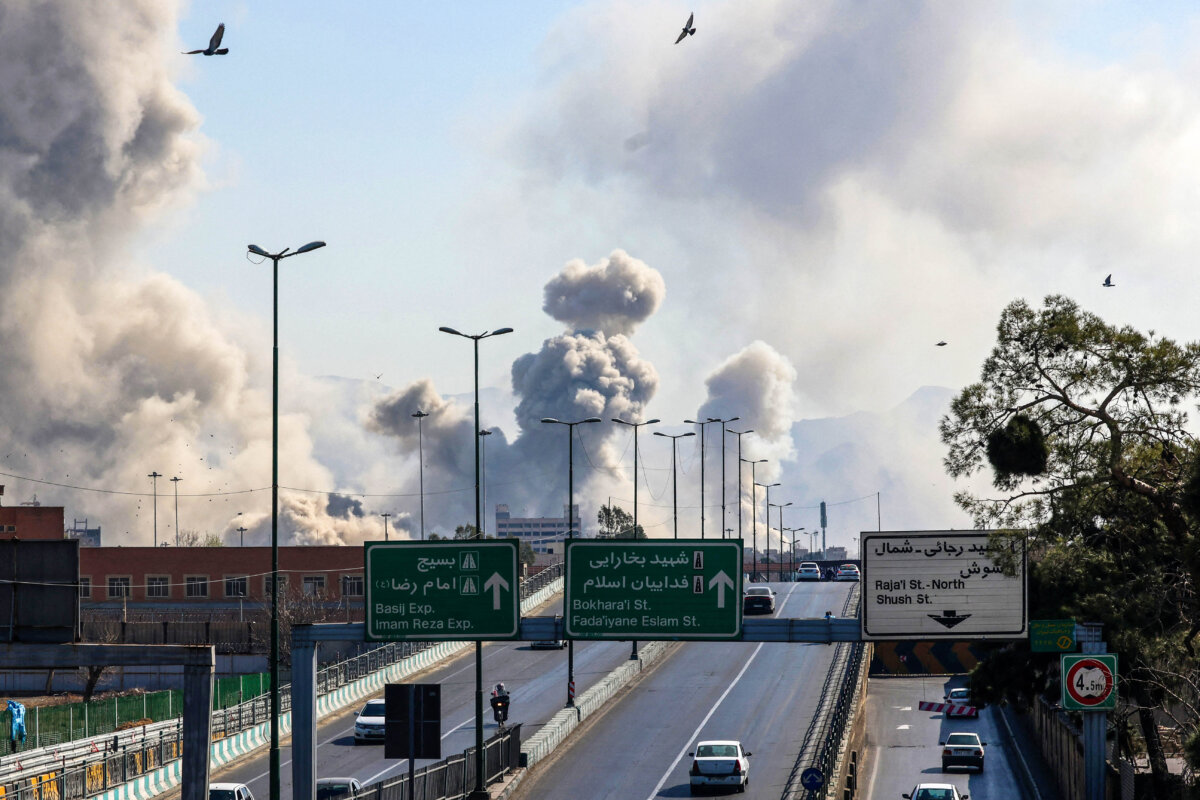
The phrase was no mere rhetorical flourish. It signaled Israel’s active role in reshaping the internal landscape—not just through strikes on military targets but by systematically weakening the regime’s tools of domestic control. In the days leading up to and during the holiday period, Israeli forces hammered Basij checkpoints across Tehran and other cities. These paramilitary roadblocks—hastily erected since the war’s start to suppress potential unrest—have become priority targets. Drones and precision strikes have hit dozens of them, often guided by real-time intelligence from ordinary Iranians on the ground who pass tips to Israeli drone handlers. The goal is explicit: loosen the regime’s grip on the streets, create breathing room for movement, and erode the fear that has crushed past protest waves.
This campaign ties directly to broader psychological and operational efforts. Well-placed sources indicate that Israeli intelligence has been making direct calls to mid- and senior-level officers in the IRGC, police, and Basij—an Iranian paramilitary militia. The messages are blunt: “We know who you are. You’re on our blacklist. Either help the opposition or face elimination.”
Leaked recordings show some recipients responding with pleas—“Please don’t hurt us; we’re with the opposition”—although loyalty remains fractured and hard to gauge beneath the surface. These operations aim to sow paranoia, accelerate defections, and signal that the regime’s enforcers are no longer untouchable.
Yet the bet on rebellion remains fraught. Past mass protests—most recently the huge December 2025–January uprisings that killed thousands—failed despite widespread anger. The opposition stays fragmented; internet blackouts persist; the regime’s deep bench of loyalists and repressive apparatus has endured. What differs now is the scale of degradation: Joint U.S.–Israeli strikes have gutted not only external military capabilities but internal policing ones too. Basij and IRGC domestic units have lost hundreds of commanders and field officers in recent weeks alone, including high-profile eliminations such as the Basij intelligence chief and key coordinators. Checkpoints continue to fall; morale reports suggest growing hesitation among enforcers who fear tribunals or Israeli drones if the regime collapses.
Minority dynamics add another layer. Persians dominate, but Kurds, Arabs (especially in oil-rich Khuzestan), Baluchis, and others have faced systemic repression for decades. Some have armed militias—Kurdish Peshmerga-linked groups in the northwest were reportedly poised for cross-border action earlier this year, although plans appear to have leaked prematurely and stalled. If internal security continues eroding, these groups could tip the balance, particularly in some strategic regions.
Still, the threshold for mass action has not been crossed. Israeli and U.S. leaders have publicly called on Iranians to rise up, but without further collapse of the repressive machinery, any street movement risks massacre. As one senior Israeli official reportedly told U.S. diplomats, protesters will “get slaughtered” if they move prematurely.
As of March 23, with U.S. President Donald Trump’s 48-hour ultimatum on the Strait of Hormuz postponed amid talks with Iran, the internal front remains tense but static, with the caveat that the internet has been shut down for three weeks. No widespread uprising has erupted amid the New Year festivities yet; Basij patrols and checkpoints still endure, although battered. Iran threatens total Hormuz closure and Gulf energy retaliation if power plants are hit—a move that would devastate its own population further. The regime clings on, but the groundwork for fracture is being laid.
When—or if—the flip happens, it will be unmistakable: Defections will cascade, checkpoints will empty, and crowds will swell without immediate machine-gun response. Until then, the war’s most potent weapon may be patience.
Israel’s strategy is not to conquer Iran from the air alone; it is to create conditions in which Iranians can finally finish the job themselves. Nowruz 2026, under bombardment and blackout, may prove the spark—or merely another stepping stone in a long, brutal struggle.
Views expressed in this article are the opinions of the author and do not necessarily reflect the views of The Epoch Times.
 Friends Read Free
Copy
Facebook
Tweet
Friends Read Free
Copy
Facebook
Tweet