
Commentary
Fifty years ago, Czechoslovakia was experiencing a baby boom that blossomed in the wake of the Prague Spring when, for a few months, Czechs and Slovaks imprisoned behind the Iron Curtain toyed with the idea of democracy.
That “spring,” led by the reform-minded Alexander Dubcek, lasted until August 1968 when, led by the Soviet Union, the tanks of other Warsaw Pact countries and 650,000 soldiers rolled in to restore the authoritarian muscle of communism. Dubcek was given a job as a forest official and in the years that followed, Czechoslovaks decided to recover their hope in the future by making babies. Encouraged by state policies such as expanded maternity leave, appealing state loans for newlyweds, and improved family allowances, the post-Prague Spring fertility frenzy launched in 1969 and peaked in 1974. The offspring became known as Husak’s Children, named after Gustav Husak, who had replaced Dubcek as president.
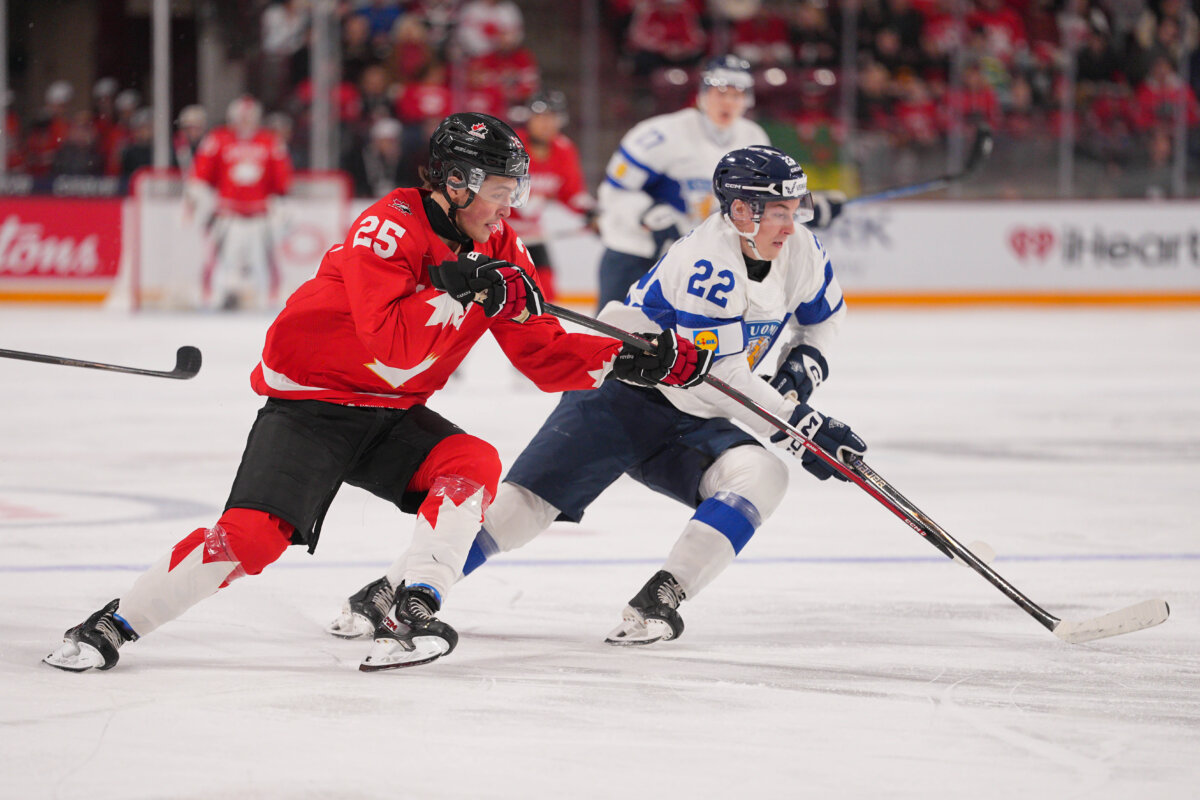
I thought of this when the roster for Canada’s men’s Olympic hockey team was announced last week and again this week when the Czech team finished second at the World Junior Hockey Championships after defeating Canada, which has now failed to reach the final for three straight years, in the semifinals of a tournament it once dominated.
How are the two related? According to a corporate seminar I attended shortly after the turn of the century that involved David Foot, one of the authors of the book “Boom, Bust & Echo,” if you want to know what’s going to happen in the future or find explanations for what is happening today, pay attention to demographics and birth rates.
It was no coincidence—or so the theory goes—that, a generation after the post-Dubcek baby boom, Czechia won the hockey gold medal at the Nagano Olympics with perhaps its greatest generation ever of players. According to legend, that triumph in 1998 inspired a celebratory crop of infants nine months afterwards while, more significantly, Czechia experienced a bit of a baby boom a few years later. Spurred on by economic prosperity and social optimism, that phenomenon peaked in 2008, directly upstream from its teams’ resurgent performances in the world junior tournament where, ending an 18-year drought, they have now won medals in four consecutive championships.
In contrast, Quebec’s fertility rate has been in decline for at least two generations, recently going as low as 1.33 babies per couple, compared to the 1950s rate of 4.1 that produced a crop of “Flying Frenchmen” on the ice, such as Guy Lafleur, Serge Savard, Guy Lapointe, Jacques Lemaire, Marcel Dionne, Mario Lemieux, etc. The replacement rate is generally stated as 2.1 children per female which means that, without immigration or a change in this pattern, Quebec will pretty much depopulate itself by the end of this century, having rejected the high birth rate strategy employed to keep its francophone culture alive for the preceding 250 years.
That’s one way of explaining why there was only one Quebecer on Canada’s 2026 world junior team: Caleb Desnoyers. In British Columbia, where housing prices are discouraging couples from parenthood, the birth rate is Canada’s lowest—a shocking 1.02 in 2024. So, unless that changes, don’t expect to see much representation from that province on Canada’s national sports teams—or anywhere else for that matter—20 years from now.
As for the upcoming winter Olympics in Italy, this will be the first time since 1952 that there will be no Quebec players on Canada’s men’s Olympic hockey team. In that year, when the Olympics were still purely amateur, the Edmonton Mercurys represented the country and won gold in Oslo, Norway. As for the women, the 2026 team will be named Jan. 9 and there are two Quebecoise (half the average in this century’s previous Olympic squads) considered likely to earn a spot on the squad.
Bruce Dowbiggin, a hockey author of some note, has explored the issue on his website and suggests several other factors involved in the long-term decline of Quebec’s ability to generate hockey talent at the level it did in the 20th century. Significantly, he notes la belle province still provides the National Hockey League with 6.1 percent of its players, second only to Ontario.
“To find the root of the drought,” Dowbiggin writes, “you can look at the draft where only one French Canadian player—Alex Lafreniere—has been taken No. 1 overall since Marc-Andre Fleury was taken in 2003.”
“There are many other factors in play,” he adds. “Access to elite training, cost, warmer winters eliminating outdoor rinks, cultural preferences for other sports—all play some part. But as we said in 2019, ‘the days when (Montreal) Canadiens GM Sam Pollock getting the top two French Canadians as protected draftees was considered a steal are long gone.’”
Dowbiggin knows a lot more about hockey than I do and there’s no doubt he makes some good points.
But the fundamentals of life can’t be ignored. If you want to reproduce a tradition of excellence, the first thing you have to do is reproduce. It’s just a matter of choice.
Editor’s note: This article has been updated regarding “Boom, Bust & Echo” co-author David Foot. The Epoch Times regrets the error.
Views expressed in this article are the opinions of the author and do not necessarily reflect the views of The Epoch Times.
 Friends Read Free
Copy
Facebook
Tweet
Friends Read Free
Copy
Facebook
Tweet