Commentary
President Donald J. Trump’s 20-point plan for peace in Gaza is remarkably historic.
It is the result of an ongoing effort for Middle Eastern peace that made substantial progress in the first Trump administration.
Since he was a presidential candidate in 2015, Trump has developed a network of key contacts throughout the region.
When necessary, he has used military force (such as bombing Iranian nuclear facilities in June). But whenever possible, he has used diplomacy to build ties that could lead to peace.
There is now a Trumpian network across the Middle East. It extends from Saudi Arabia to Egypt. Many countries now have genuine ties to Trump—and express a willingness to work with him to try to bring peace to the region.
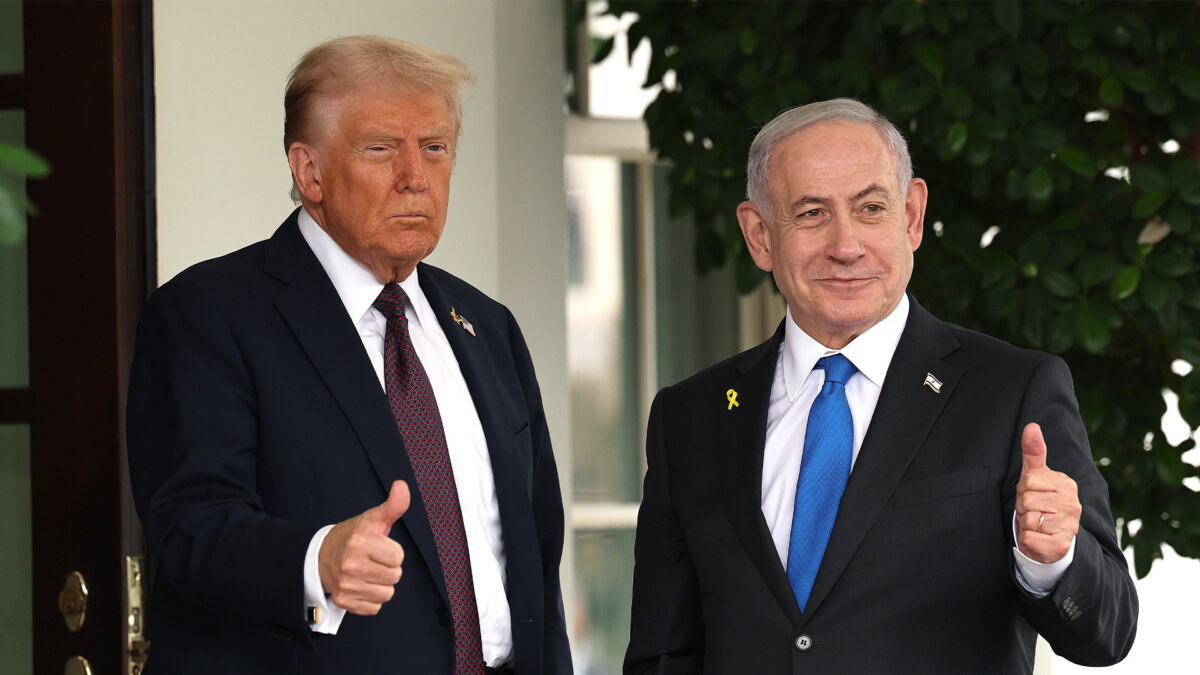
In the process of cultivating these relationships, Trump has developed a deep understanding of the Middle East. Having Israeli Prime Minister Benjamin Netanyahu call the leadership of Qatar from the Oval Office is an expression of this understanding. The Israelis had recently killed leaders of Hamas with a bombing raid in Qatar. The Qataris have consistently played both sides of the struggle (they host Hamas while they also host the largest American military base in the entire region).
However, Qatar had made clear that it would only help implement the peace plan if the Israeli prime minister apologized and promised not to bomb Qatar again. Trump understood the nuances. Netanyahu would be criticized by his own coalition back home for reaching out to Qatar. Yet Trump still convinced Netanyahu to get on the phone. It was the price of getting the peace process moving, and Trump ensured that everything would come together.
The announcement of the peace plan for Gaza was so dramatic and well thought out that two of the most respected media commentators on foreign policy felt compelled to write positively—keep in mind neither of them is a conservative or a fan of Trump.
New York Times senior foreign policy analyst Tom Friedman wrote: “President Trump’s 20-point peace plan for Gaza is a smart plan for turning a bomb crater into a launchpad for peace—for taking a terrible, terrible war in Gaza and leveraging it to not only create a new foundation for solving the Israeli–Palestinian conflict, but also for normalization between Israel and Saudi Arabia, Lebanon, Syria and maybe even Iraq as well. If it succeeds, it could even set in motion a much-needed transformation in Iran.”
The Washington Post’s David Ignatius concurred with Friedman’s positive analysis.
He wrote: “Donald Trump first talked about Israeli–Palestinian peace as ‘the deal of the century’ when he ran for president in 2016. That peace is still a long way off, but Trump laid a strong foundation for it with his plan Monday to end the nightmare war in Gaza and begin the transition to a stable ‘day after’ there.”
As Ignatius importantly pointed out, Trump has been building this strong foundation since he first became president. The peace plan has evolved and gathered support over a nine-year process.
Great credit goes to Jared Kushner, who was the architect of then-candidate Trump’s speech to the American Israel Public Affairs Committee during the 2016 presidential campaign. Kushner then developed the proposal to have Trump’s first foreign visit be to Saudi Arabia, where the Saudi king gathered representatives from Muslim countries. Kushner has worked steadily in the Middle East. In many ways, he knows more about the personalities and cross pressures of the region than the traditional establishment experts.
Similarly, Steve Witkoff has brought to the American diplomatic system the same deal-making savvy that served him so well in business. Once again, Trump’s willingness to rely on experienced, successful outsiders has achieved more than three generations of establishment experts.
Finally, former UK Prime Minister Tony Blair’s steady dedication to finding a road to peace between Israel and its neighbors has paid off. Trump’s faith in him was made clear in the peace proposal announcement.
The news media can’t seem to cover developments over time—nor can it grasp the broader picture behind immediate events. The result is a storyline of narrowly focused Polaroids about various activities in the Middle East. Individually, they lack context. Together, the Polaroids create a dynamic movie that must be viewed broadly.
Trump has been engaged in Middle Eastern peace for his entire presidency (both terms). He still is. It was no accident that he spoke hopefully about a possible agreement with Iran. While the president has proven he can use and support military force, he has also proven that he understands Winston Churchill’s notion that “meeting jaw to jaw is better than war.”
This is an important, historic moment that has been nine years in the making. There is more to come for Middle Eastern peace.
Now, eight years later, they realize they are dealing with one of the most powerful figures in modern history. They watched the all-out effort to destroy him—and his phoenix-like rise from the ashes. In nine months, he has begun to reshape every aspect of international trade, patterns of migration, and military capabilities. He’s doing this while also restoring the values and principles of American nationalism.
Trump’s speech clearly outlined the core principles that will define the world he is determined to grow.
Every American—and foreign leader—should study Trump’s recent address to understand the principles that will shape the future. He plans to replace the failures of the past and achieve the golden age in which a practical America leads.
From Gingrich360
Views expressed in this article are the opinions of the author and do not necessarily reflect the views of The Epoch Times.
 Friends Read Free
Copy
Facebook
Tweet
Friends Read Free
Copy
Facebook
Tweet