
Commentary
Russia and China are preparing for a major territorial grab in Antarctica, where the United States and its allies are totally unprepared for a confrontation. And it’s about access to resources: oil and krill, for starters.
The “scramble for Antarctica” reached a significant milestone in early 2025 as Russia announced that it had discovered a major oilfield in the British Antarctic Territory, holding at least 511 billion barrels of oil, more than any other oilfield in the world.
The Russian oil search was illegal under the 1959 Antarctic Treaty. Still, the Russian geological survey ship, operated by the state-owned Rosgeo, conducted surveys in the Weddell Sea region, claiming the research to be “purely scientific” in nature. It clearly was not. But then, Russia and the People’s Republic of China (PRC) have been dramatically expanding their attempts to claim rights in Antarctica in recent years, despite not being proximate to or facing states on the continent.
The Antarctic Treaty stipulates that any claims to resource exploitation remain frozen, and Russia holds to its stance that it will abide by the treaty and is peacefully conducting research. But the implications and temptations are clear. And Chile and Argentina—which, like Russia, are among the 56 signatories to the Antarctic Treaty—have already begun to express interest in the oil find in an area where the two states have overlapping claims on the British Antarctic Territory.
Tobias Ellwood, a UK Conservative Member of Parliament (Bournemouth East constituency) and former chairman of the UK Parliamentary Defence Select Committee, noted that in May, “Russia’s blatant prospecting for oil in Antarctica (in breach of the Treaty) reflects [Russian President Vladimir] Putin’s growing confidence to test international norms, with every expectation the West will be too risk-averse to stand in its way.”
He may be right. Neither the UK nor its ally, Australia—which has the greatest territorial claims on the Antarctic continent—has committed major resources or political interest in the region for some time, while the PRC and Russian projection there has increased substantially.
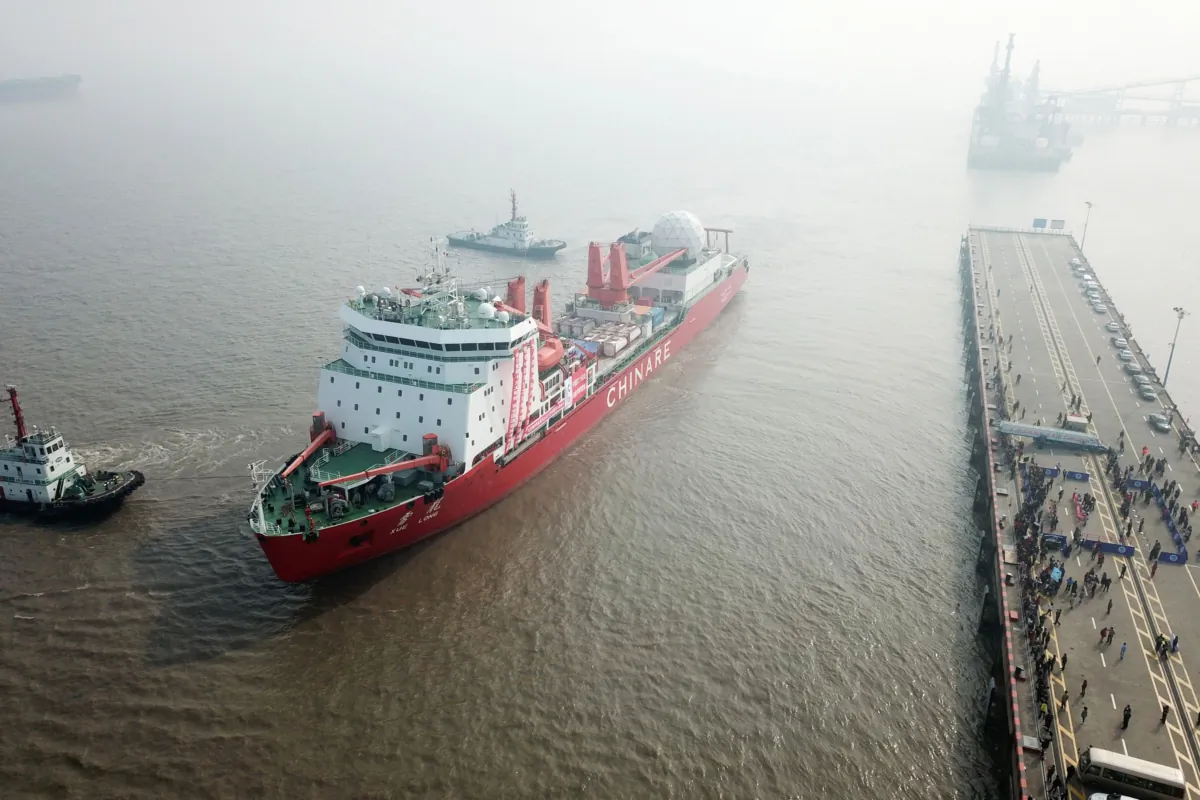
The U.S.-based trade publication, The Maritime Executive, on March 2 published a report indicating that China and Russia were cooperating at an increasing pace in Antarctica, despite their mutual tensions in other areas. This cooperation ostensibly was for the purpose of geophysical surveys to understand the Earth’s climate system, but it clearly had broader implications and unstated objectives. In 2025, the publication noted, “China and Russia have held talks over joint drilling in Antarctica.”
“In September [2024], Beijing and Changchun city hosted international conferences on Antarctic exploration, which were attended by Russian specialists from the Federal Agency for Mineral Resources (Rosnedra). With the successful geophysical survey this year [2025], the cooperation is likely to extend to other sites in East Antarctica,” the report reads.
It also noted that “China and Russia have consistently opposed plans to expand marine protected areas (MPAs) in the Southern Ocean, which would mean reduced areas available for krill fishing.”
Significantly, the Russian and PRC moves are not just to “test international norms”; they are in keeping with a widespread trend—now championed by U.S. President Donald Trump—to move to a new era in which old—and theoretically outmoded—treaties and agreements are sidestepped or renegotiated. And Washington itself, although widely engaged in Antarctica and a driving force in establishing the 1959 Antarctic Treaty, is as anxious as Moscow and Beijing to retain its options in exploiting the continent’s resources should the situation change.
But what is significant is that South Africa, New Zealand, and Australia have not stepped up their strategic positioning with regard to Antarctica. Under the Antarctic Treaty, they have significant claims to territory there, especially Australia, given its broad southern exposure to the continent and the principal guardian of the northern limits of the Southern Ocean.
The most recent Antarctic Treaty Consultative Meeting (ATCM) was held in Milan, Italy, from June 23 to July 3 and was attended by representatives from all signatory states to the Antarctic Treaty. The meeting was hosted by the Italian Foreign Ministry and attended by 450 delegates, but it focused mainly on environmental issues, developing a framework for Antarctic tourism, and so on. It failed to address the imminent change in the strategic nature of the Antarctic continent and the probable negation of the treaty.
Indeed, it was almost as though the ATCM was totally divorced from the reality of Antarctic historical engagement or the involvement of the earlier regional powers or even the United States, Russia, China, or India, four of the main strategic out-of-region powers determined to dominate the continent.
The ATCM Secretariat, in fact, has only been operating since 2004 and has its permanent base in Buenos Aires, Argentina, but most critical strategic actions regarding Antarctica by powers with bases on the continent are taken without reference to the largely academic engagement of the secretariat. Indeed, the most significant activities regarding the region are conducted in a climate of deep secrecy.
The treaty demands that all bases on the Antarctic continent or ice-shelf be available at all times for visits by inspectors from other states. The five PRC bases, however, while most have airfields, have their runways blocked to prevent visits by other powers.
The trend toward the abandonment of older international treaties and transnational supervisory organizations had already moved a long way toward completion, even by the time Trump began his second presidential term on Jan. 20. He has significantly accelerated the process, hoping to structure—and for the United States to dominate—a new international architecture.
That means that the “scramble for Antarctica” is now well underway, and, because it is theoretically the last terra nullius—legally, “no man’s land”—open for domination, the contest may well move rapidly toward demonstrations of force or forceful projection of claims.
The Russian “oil discovery” means that the strategic stakes are high and potentially holds the prospect of China’s escape from its high level of foreign oil dependency. Given its assumed role of protector of Antarctica, why has Australia—with the largest claims to the continent—not specifically geared much of its maritime and air power capabilities toward dominance of the Antarctic region?
Australia’s posturing of the PRC as its main military threat should therefore also require Canberra to defend against presumably imminent PRC attempts to breach the Antarctic Treaty to control mineral and fisheries resources there.
Australian Prime Minister Anthony Albanese did not challenge PRC officials on this matter during his July visit to Beijing. But then, there was no domestic voter or media pressure on him in Australia to do so.
Views expressed in this article are the opinions of the author and do not necessarily reflect the views of The Epoch Times.
 Friends Read Free
Copy
Facebook
Tweet
Friends Read Free
Copy
Facebook
Tweet