
Commentary
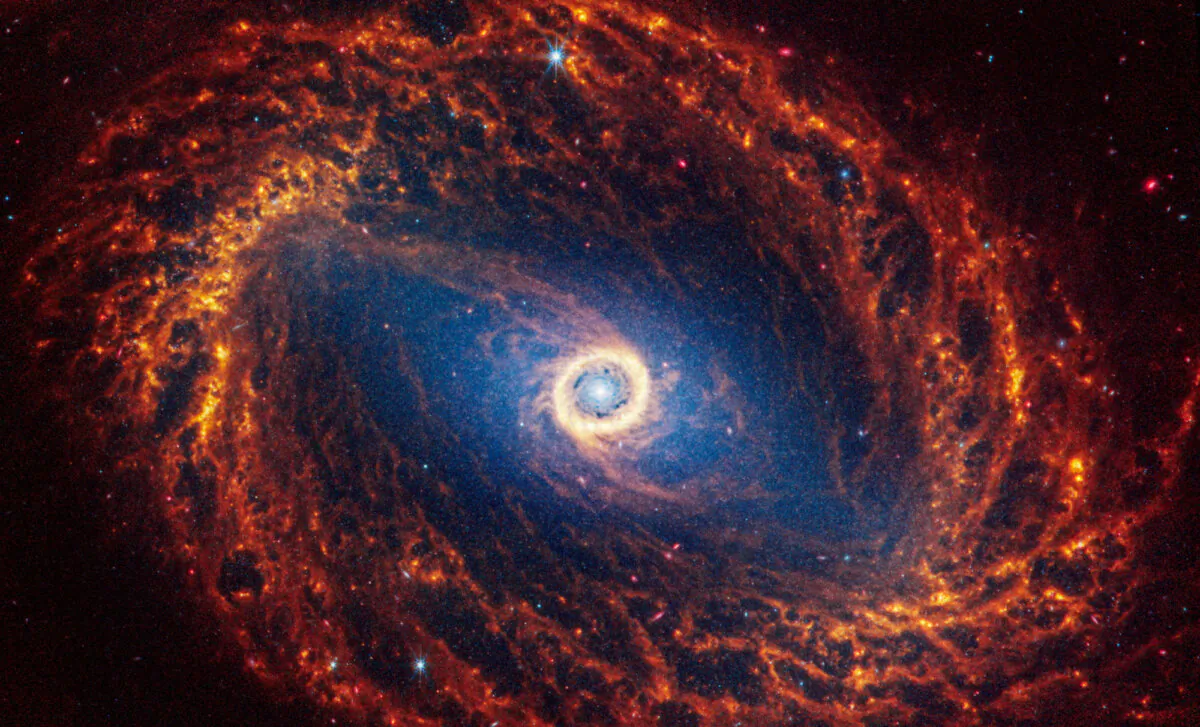
The images are breathtaking.
With the release of new observations from the James Webb Space Telescope, humanity is seeing the universe with a clarity that would have been unimaginable a generation ago. Galaxies that once appeared as faint smudges now emerge as vast, structured systems. Clouds of gas glow in delicate layers. Even regions around black holes, once spoken about only in theory, are now visible, shaping the matter around them.
It’s hard to look at these images without feeling a sense of awe. They are real observations, gathered from light that has traveled for billions of years through space before reaching us. They are a triumph of human ingenuity. And yet, for some scientists, these images are somewhat unsettling because what they reveal is not what was ever expected.
For decades, we assumed that a better vision of the universe would bring a better understanding of it. As our telescopes improved, we believed the story of the cosmos would finally come into focus. Instead, the opposite has happened.
One of the most surprising discoveries enabled by the James Webb telescope is that galaxies appear to have formed much earlier than existing models predicted. Structures once thought to require immense stretches of time seem to have emerged quickly. The early universe, long imagined as simple and sparse, now appears complex and highly organized.
Black holes tell a similar story. The James Webb telescope has shown that they are far from rare cosmic oddities. They are common and influential, shaping entire regions of space.
Then there is the largest mystery of all. Most of the universe appears to be made of matter we cannot directly see. Dark matter and dark energy are the names we give to unknown forces inferred only through their effects. And they seem to dominate everything. Despite decades of increasingly sensitive instruments, we still don’t know what they are.
The sharper our tools have become, the clearer our images grow, and yet the larger the unknown seems to be.
This pattern isn’t limited to astronomy.
On the opposite end of the scale of vision, microscopes have revealed astonishing complexity within a single cell. What was originally expected to be a simple structure has been revealed as an intricate system working in coordination at incredible speed.
Particle accelerators uncover new particles and forces yet still leave us wondering why the laws of physics exist in the form they do or why the universe holds together.
Consciousness remains a mystery. Although we can describe what the brain does, we have no idea why awareness exists at all.
Again and again, our tools show us how things behave, but not why they exist.
For a long time, we assumed that if we just looked harder, zoomed in farther, or zoomed out farther, those questions would eventually answer themselves. We imagined that understanding was waiting just beyond the next increase in resolution. But the past few decades have only revealed that we are surrounded by unprecedented detail, design, and data, yet the deepest mysteries remain further away than ever.
While our instruments are extraordinarily good at measuring and mapping, they were never designed to tell us what it means. We have no scope of vision that can tell us why physical laws exist, or why they are so finely balanced. It is a limit on our mechanical pursuits that we should have long seen coming.
Historically, the most important breakthroughs didn’t come from sharper tools alone, but from shifts in perspective, from people asking new questions about what they were already seeing. Observation has always mattered, but insight and wisdom used to matter more.
Today, we are exceptionally good at gathering information, yet we are less certain about what it all adds up to. That should give us pause. Because what the James Webb telescope ultimately reveals is not randomness, but remarkable precision. At every scale it brings into view, we see balance, structure, and fine-tuning so exact that even small changes would unravel entire systems. From galaxies to matter itself, reality appears carefully designed.
We live in a culture that often treats knowledge as a form of control. We assume that understanding means mastery, and that mastery naturally follows clearer vision. But the universe keeps resisting that idea. The more precisely we see, the more clearly we encounter limits, not just in our theories, but in what our tools can give us.
Our new instruments of vision are extraordinary. They allow us to see farther than any generation before us. But none has taken us any closer to answering our biggest questions. They have simply shown us that answers won’t come from new tools or a narrower vision. They have shown us where the answers won’t come from.
That doesn’t diminish human achievement. It puts it in perspective.
At some point in history, we began to expect our tools and machines to seek meaning for us, to provide not just information but also significance. And when they failed to do that, again and again, instead of pausing to reflect, society instead decided that meaning itself must be an illusion, and that human perception was the problem.
But what if the opposite is true?
What if human vision—shaped by experience, memory, conscience, and awe—is the perfect design and an essential way of knowing? What if reflection, reverence, and even prayer are ways of perceiving reality that no instrument can replace?
In that sense, the James Webb telescope isn’t just extending our vision—it’s restoring perspective.
If these new images are teaching us anything, it’s not that the universe is finally explained. It’s that reality is more carefully made, more grand, and more mysterious than we could have ever imagined.
Perhaps the next step forward isn’t to look harder, but to look more wisely, to relearn how to see with the eyes we have been given. And perhaps that is what vision, at its highest, has always been for.
Views expressed in this article are the opinions of the author and do not necessarily reflect the views of The Epoch Times.
 Friends Read Free
Copy
Facebook
Tweet
Friends Read Free
Copy
Facebook
Tweet