

Commentary
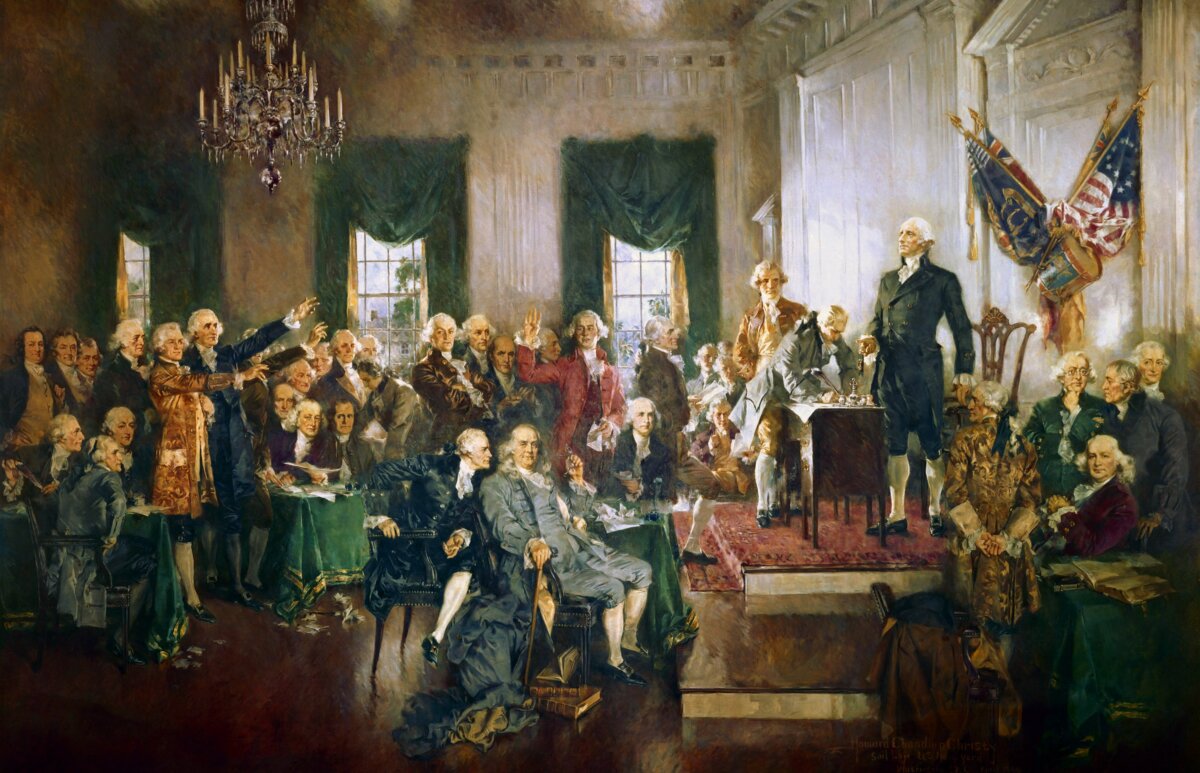
Almost 240 years ago in Philadelphia, 39 delegates to the Constitutional Convention signed the U.S. Constitution on Sept. 17, 1787. Eleven years after the adoption of the Declaration of Independence, this historic event marked an important milestone for our remarkable experiment in self-government.
Symbolically, the signing of the U.S. Constitution was the reward for years of toil and bloodshed in the Revolutionary War. It sent a signal to the world that the principles of freedom, liberty, and elected government would prevail. In a more practical sense, it was the official start of the United States government.
For more than two centuries, states and local governments recognized Constitution Day in various ways. Some named it “I am an American Day” or “Citizenship Day.” However, it was not federally recognized until 2004, when former Sen. Robert Byrd offered the Constitution Day amendment to the fiscal year 2005 Consolidated Appropriations Act.
Along with officially observing Constitution Day nationwide, this amendment mandated that all federal employees receive training materials on the U.S. Constitution when they begin public service—and each following year on Sept. 17.
Additionally, the law required that: “[e]ach educational institution that receives Federal funds for a fiscal year shall hold an educational program on the United States Constitution on Sept. 17 of such year for the students served by the educational institution.”
This educational requirement is vitally important, but it has not been enough to preserve our Constitution and history. Unfortunately, we have historically done a poor job of teaching the next generation of Americans about our nation’s founding, our core principles, and the great sacrifices of those who forged our exceptional country.
According to the National Assessment of Educational Progress (NAEP), student scores in American history have declined in recent years—and aren’t statistically different from scores first recorded in 1994. In 2022, the most recent NAEP scores, only 13 percent of eighth-grade students were proficient in American history. This was two percentage points lower than the 2018 assessment.
It is clear our national approach to education has not been leading us in the right direction. This is exactly why President Donald J. Trump and his administration are working to break Americans out of the top-down education system which has been failing us. On his first day in office, President Trump reinstated the 1776 Commission, which he convened during his first term. As some forces in America seek to revise and reimagine our history—and teach our children to denigrate and condemn our nation’s founders—the 1776 Commission was formed to develop and promote patriotic education, so young Americans learn about the achievements, ideals, and great sacrifices that made our country great.
President Trump is also working to give states more say over what and how their children learn. It’s clear from national scores that Washington has failed to improve—or even provide—American educational achievement.
Just this week, President Trump announced the Department of Education would be redirecting funding from failing programs to support charter schools and efforts which teach students American history and civics. This includes $137 million for American history and civics education programs, and $60 million for charter schools.
As President Ronald Reagan once said, “The education our children deserve is the kind no American should be deprived of, for it’s the basic instruction in what it means to be an American.”
The best way to preserve and defend our Constitution is to ensure every American learns about those who wrote it, the sacrifices they made, and the ideals and values on which they founded our extraordinary country.
From Gingrich360
Views expressed in this article are the opinions of the author and do not necessarily reflect the views of The Epoch Times.
 Friends Read Free
Copy
Facebook
Tweet
Friends Read Free
Copy
Facebook
Tweet