
Commentary
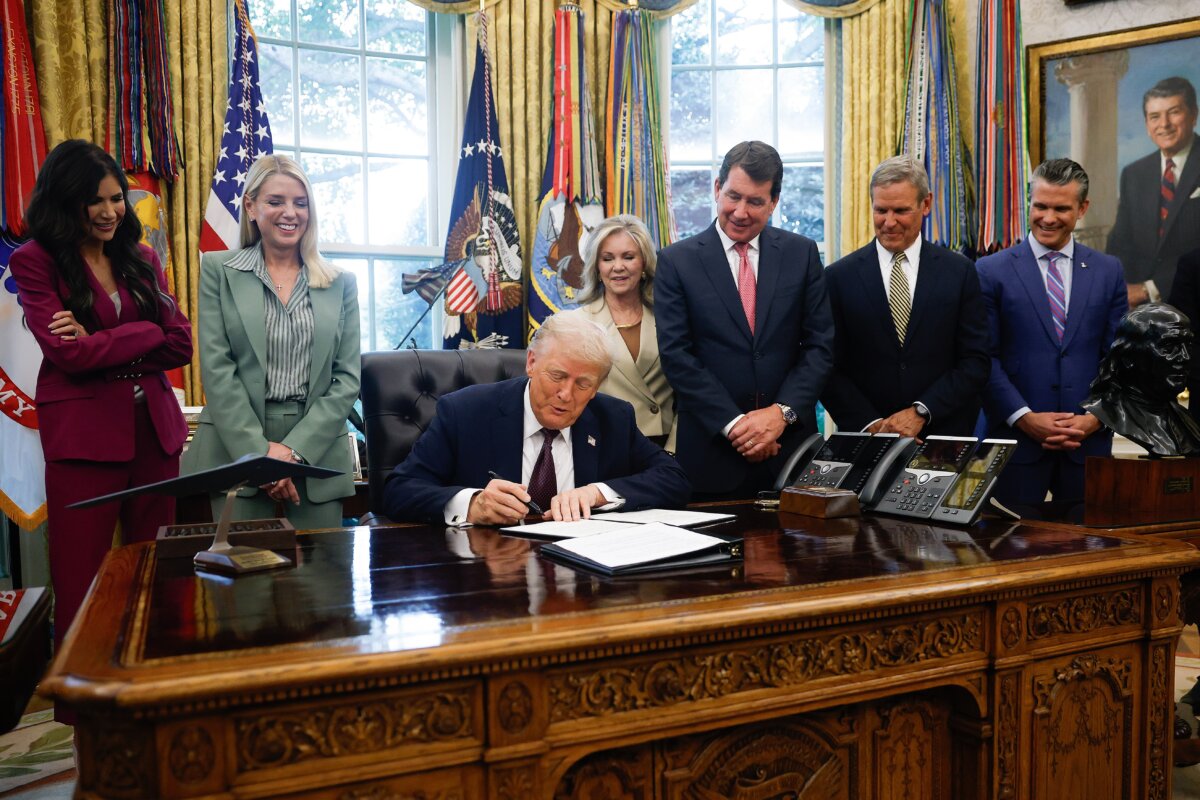
The second Trump presidency is, by all accounts, a robust and aggressive one in terms of executive actions taken and major U.S. policy shifts enacted to date.
For example, as of Sept. 30, 2025, President Donald Trump has signed 209 executive orders, 52 memoranda, and 91 proclamations since his inauguration on Jan. 20, 2025.
This compares with the 64 executive orders, 25 executive memoranda, and 51 proclamations signed during the equivalent period in 2021.
However, simple numbers of executive actions taken do not tell the tale of the potentially far-reaching impacts of major policy shifts enacted so far in the second Trump presidency.
Let us examine the issue.
Major Executive Actions Affecting US Domestic Policy
Many of Trump’s initial actions delivered on his 2024 campaign promises, which included the following major executive orders:
The first executive order (No. 14147) signed by Trump on Jan. 20 is titled “Ending the Weaponization of the Federal Government” and is intended to end years of “weaponizing the legal force of numerous Federal law enforcement agencies and the Intelligence Community against … perceived political opponents in the form of investigations, prosecutions, civil enforcement actions, and other related actions.”
The second executive order (No. 14148) signed is titled “Initial Rescissions of Harmful Executive Orders and Actions.” It rescinded 78 executive orders signed under the Biden administration that implemented so-called diversity, equity, and inclusion (DEI) policy actions throughout the federal government, as well as other administration actions deemed harmful or dangerous to the American people, including radical climate actions, COVID-19 pandemic policies, and open borders enablement.
Later, executive order No. 14151 directed further actions in “Ending Radical and Wasteful Government DEI Programs and Preferencing” in hiring and promotion decisions. And executive order No. 14170 restored merit as the principle criterion in federal hiring and promotion.
The third executive order (No. 14149) signed is titled “Restoring Freedom of Speech and Ending Federal Censorship.” It directs actions to “secure the right of the American people to engage in constitutionally protected speech” while at the same time ending any taxpayer-funded efforts that would “unconstitutionally abridge the free speech of any American citizen.”
The fourth executive order (No. 14150) signed dealt with U.S. foreign policy. Titled “America First Policy Directive to the Secretary of State,” this executive order directed a unified federal government approach to U.S. foreign policy that “shall champion core American interests and always put America and American citizens first.”
These four orders were focused on depoliticizing federal agencies and represented a virtual reversal of Biden administration policies. Trump went much further in pursuing long-held policy goals and objectives with subsequent executive actions. Some of the more important actions taken since January include the following:
- An order expediting the permitting and leasing of energy and natural resource projects in Alaska; another focused on opening up other federal lands, including the U.S. continental shelf, for resource exploitation; and a third declaring a national energy emergency aimed at expediting government approval processes to “facilitate the identification, leasing, siting, production, transportation, refining, and generation of domestic energy resources.”
- An order eliminating the “electric vehicle (EV) mandate” and promoting consumer choice unbiased by government subsidies.
- Two orders designating certain groups as terrorists. Eight Latin American groups were designated as foreign terrorist organizations and specially designated global terrorists under executive order No. 14157, while a presidential document signed on Sept. 22 designated the far-left extremist group Antifa as a domestic terrorist organization.
- An order establishing the Department of Government Efficiency (DOGE), with the goal of modernizing federal technology and software to maximize governmental efficiency and productivity while identifying potential cost savings and reductions in redundant programs and personnel and other inefficiencies. By some estimates, more than $214 billion has been saved through DOGE actions, but further progress has been stalled through various lawsuits, congressional pushback, and other disruptions.
- Various orders aimed at restoring U.S. immigration laws and closing the southern border, including orders realigning refugee admissions with national security and public safety, securing the border through physical barriers and policy actions, and reprioritizing the mission of the U.S. military to protect the sovereignty and territorial integrity of the United States. As a direct result, Customs and Border Protection reported that illegal crossings of the southern border in June “dropped to the lowest level ever recorded.”
- An order recognizing two sexes, male and female, that are “not changeable and are grounded in fundamental and incontrovertible reality.” This and other actions removed federal subsidization of transgender surgeries and other so-called gender transition programs around the country.
- An order directing the heads of all agencies to ensure that the total incremental cost of all new regulations in 2025 “shall be significantly less than zero,” as determined by the director of the Office of Management and Budget. Note: A key goal of Trump’s America First economic policy is government deregulation.
- An order directing the declassification and release of federal records of the assassinations of President John F. Kennedy, Sen. Robert F. Kennedy (D-N.Y.), and the Rev. Dr. Martin Luther King Jr.
- An order enforcing the Hyde Amendment, which ended the forced use of federal taxpayer dollars to fund or promote elective abortion (a reversal of Biden administration policy that provided taxpayer dollars to Planned Parenthood et al. for abortions).
- An order keeping men out of women’s sports (and locker rooms). This is an 80-20 issue in America, with nearly 80 percent saying they don’t want men playing in women’s sports.
‘America First’ Foreign and National Security Policy
Just as there was a sea change in U.S. domestic policy, Trump enacted a series of major shifts in U.S. foreign and national security policy. In addition to the America First foreign policy executive order No. 14150, there were other important executive orders issued.
An order directed a reevaluation of all U.S. foreign aid and assistance programs to ensure their alignment with “America First” policies. Combined with revelations exposed by DOGE, this led to a major restructuring of U.S. foreign aid programs under the State Department, including the termination of the U.S. Agency for International Development on July 1 and the termination of open-ended nonprofit organization administration of U.S. foreign assistance programs. This was the most significant and far-reaching change to U.S. foreign aid programs ever implemented.
An order established high military standards for “troop readiness, lethality, cohesion, honesty, humility, uniformity, and integrity” that resulted in the termination of individuals with gender dysphoria. A companion order restored meritocracy by eliminating race-based and sex-based discrimination “within the Armed Forces of the United States.” One direct result is that, as of July, all of the U.S. military services had met their recruiting goals for 2025 (in contrast, the services had difficulty reaching those goals during the previous administration).
An order established the Make America Healthy Again Commission, charged with aggressively combating the critical health challenges facing our citizens, including the rising rates of mental health disorders, obesity, diabetes, and other chronic diseases. The commission is examining dietary standards, vaccinations, food additives, and other items affecting the health and well-being of Americans.
An order established “a sovereign wealth fund to promote fiscal sustainability, lessen the burden of taxes on American families and small businesses, establish economic security for future generations, and promote United States economic and strategic leadership internationally” (economic national security).
A series of orders reevaluated U.S. involvement and/or support for international organizations and realigned that involvement with America First principles. Those orders affected U.S. involvement in the World Health Organization; international environmental organizations; the International Criminal Court; the U.N. Human Rights Council; the U.N. Educational, Scientific, and Cultural Organization; and the U.N. Relief and Works Agency for Palestine Refugees in the Near East.
Various orders have directed the implementation of a reciprocal tariffs regime that is realigning international trade in accordance with America First macroeconomic policies. That regime was projected by the Congressional Budget Office in August to deliver $4 trillion of total deficit reduction from 2025 through 2035, according to the Committee for a Responsible Federal Budget (the ultimate in economic national security).
Concluding Thoughts
The pace of Trump’s executive actions and the resulting benefits delivered to the American people have put him on course to be one of the most consequential presidents in U.S. history.
And then there are his actions affecting world peace on multiple fronts:
- Facilitated a Cambodia–Thailand cease-fire and resource-sharing pact in February.
- Helped avert an India–Pakistan nuclear war in May.
- Signed a Congo–Rwanda peace accord in the White House on June 27, ending 30 years of war between the two countries.
- Facilitated an Israel–Iran cease-fire in the two countries’ 12-day war after having ordered a B-2 airstrike that destroyed three Iranian nuclear facilities.
- Facilitated a joint declaration for full peace, border delimitation, and economic integration between Azerbaijan and Armenia in August, ending nearly 40 years of conflict.
- Continued efforts to end the Russia–Ukraine war, including direct meetings with Russian President Vladimir Putin, Ukrainian President Volodymyr Zelenskyy, and European leaders.
- And finally, negotiated a cease-fire in the Gaza Strip.
Whew! The U.S. political class and the legacy media are having difficulty in keeping up with the actions of a 79-year-old president. Who knows what might be accomplished over the next 39 months of his presidency?
Views expressed in this article are the opinions of the author and do not necessarily reflect the views of The Epoch Times.
 Friends Read Free
Copy
Facebook
Tweet
Friends Read Free
Copy
Facebook
Tweet