Commentary
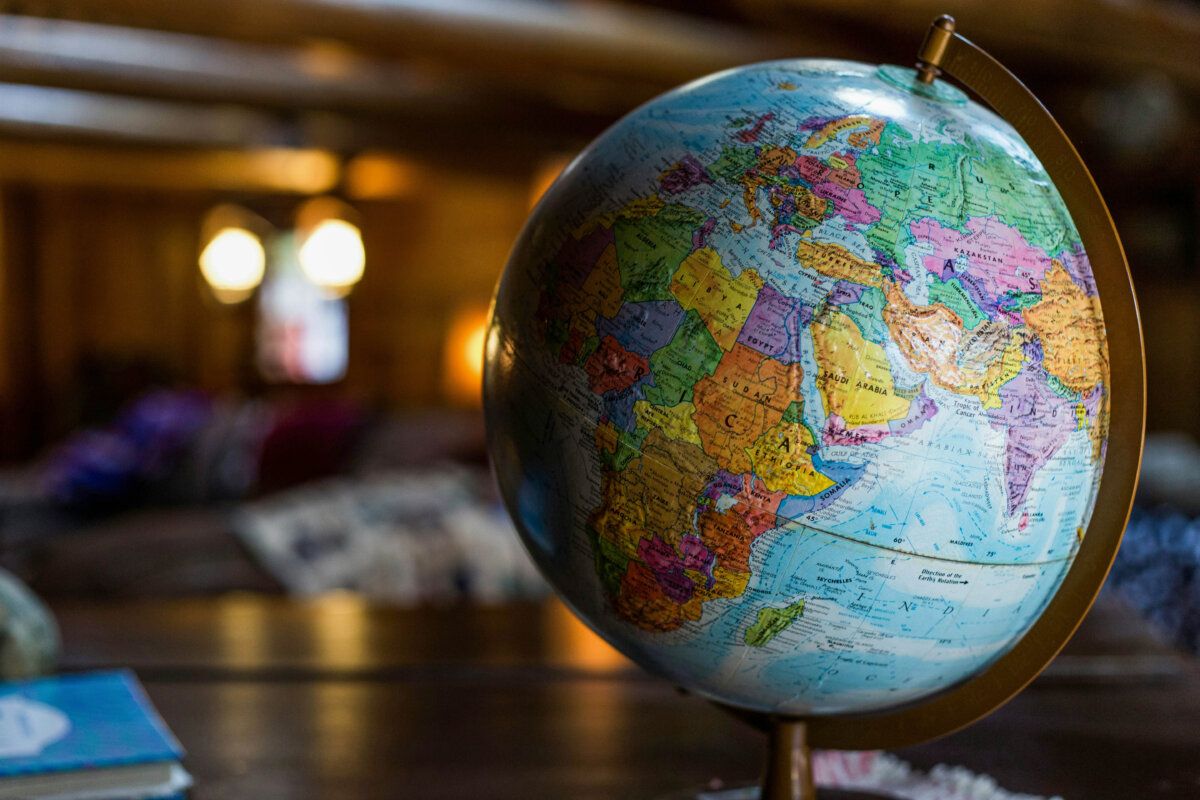
If you’ve abandoned the idea of owning a globe because there’s technically no need for one, or if you’ve never owned one, I urge you to reconsider. Everyone should have one—young, old, and in between. For those who crave the big picture, looking at a globe helps you grasp where you are in the universe. Big ideas suddenly make sense—why the sun rises in the east and sets in the west, why tides ebb and wane, why seasons change, why time passes—it’s all there.
Sure, you can watch videos about Earth, but having a globe to ponder and touch makes you feel kind of like God—no blasphemy intended: We should all feel as Apollo 8 Commander Frank Borman felt the first time he saw the Earth rise from behind the moon and said, “This must be what God sees.”
It just seems that when you’ve got a globe—the whole world literally in your hands—you really begin to understand that all of this existence stuff didn’t just happen randomly.
Isaac Newton observed, “This most beautiful system of the sun, planets, and comets could only proceed from the counsel and dominion of an intelligent and powerful Being.”
The beauty of the globe lies in its simplicity: a three-dimensional representation of Earth that invites touch, rotation, and wonder. Flat maps warp the world to fit a page—the common Mercator projection makes Greenland look as big as Africa, when Africa is actually more than 14 times larger; polar regions get stretched massively.
A globe, however, is a three-dimensional sphere that generally preserves the planet’s actual curved shape—like the deep blue arc of its own shadow that rises behind you as the sun sets. The moment you realize that soft rosy glow arching above earth’s shadow is the Belt of Venus—sunlight scattered through the upper atmosphere—your world opens up to all the mysteries you never knew you never knew.
This generation takes for granted its Space Age inheritance: a rapidly growing, open-access library of stunning Earth imagery—from Apollo 17’s famous “Blue Marble” to high-resolution satellite maps documenting deforestation and changing ocean patterns. We’re the first armchair astronauts—peering through the spacecraft window, staring in awe at a fragile blue dot suspended in the void: our only refuge in the vast unknown.
Yet it’s that same sense of wonder that inspired our Founding Fathers with their comparatively rudimentary knowledge of planet Earth. George Washington, ever the practical leader, ordered a large terrestrial globe from London just four months after becoming president in 1789. He requested a globe “of the largest dimensions and of the most accurate and approved kind now in use.” And he didn’t want it to decorate the parlor or library; he consulted it regularly for trade routes, diplomacy, and strategy, then placed it in his study at Mount Vernon after retirement.
Remarkably, his original globe has remained at his Virginia home, conserved and on display today as a testament to how leaders once turned to such geographic tools for a clearer view of the world.
In today’s advanced world, geography has fallen by the wayside. It’s rarely taught as a stand-alone subject in schools anymore, and many states don’t require it for high school graduation. Basic skills such as reading maps and identifying location on a globe get squeezed into other classes (such as social studies), where they might only get a quick mention.
Author Robert C. Thornett recently wrote an article criticizing modern academic geography for drifting from its traditional focus on regional studies toward GIS tech, “climate fanaticism,” and “woke agendas.” He points out that college curricula often treat it as an afterthought.
“At a minimum, world regional geography should be required for all college students,” he wrote. “An orientation to the world is as essential as orientation on campus.”
The results manifest in everyday life: I’d guess most Americans can’t confidently point to places on a map, let alone explain why they matter. Not knowing where Greenland is—that massive Arctic island strategically positioned between North America and Europe—means overlooking its outsized strategic role in the 21st century: its position for monitoring Russian and Chinese military and economic activity in the far north, its proximity to key sea routes, and its rare-earth minerals, which are critical for modern technology.
Not knowing Israel’s location—surrounded by Arab neighbors (Egypt, Jordan, Lebanon, Syria)—likely leaves many unable to fully comprehend basic news headlines. Protesters shouting “from the river to the sea” should be asked: “What river? What sea?”
And not knowing Venezuela’s place on the South American continent ignores the bigger picture of its ongoing crisis, the resulting migration waves, and the ripple effects on U.S. borders and energy markets.
When people don’t know where they are in relation to the rest of the world, current events seem far away and abstract. But they’re not—they shape everything from national security to prices at the pump.
In the end, a globe is more than mere decoration—it’s a hands-on reminder that the world is connected and every headline hits close to home. Everyone should own a globe, if only to remind us that we share one fragile humanity—bound together under God’s watchful gaze.
Views expressed in this article are the opinions of the author and do not necessarily reflect the views of The Epoch Times.
 Friends Read Free
Copy
Facebook
Tweet
Friends Read Free
Copy
Facebook
Tweet