
Commentary
Xi Jinping is orchestrating a deliberate, decade-long, multidomain campaign of ideological and political reconsolidation, drawing conscious inspiration from Mao Zedong’s methods while adapting them to a modern surveillance state. The comparison is imperfect but illuminating, and the trend lines are unmistakably moving in one direction—tighter, deeper, and more permanent.
Let us examine that premise in some detail.
Comparing Goals and Objectives
Mao’s Cultural Revolution (1966–1976) was driven by overlapping imperatives: personal revenge against Party rivals who had sidelined Mao after the Great Leap Forward catastrophe, a genuine ideological obsession with destroying “revisionism” and purifying Marxist-Leninist doctrine, and a desire to prevent the Soviet-style “restoration of capitalism” that he believed was corrupting the Chinese Communist Party’s revolutionary mission. The “Four Olds”—old ideas, culture, customs, and habits—were to be annihilated. It was fundamentally a campaign against the Party itself, using mass mobilization outside the Party to destroy it and then rebuild it under Mao alone.
Xi’s campaign shares the purification impulse but inverts the institutional strategy. Xi is not trying to destroy the Chinese Communist Party (CCP)—he is trying to own it entirely and make it permanently subservient to his personal ideological vision.
He aims to eliminate political rivals and potential successors under the banner of anti-corruption, reinvigorate communist ideology as a legitimizing force, and ensure absolute Party control over the military, judiciary, media, internet, academia, and civil society. Further, he wants to build a technological control apparatus capable of governing 1 billion people indefinitely, without democratic consent, while ruthlessly suppressing all dissent.
Where Mao wanted to burn the house down and rebuild it, Xi wants to renovate it from the inside and never leave.
The Military Purges
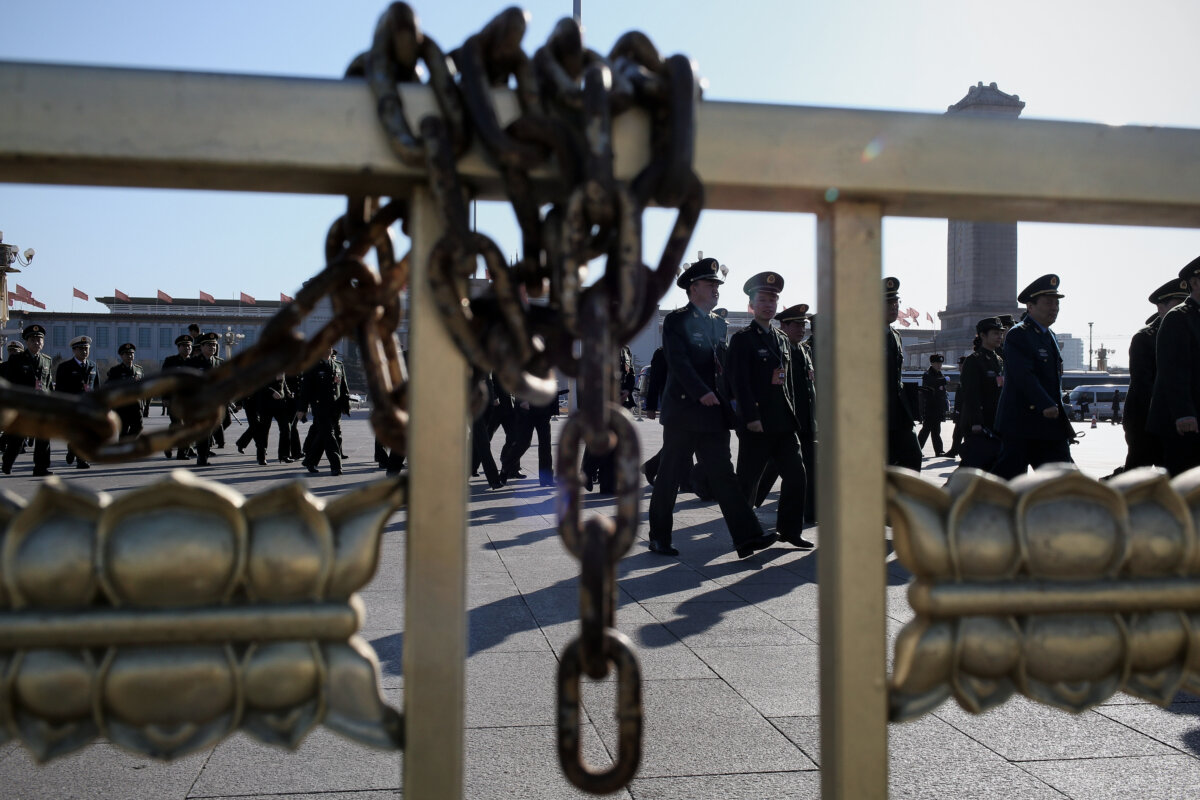
This may be the most dramatic parallel to the Cultural Revolution. Mao systematically destroyed the existing military leadership through denunciations and realignment. Xi has pursued something structurally similar—although with forms rather than Red Guards.
According to data from the Center for Strategic and International Studies, 36 generals and lieutenant generals have been officially purged since 2022, with an additional 65 officers missing or potentially purged.
The parallel to Mao is stark, but with a crucial difference. Mao used Red Guards—a revolutionary mob outside the party—to topple his enemies. Xi uses the Central Military Commission’s Central Discipline Inspection Commission, the National Supervisory Commission, and formal legal proceedings. The outcomes are similar (removal, imprisonment, erasure of biographical records), but Xi’s method maintains a veneer of procedural legitimacy that Mao disdained while hiding its devastating effects on those purged from public scrutiny.
Ideological Indoctrination
Mao’s Cultural Revolution sent Red Guards into schools, closed universities, burned textbooks, and dispatched educated youth to the countryside for “reeducation through labor.” Xi’s equivalent is subtler but structurally analogous: the systematic ideological reengineering of China’s entire education system from kindergarten to postgraduate study.
New Chinese textbooks introduced in 2024 emphasize Xi Jinping Thought, traditional Chinese culture, and national security as mandatory subjects in all nine grades of compulsory education. The subject formerly known as “ideology and politics”—briefly renamed “morality and law”—remains a mandatory course promoting the ideology of the ruling communist party.
The differences from Mao are significant but not reassuring. Mao’s educational disruption was chaotic and ultimately self-defeating—an entire generation lost years of schooling. Xi’s approach is methodical, cumulative, and designed to produce a generation that internalizes Party ideology as natural truth rather than recognizing it as imposed belief. Xi’s actions amount to cultural genocide when applied to minority populations such as the Tibetans and especially the Uyghurs.
Internet Control and the ‘Locknet’
Mao had no internet to contend with; he controlled information through physical seizure of printing presses, public book burnings, and the omnipresent Little Red Book. Xi has built something far more comprehensive—a layered digital control architecture that ChinaFile has termed the “Locknet.”
The Locknet project describes a multi-layer censorship system operating simultaneously at the “meatspace” level (real-world enforcement), the service level (corporate censorship by Chinese platforms), and the network infrastructure level (the Great Firewall itself). The system has expanded beyond domestic surveillance to what researchers describe as “the Locknet leaking out”—Chinese digital control methods influencing governance globally.
This represents something qualitatively new, even by Chinese censorship standards. Mao could burn a book once. Xi’s system is aimed at making certain thoughts technically impossible to communicate—an ambition Mao never had the tools to pursue—coupled with a surveillance and security apparatus that can rapidly identify and punish dissenters.
The ‘Lifetime Accountability’ System
One of the most chilling innovations of Xi’s campaign—with no precise Maoist analog—is the concept of “lifetime accountability.” Officials who implement policies can be held responsible for negative outcomes years or even decades later, even after retirement. This has created a culture of extreme caution and paralysis among bureaucrats, who increasingly avoid making decisions that could later be used against them.
This is distinct from Mao’s approach, in which the terror was acute and immediate; Xi’s system creates chronic, low-level anxiety that functions as a permanent loyalty enforcement mechanism. The physical punishment is real (for example, forced organ harvesting); however, its existence is carefully squelched by the regime. Officials who do nothing wrong can still be purged if a past decision is later reframed as ideologically incorrect—a design feature, not a bug.
Key Similarities
Cult of personality: Mao’s image was ubiquitous; his Little Red Book was mandatory. Xi has mandated “Xi Jinping Thought” at every level of education and governance, enshrined it in the constitution, and removed presidential term limits. The 20th Party Congress elevated Xi to a status approaching Mao’s—the phrase “two establishments” (两个确立) declaring Xi’s “core” status and the authority of Xi Thought is now a mandatory catechism.
Loyalty tests: Both leaders have used mass campaigns to force officials and citizens to publicly demonstrate ideological alignment. Mao’s “struggle sessions” have been replaced by Xi’s “democratic life meetings,” political study sessions, and compulsory online courses in Xi Thought.
Purging potential successors: Mao systematically destroyed anyone who might succeed him or challenge his primacy—Liu Shaoqi, Lin Biao, Deng Xiaoping (temporarily). Xi has done the same with Bo Xilai, Sun Zhengcai, and effectively anyone with a political base independent of his patronage.
Attacking intellectual independence: Mao targeted professors, artists, and writers as enemies of the revolution. Xi has “securitized” universities, tightened academic freedom, expelled foreign-trained scholars, and subjected research collaboration with foreign institutions to national security review. Securitization under Xi means that dissent, critical inquiry, or exposure to non-CCP-approved ideas (e.g., “Western” values) is portrayed as a threat to “ideological security,” regime legitimacy, and national unity and is punished by harsh measures, including long prison terms.
Extending control into civil society: Mao sought total penetration of Chinese social life. Xi’s social credit systems, facial recognition networks, mobile phone monitoring, and mandatory app installations represent the same totalizing impulse equipped with 21st-century tools, with swift punishment of all nonconformance and dissent.
Key Differences
Institutional method: This is the most fundamental distinction. Mao deliberately bypassed and destroyed party institutions to achieve his goals. Xi works through party institutions—the discipline commission, the courts, the military structure—even while hollowing out their independence. This makes Xi’s revolution more durable and less catastrophic in the short term but potentially more permanent in the long term.
Economic context: Mao’s Cultural Revolution was indifferent to economic destruction—indeed, it deliberately attacked the “expert” class and economic management. Xi is conducting his revolution while trying to maintain and grow a $17 trillion economy, manage a severe property sector crisis, sustain export-led growth under U.S. tariff pressure, and keep urban employment stable. As a result, the ideological tightening that serves Xi’s political goals creates the business uncertainty, capital flight, and talent emigration that undermine his economic goals. Xi cannot escape the economic conundrum that communism presents to the modern Chinese economy.
Scale of direct violence: The Cultural Revolution killed between 1 million and 2 million people through direct violence, with millions more dying from famine and persecution-related causes. Xi’s campaign has not produced mass physical violence. The coercion is real—disappearances, torture in detention, executions for corruption, forced confessions—but it operates through institutional mechanisms that maintain a surface appearance of lawfulness. International institutions have great difficulty in collecting and verifying statistics associated with the ongoing domestic oppression of minorities.
Technology: Mao had propaganda posters, loudspeakers, and political cadres. Xi has AI-powered facial recognition, mobile surveillance, social credit scores, the Great Firewall, mandatory phone inspection at checkpoints, and now a legal framework criminalizing any tool that could evade surveillance. This is not merely a difference of degree—it represents a qualitatively different form of social control that makes Mao’s surveillance apparatus look primitive.
International ambition: Mao’s China was largely isolated, poor, and focused on internal revolution. Xi’s China is the world’s second-largest economy, deeply integrated into global supply chains, and actively projecting influence abroad. Xi’s ideological campaign has a global dimension—through the United Front Work Department, Confucius Institutes, surveillance of overseas diaspora communities, and the export of Chinese surveillance technology to authoritarian governments—that Mao’s Cultural Revolution never approached.
Concluding Thoughts
Xi’s revolution is Mao’s Cultural Revolution with three critical upgrades: institutional sophistication replacing mob chaos, digital surveillance replacing physical coercion, and economic preservation replacing deliberate destruction. It is slower, more methodical, and more durable. It is also, in some ways, more cruel and total—because where Mao’s Red Guards burned books and then exhausted themselves, Xi’s surveillance apparatus never sleeps, never tires, and is more efficient than Mao’s methods.
The most important difference may be this: Mao’s Cultural Revolution eventually failed on its own terms. The chaos became unmanageable, the economy collapsed, and after Mao’s death, the Party reversed course under Deng. Xi has explicitly studied that failure. He is trying to achieve Mao’s goals of permanent personal ideological dominance—while avoiding the institutional chaos and economic destruction that brought Mao’s revolution to its end.
Whether Xi will succeed is the defining political question of the coming decade.
Views expressed in this article are the opinions of the author and do not necessarily reflect the views of The Epoch Times.
 Friends Read Free
Copy
Facebook
Tweet
Friends Read Free
Copy
Facebook
Tweet