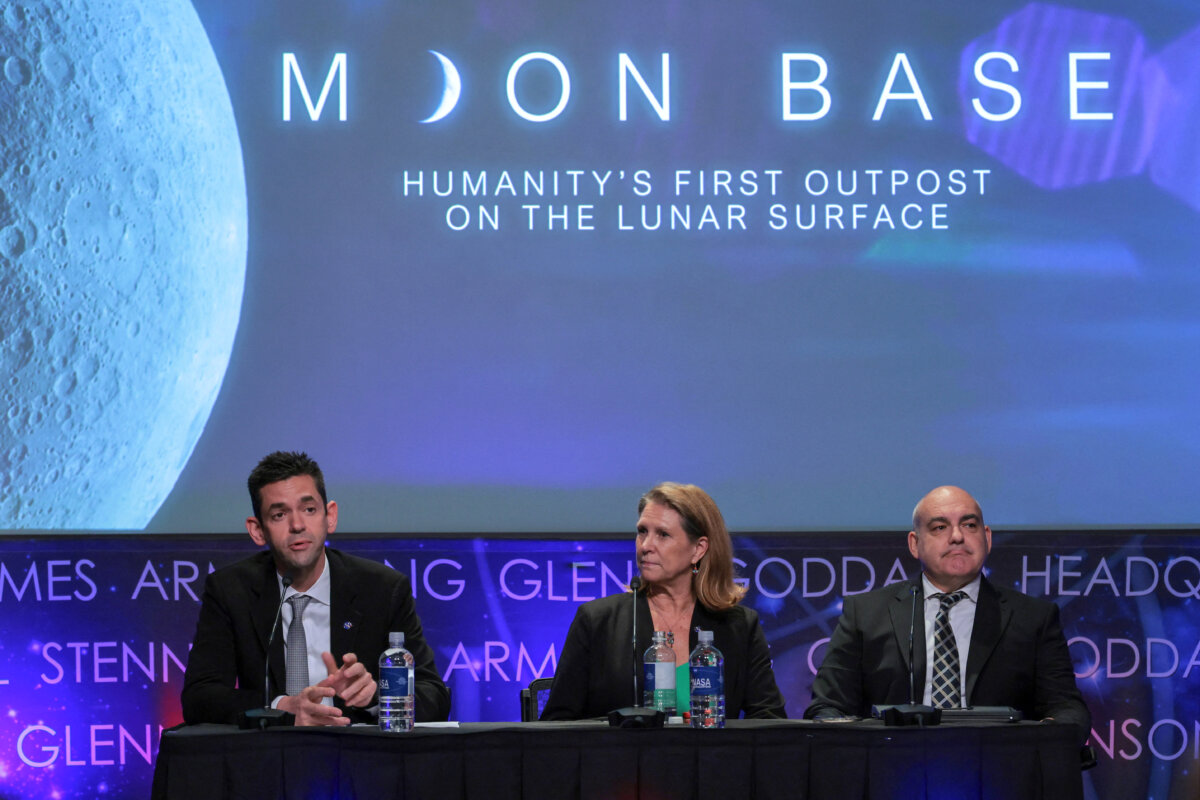

NASA unveiled new details on Tuesday regarding its plans to build a base on the moon, with the first phase set to send robotic landers and rovers to the lunar surface by this year.
According to NASA, the first phase of its moon base plan would involve missions to scout locations in the lunar South Pole region, conduct scientific research, and test system capabilities.
“The moon base will be America’s and humanity’s first outpost on another celestial world,” NASA administrator Jared Isaacman said in a May 26 statement.
“Every mission, crewed and uncrewed, will be a learning opportunity as we return to the lunar surface, build the infrastructure to stay, and master the skills required to live and operate in one of the most demanding and dangerous environments imaginable,” he added.
The first mission will be privately funded, with Blue Origin, an aerospace manufacturer owned by Amazon founder Jeff Bezos, providing landers that will be used to deliver NASA payloads to the lunar surface. The mission is slated for launch no earlier than fall this year.
NASA said the second mission, targeted for launch later this year, will use a lander from Astrobotic—a Pennsylvania-based company—to send more than 1,100 pounds of cargo and a moon rover to the lunar surface.
Speaking at a May 26 press conference, Isaacman said this mission will help develop the capabilities needed to support future lunar terrain vehicles, autonomous operations, and logistics.
The third mission aims to expand NASA’s scientific understanding of the lunar surface. This launch will carry the first payload selected through NASA’s Payloads and Research Investigations on the Surface of the Moon initiative, according to the space agency.
The mission will also carry payloads from the European Space Agency and the Korea Astronomy and Space Science Institute. Isaacman said this shows that the future of lunar exploration is an international effort.
“Moon Base II and III are targeted to launch before the end of 2026. Now, these represent the first of more than a dozen missions we expect to announce through the balance of this year as we return, build the base, and never give up the moon again,” he said.
NASA said in March that its lunar base plan, estimated to cost $20 billion, will happen in three phases, with the first focused on unmanned landings under the Commercial Lunar Payload Services program.
Phase two of the program will establish “semi-habitable infrastructure” supporting recurring but limited astronaut operations, and phase three will introduce the infrastructure needed to support continuous human presence on the moon, according to the space agency.
NASA also aims to increase the frequency of its flagship Artemis crewed lunar missions. The fourth Artemis mission is slated to fly in early 2028 and be the first manned lunar landing since 1972.
T.J. Muscaro contributed to this report.
 Friends Read Free
Copy
Facebook
Tweet
Friends Read Free
Copy
Facebook
Tweet