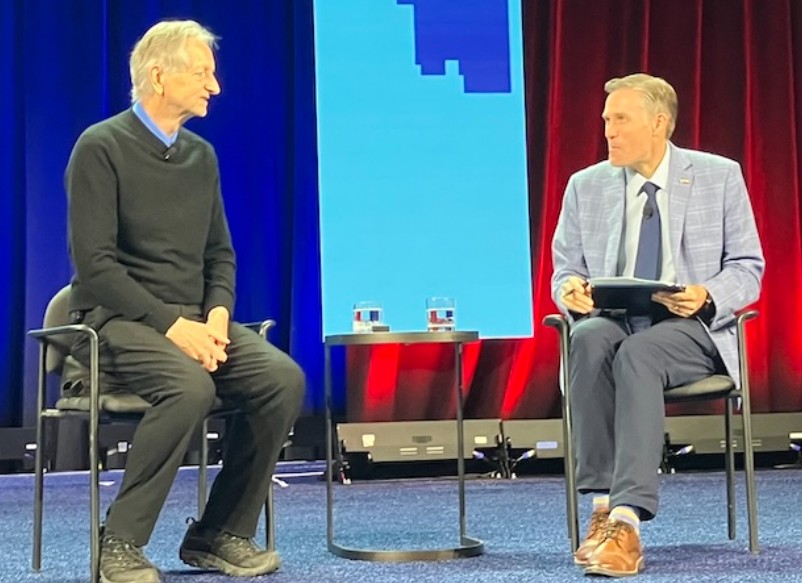

CHICAGO–There would be less need for “guardrail” regulations that enrich lawyers and aggravate state-federal disputes if artificial intelligence developers “steered” large language models into being “intrinsically good,” according to 2024 physics Nobel Prize laureate Geoffrey Hinton.
“You can model good behavior,” he said during a July 28 presentation at the National Conference of State Legislatures’ (NCSL) 51st Annual Summit. “It’s the same with a child.”
AI products, such as chatbots, “ought to be trained as agents that exhibit good behavior,” he said.
California’s 2024 House Bill 1047 was a first attempt with “tiny little teeth” to tentatively require such a standard, he said, but Gov. Gavin Newsom vetoed it.
“I don’t know why,” Hinton said, “but I have my suspicions.”
Before any large language model is released, “you should be required to tell the governments, both local and federal, what the tests you did and what the results were” that confirm it has been trained to distinguish between good and bad, with a verifiable goal to be good, he said.
Hinton, a British Canadian University of Toronto professor emeritus referred to as the “Godfather of AI,” said he is better at explaining AI than explaining government AI policy.
But governments must prepare for employment disruption and do better at protecting privacy and property, he told a packed general session during the July 27–29 summit at Chicago’s McCormick Place attended by nearly 7,700 lawmakers, legislative staffers, and officials from every state and U.S. territory, at least 15 nations, and the European Union.
“There’s lots of tax base [from AI development] at the same time you need lots more government money” for workforce transition, he said. “Government probably can play some role in how data is curated. A creative artist ought to have the freedom to say ‘You’re not allowed to train on my data.’”
The debate over how to regulate AI, and who should regulate AI, could be productive by emphasizing a different word, just like how a large language model can be “intrinsically good,” Hinton said.
“Innovation is the accelerator. Regulation is the steering wheel. You won’t want to make very fast cars without a steering wheel,” he said. “Regulation is not to stop progress; it’s to cause progress to happen in the right direction; it’s to make these technology companies produce things that are good for people, not things that are bad for people.”
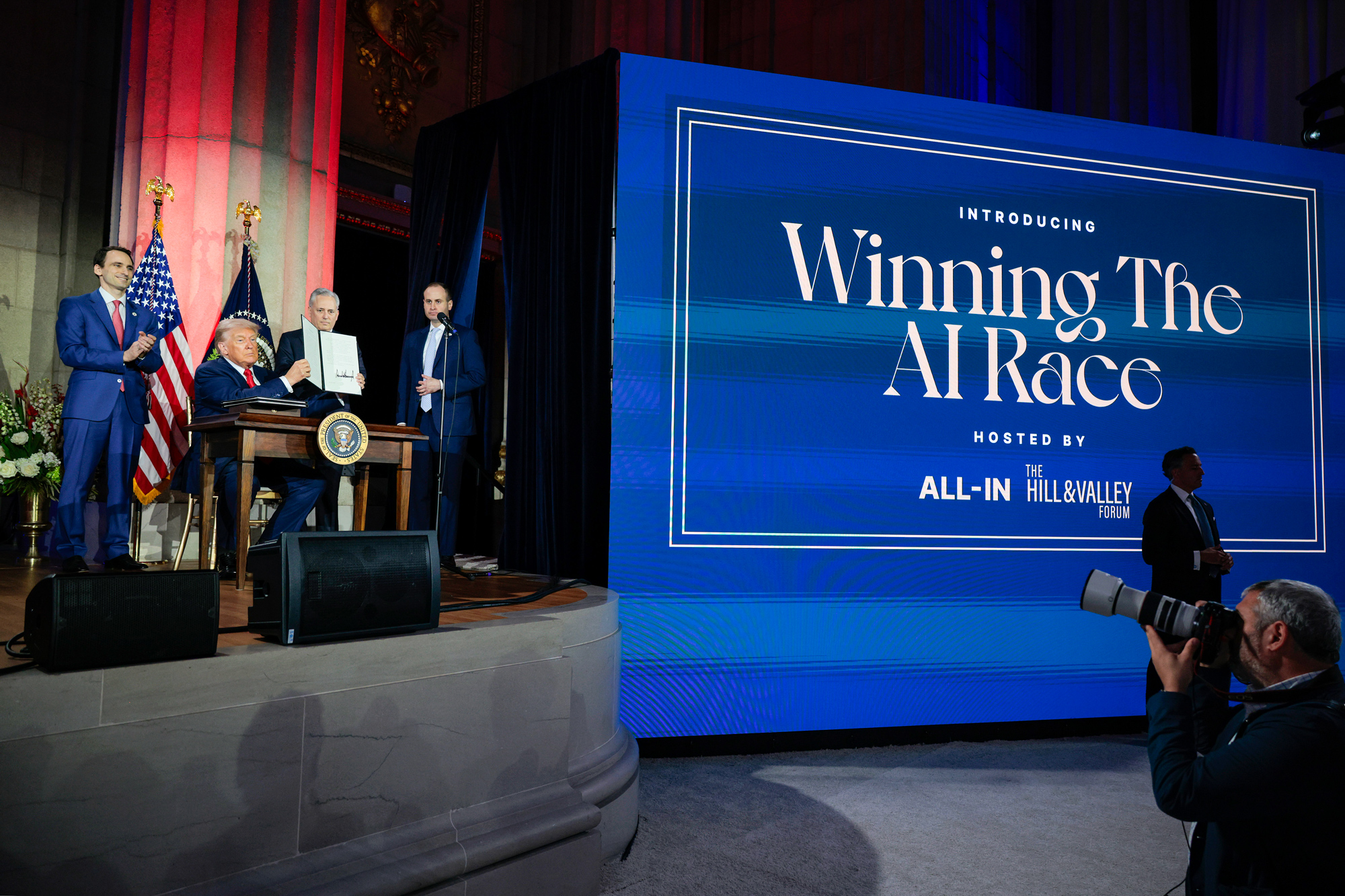 President Donald Trump displays a signed executive order during the “Winning the AI Race” summit in Washington on July 23, 2025. (Chip Somodevilla/Getty Images)
Preempting the Preemptors
AI regulatory bills have been introduced in the past three years in all 50 states, Puerto Rico, and the District of Columbia, with about 100 adopted in 38 states in 2025, and 109 approved in 29 by July 1, 2026, according to the NCSL.
Enacted state measures include laws that clarify ownership of AI-generated content, security for AI-controlled critical infrastructure, whistleblower protections, requirements for state and local agencies to publish information detailing automated decision-making tools on public websites, penalties for using an AI-powered robot to stalk or harass, and prohibitions against AI agents assuming specific licensed and certified medical professionals’ titles, such as a registered nurse.
“AI and integration in business, government, and society is happening faster than any of the substantive climate shifts in our past history. Our legislative agendas are often dominated by AI issues,” said Utah Rep. Paul Cutler, the Republican vice chairman of the Utah House Economic Development and Workforce Services Committee, who moderated the session.
“All of us in this room are trying very hard, with good intentions, to balance innovation—the good things that come from AI—with the potential risks to children, to vulnerable adults, to society at large,” he said, predicting “hundreds and hundreds” of AI bills would be filed in 2027 state legislative sessions.
States are acting, and will continue to lead, in structuring the emergent industry, Cutler said, despite Congress pondering policy measures and the Trump administration threatening to take actions that would preempt state and local governments from regulating most aspects of AI development.
President Donald Trump’s December 2025 executive order created an AI Litigation Task Force to challenge state AI laws deemed “not minimally burdensome” and directed the Department of Commerce to potentially withhold federal broadband funding for states that enact “onerous” AI laws.
Hinton said the order reflects the aims “from this lobby that says, ‘We mustn’t regulate AI, otherwise the Chinese will get ahead.’ So they want you to think of innovation as the accelerator, and they want you to think of regulations like the brake setup, and, ‘We don’t want too much regulation because it will slow down the innovation.’”
“Too much regulation” could be avoided, he said, if developers use less, more refined, and filtered data to “train up” an AI agent to prioritize good outcomes rather than producing agents “that learn everything from the internet” and know it’s a lie when told “two plus two is five,” but don’t know lying is bad since they weren’t developed to be “intrinsically good.”
It’s similar to “training your kids to read,” the ‘Godfather of AI’ said. “Your controls over it are much the same as your controls over your children. [As] with your children, you can reinforce them. You say, ‘That’s bad. That’s good.’ That has effect.”
 Friends Read Free
Copy
Facebook
Tweet
Friends Read Free
Copy
Facebook
Tweet