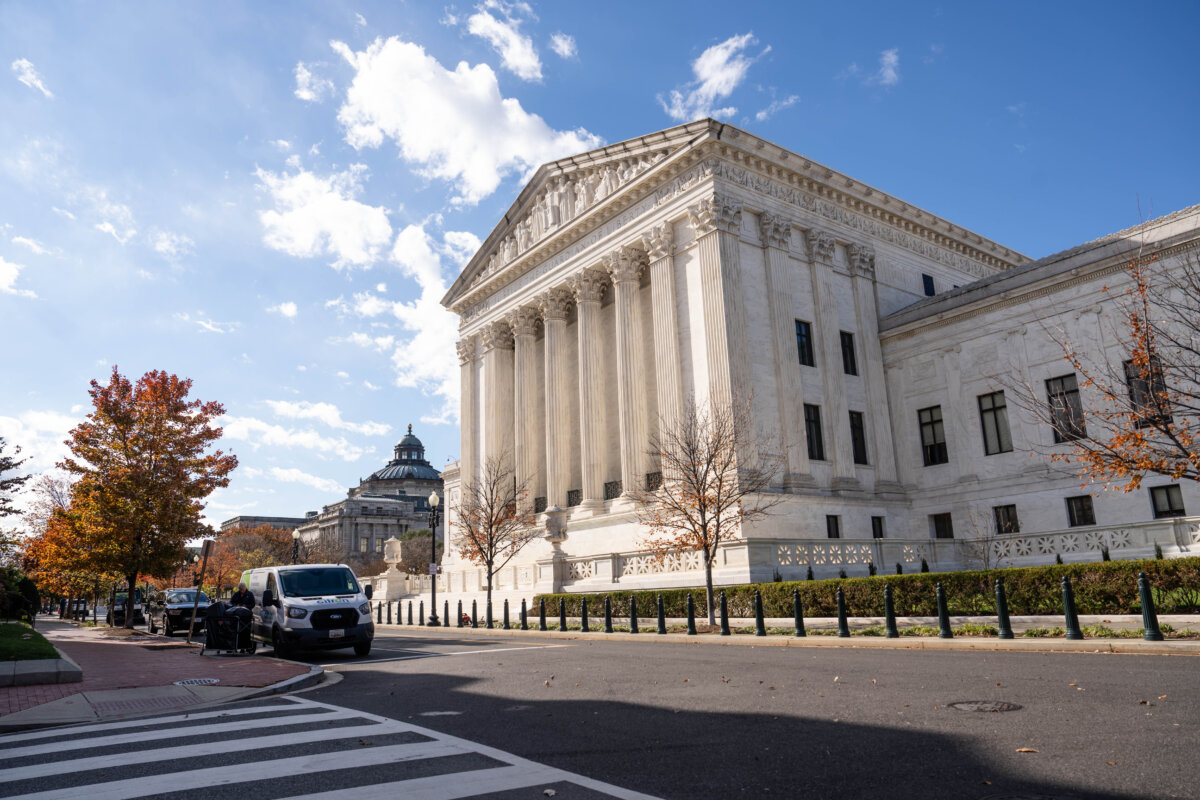

The Supreme Court heard oral arguments on Dec. 8 over whether Congress could limit President Donald Trump’s ability to fire members of the Federal Trade Commission (FTC).
The case, known as Trump v. Slaughter, focused on Trump’s firing of FTC Commissioner Rebecca Slaughter but is expected to affect a long list of other agencies.
Congress has passed laws limiting the reasons for which presidents can remove top officials from federal agencies, including the FTC. Trump has said that those types of restrictions intrude on his authority as the head of the executive branch. He has also specifically asked the court to overrule a 90-year-old precedent established in Humphrey’s Executor v. United States, which upheld Congress’s protections for FTC commissioners.
During oral arguments, the justices waded into complex questions about the separation of powers, independent agencies, and the future of the federal government.
Here are some of the main takeaways.
Slaughter Faces Uphill Battle
The Supreme Court’s landmark decision in Humphrey’s Executor held that Congress could protect FTC commissioners from removal because they exercised “quasi-judicial” or “quasi-legislative” power.
Lower court judges have cited that decision in ruling against Trump’s firings of Slaughter and other officials. However, a key question remains over what exactly constitutes quasi-legislative power as opposed to executive power.
Even if the Supreme Court doesn’t take up the administration’s request to overrule Humphrey’s Executor, it could still uphold Trump’s firing of Slaughter. That’s because some of the justices’ comments indicated they were sympathetic to Trump’s argument that the current FTC wields significantly more executive power than the FTC of the 1930s and therefore should receive less protection from Congress.
One of the examples U.S. Solicitor General D. John Sauer, arguing for the administration, cited was the commission’s ability to enter into agreements with foreign countries—albeit with approval from the secretary of state. Justice Amy Coney Barrett similarly cited this power during oral argument, while Chief Justice John Roberts said the FTC looks much different in its current form from how it did originally.
This point from Roberts followed an opinion he expressed in a 2020 case, in which he said the Supreme Court’s “conclusion that the FTC did not exercise executive power has not withstood the test of time.”
Humphrey’s Faces Cold Reception
The decision in that case, known as Seila Law v. Consumer Financial Protection Bureau (CFPB), is likely to influence the justices’ decision in Slaughter’s case. Along with other cases, Seila Law has been described by attorneys as weakening the effect of Humphrey’s Executor as a binding precedent.
In Seila Law, the Supreme Court rejected Congress’s protections for the director of the CFPB. Although it emphasized the strength of the president’s removal power, it declined to overrule Humphrey’s Executor—at least explicitly.
Roberts, who wrote the majority opinion in Seila Law, indicated that the case had gutted the power of Humphrey’s Executor.
“The one thing Seila Law made pretty clear, I think, is that Humphrey’s Executor is just a dried husk of whatever people used to think it was,” Roberts, often considered a swing vote, said during oral argument.
Barrett, another swing vote, said “there’s been an eroding of Humphrey’s Executor over the years.”
Several Justices Worry About Government Structure
A legal doctrine known as stare decisis directs courts to follow the primary reasoning in prior court decisions unless there are factors, such as a major error in a decision, indicating that they should be overruled.
On Dec. 8, multiple justices wrestled with one of the factors supporting stare decisis, known as reliance interests. More specifically, they probed how much of the current agency structures are based on the decision in Humphrey’s Executor.
“You’re asking us to destroy the structure of government,” Justice Sonia Sotomayor told Sauer.
She asked, “Where else have we so fundamentally altered the structure of government?”
Justice Elena Kagan suggested that Sauer was advocating a view of executive power that lacked reasonable limits.
“Once you’re down this road, it’s a little bit hard to see how you stop,” she said.
What Happens to Other Agencies?
Whatever the justices decide, this case could have far-reaching consequences for the federal government. Slaughter’s firing was just one of many that the justices and lower courts have considered during Trump’s second term.
Several of those firings have been temporarily allowed through more tentative rulings on the Supreme Court’s emergency docket. Slaughter’s case, however, is expected to offer final conclusions of law that could affect presidents’ ability to terminate and replace agency officials.
The hearing also came as federal courts have been wrestling with Trump’s decisions to replace vast numbers of lower-level employees in the executive branch.
“Really the question is, where does this lead?” Kagan asked.
“Employees are wielding executive power all over the place, and yet we’ve had civil service laws that give them substantial protection from removal for over a century.”
As multiple justices suggested, the reasoning the court endorses could extend to current and future agencies. The Supreme Court indicated as much when it said it would refrain from issuing a decision in the case of a fired copyright official until its decision in Slaughter’s case.
At one point, Justice Brett Kavanaugh seemed to push back on the idea that siding with Trump would lead to chaos.
Instead, he suggested that the court could “sever” and deem unconstitutional only the “for-cause” termination provision in the challenged law, rather than invalidating the structure of the FTC.
Sotomayor and Roberts asked about the possibility of removing a portion of the commissioners’ power.
“If you think they’re wielding power that is inappropriate, why don’t we sever that power instead of the removal power?” Sotomayor asked Sauer.
Balancing Power With Congress
Much of the questioning focused on the balance of power between Congress and the executive branch. Some justices asked about how far Sauer’s argument would extend in allowing removals, while others asked about the potential that Congress could go too far in limiting Trump’s authority.
For example, Justice Clarence Thomas asked what would stop Congress from insulating the secretary of commerce from removal by the president. Kavanaugh similarly asked whether Congress could convert Cabinet-level departments such as the State Department into multi-member commissions with members who are only removable for “cause.”
Justice Ketanji Brown Jackson was more critical of Sauer’s position, questioning why Congress shouldn’t be able to set limits on removals. She pointed to the necessary and proper clause of the Constitution, which allows Congress to “make all Laws which shall be necessary and proper for carrying into Execution the foregoing Powers, and all other Powers” vested by the Constitution in the government of the United States.
Congress, Jackson said, was protecting the American people by creating an independent structure within the executive branch.
“I don’t understand why it is that the thought that the president gets to control everything can outweigh Congress’s clear authority and duty to protect the people in this way,” she said.
Justice Neil Gorsuch was more sympathetic to the administration’s case and asked whether it was time for the court to rein in the legislative branch. In an exchange with Sauer, he suggested that the court should not only disallow “quasi-legislative” powers within agencies, but also limit how Congress can delegate its authority in that way.
 Friends Read Free
Copy
Facebook
Tweet
Friends Read Free
Copy
Facebook
Tweet