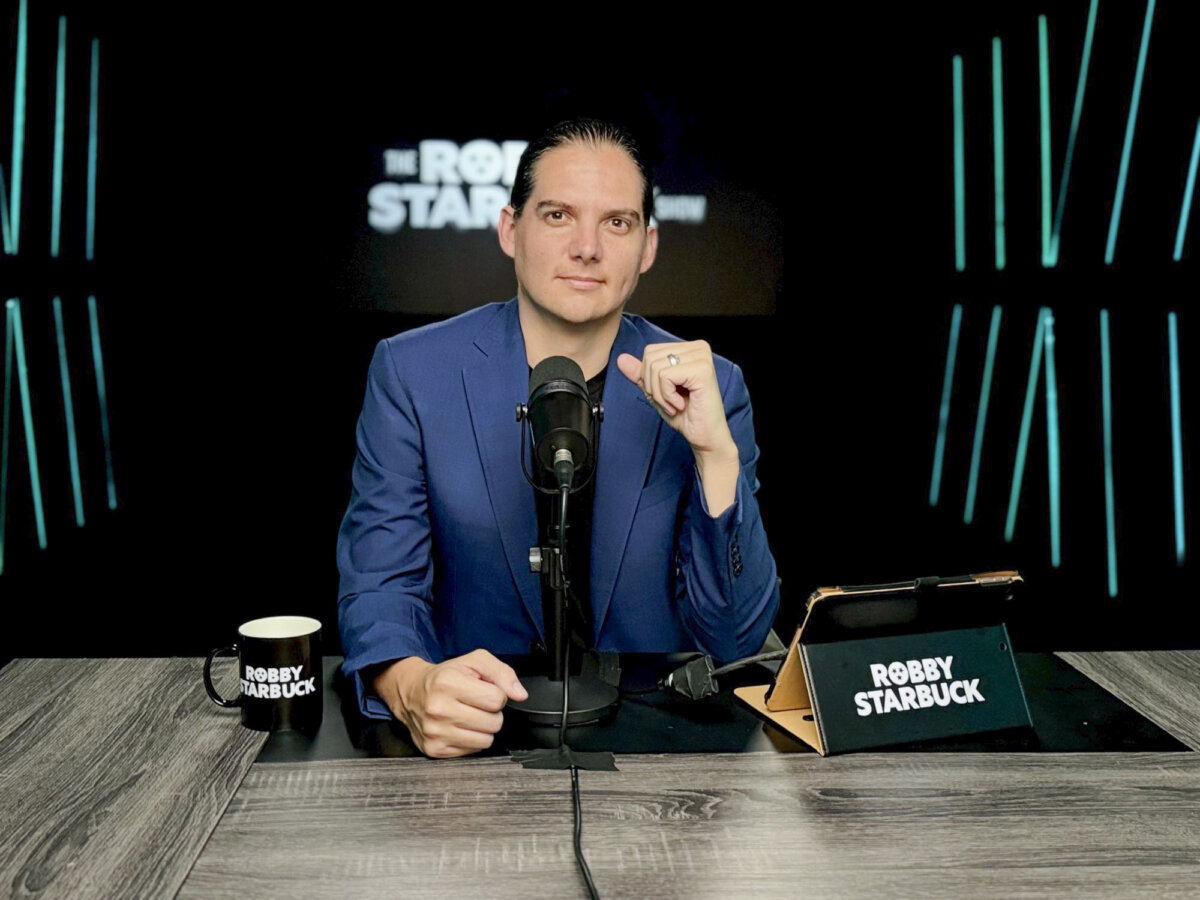

Conservative activist Robby Starbuck’s case against technology giant Google can move forward, a judge ruled on July 24, saying his accusations of artificial intelligence (AI) fabrications open “a new frontier for defamation cases.”
Delaware Superior Court Judge Meghan Adams denied Google’s motion to dismiss a lawsuit that Starbuck filed in October 2025. He settled a similar case against another tech giant, Meta, last August.
In the complaint against Google, Starbuck says that Google AI tools generated hundreds of false statements about him over two years, and even made up “sources” to back up false assertions labeling him a killer and a rapist.
Google’s lawyers argued that Starbuck failed to meet “necessary elements of a defamation cause of action,” Adams wrote. She disagreed, and ruled that Starbuck had presented enough evidence for the case to proceed.
She based that decision on “established defamation caselaw and the plaintiff-friendly standard” at this early stage of the litigation.
Starbuck’s “novel” accusation—that “artificial intelligence tools are allegedly employed to effectuate the defamatory ends of their makers”—will be addressed later, the judge said.
Starbuck says the problem began in 2023 and continued into 2025, even though he quickly alerted Google and demanded retractions and corrections. The alleged misinformation may have been distributed to 2.8 million Google users, Starbuck’s suit says.
In a July 24 post on X, Starbuck called the ruling “a major victory for humanity” and “a historic decision.”
“This case is bigger than me and it’s bigger than my political beliefs. No person should EVER have their life destroyed with heinous lies by an AI company and then be told there’s no accountability, even after begging for the lies to stop for years,” he wrote.
The Epoch Times sought comment from two lawyers, Kaitlin Maloney and Brooke Pridham, who represent Google, but received no reply by publication time.
When Starbuck first filed the suit, Google spokesman Jose Castaneda said the allegedly false information stemmed from AI “hallucinations” that the company has worked hard to address.
“But as everyone knows, if you’re creative enough, you can prompt a chatbot to say something misleading,” Castaneda said, according to Reuters.
Starbuck became well-known for persuading companies to discontinue diversity, equity, and inclusion (DEI) initiatives.
He alleges that “Google AI admitted to having a ‘deliberate, engineered bias designed to damage the reputation of individuals with whom Google executives disagree politically,’” including him, the judge wrote.
Adams said Google AI’s capabilities are “not yet universally understood.” Therefore, she said it was plausible that the AI agent may “know” that it was programmed “to defame individuals such as Starbuck.”
“Sensational as that theory may be … the Court will not disregard the theory” without any evidence to the contrary, she said, noting that her ruling does not establish that the allegations are true. Rather, she based her ruling on the possibility that Starbuck might be able to prove that claim.
Google is registered as a Delaware LLC, but Starbuck lives in Tennessee. The company’s lawyers argued that Tennessee law should apply, and that Starbuck fell short of that state’s standards.
Adams opined that Delaware’s law should decide—and that, under either state’s law, Starbuck had provided adequate evidence that he may be able to prove emotional harm and meet other criteria. “The benchmark for pleadings in Delaware ask whether success on a claim is possible, not probable,” she wrote.
Under Delaware law, Starbuck must “allege facts supporting five elements,” Adams said: that a statement referred to him, was defamatory, was “published” to others, that the recipient understood the “defamatory character” of the statement, and that the statement caused “injury,” such as damage to reputation.
In addition, under U.S. Supreme Court rulings, a “public figure” such as Starbuck “must prove the defendant spoke or wrote with ‘actual malice,’ meaning ‘with knowledge that [the statement] was false or with reckless disregard of whether it was false or not,” the judge noted.
Starbuck, in his X post, said the judge’s ruling paves the way for discovery—required information-sharing between both sets of lawyers.
“Huge questions remain for us about who knew what, and how deep this went at Google,” Starbuck said, adding, “Sunlight is the best disinfectant, and it’s about to get bright in here.”
 Friends Read Free
Copy
Facebook
Tweet
Friends Read Free
Copy
Facebook
Tweet