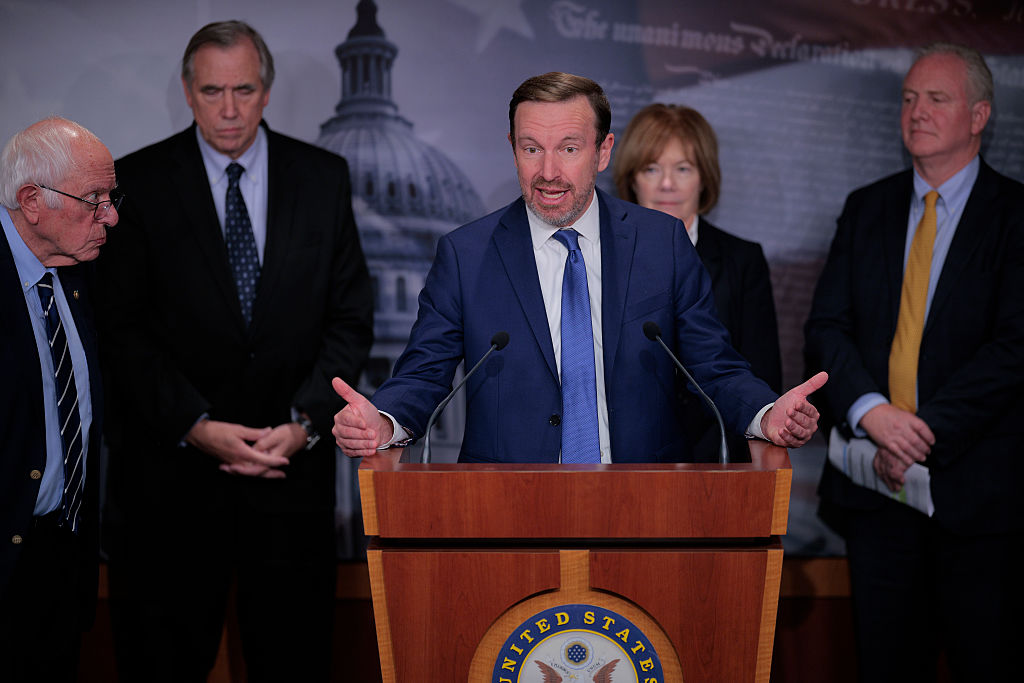

AUSTIN—Connecticut Democratic Sen. Chris Murphy argued during a speaking engagement that ending the filibuster is necessary for his party to pass major legislative priorities in the future.
Murphy’s remarks came on Nov. 14 at the Texas Tribune Festival in Austin. The annual event features a lineup of political speakers, newsmakers, and journalists discussing current events.
Debate over ending the filibuster reignited during the longest federal government shutdown in history, which ended this month, with President Donald Trump urging the U.S. Senate to end the rule to reopen the government.
During the shutdown, most Senate Democrats voted to reject a stopgap funding bill that would reopen the government, preventing Republicans from securing the 60 votes needed to pass the proposal.
After sweeping elections on Nov. 4 in states such as Virginia and New Jersey, where polls suggested Republicans were competitive in some races, Democrats were emboldened to keep the government shutdown going, which worked in their favor.
The shutdown highlighted the significance of the Senate filibuster—a long-standing parliamentary tool requiring a 60-vote supermajority, not a simple majority, to pass most bills. This rule is not constitutionally mandated and can be changed by a majority vote of the Senate.
Amid these discussions, Trump told Senators he would support their decision on the filibuster if they chose to keep it. But he urged them to consider acting before Democrats regained power.
Trump told reporters, “You’re very smart people. We’re good friends, but I think it’s a tremendous mistake, really. It would be a tragic mistake, actually. It’s time.”
Murphy later stated that during the shutdown, about half of Senate Republicans were open to eliminating the filibuster.
He added that if Trump continues to press the issue, Republican interest in filibuster reform could increase.
“I think it’s possible that they will,” he said of Republicans supporting filibuster elimination. “I think the president will probably keep up that ask.”
Trump called on Republicans to act in a TruthSocial post on Nov. 4.
“If we do terminate the Filibuster, we will get EVERYTHING approved, like no Congress in History,” he wrote. “We will have FAIR, FREE, and SAFE Elections, No Men in Women’s Sports or Transgender for Everybody, Strong Borders, Major Tax and Energy Cuts, and will secure our Second Amendment, which the Democrats will also terminate, IMMEDIATELY.”
Despite Trump’s urging, Republicans may hesitate to change the filibuster due to concerns that Democrats will return to power in the 2026 midterms and beyond and use it against them.
Murphy observed, “They are going to be increasingly politically skeptical of changing the filibuster, because they now see that the likelihood is growing that we’re going to win back the Senate in 2026.”
Democrats have said, once in power, they intend to use their majority to kill the filibuster and make significant institutional changes, including expanding the Supreme Court and granting statehood to Washington, D.C., and Puerto Rico. Such actions would secure legislative advantages for Democrats and alter the long-term balance of power.
Murphy, meanwhile, has identified restoring Roe v. Wade, passing universal background checks for all firearm purchases, and enacting voting rights legislation as top Democratic priorities—all of which are blocked by the filibuster. He said that eliminating it is essential to enacting these measures.
Emel Akan contributed to this report.
 Friends Read Free
Copy
Facebook
Tweet
Friends Read Free
Copy
Facebook
Tweet