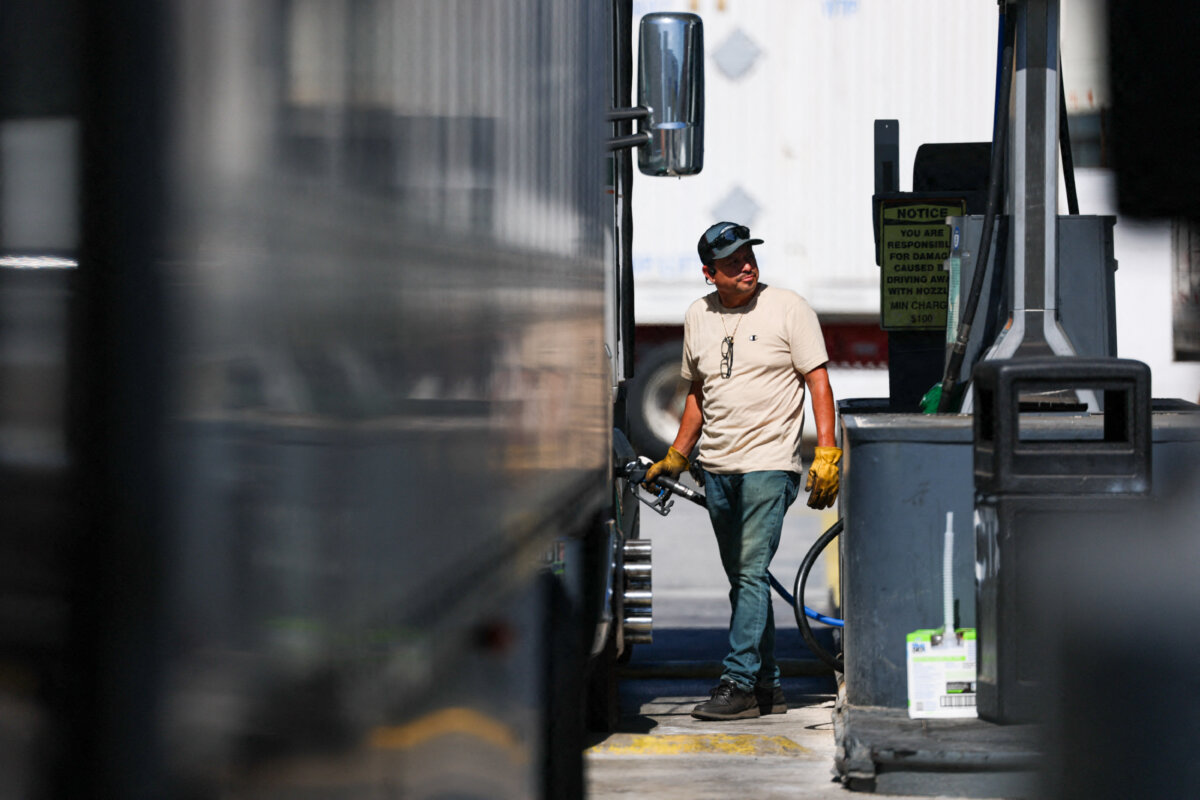

U.S. diesel prices have topped $6.50 a gallon for the first time, extending a rally fueled by supply disruptions from the war in Iran and Ukrainian strikes on Russian refineries.
The nationwide average rose to $6.51 per gallon on Sept. 21, according to the American Automobile Association (AAA), which cited war-related disruptions in crude oil markets as a key factor driving up prices at the pump.
Diesel powers much of the country’s trucking, freight, farming, and delivery networks, making higher prices a source of pressure on transportation costs across the U.S. economy.
About 10 percent of America’s service stations now charge more than $7 a gallon for diesel, while prices at the cheapest 10 percent average $5.83, according to GasBuddy analyst Patrick De Haan.
“Expecting further increases to all of these metrics,” he wrote in a Sunday post on X.
Some U.S. lawmakers have called for diesel export bans to increase domestic supply and help cap the price surge.
Sen. Chuck Grassley (R-Iowa) on Saturday urged President Donald Trump to impose an embargo on diesel exports, saying in a social media post that high diesel prices were “killing” farmers’ incomes.
Disruptions Squeeze Supplies
AAA attributed rising gasoline and diesel prices in a recent note to “continued volatility” in the Strait of Hormuz.
Traffic through the strait, which before the war carried roughly a fifth of the world’s oil and liquefied natural gas, has slowed to a trickle as the United States and Iran vie for control of the critical maritime chokepoint.
Just 17 commodity vessels passed through Hormuz over the weekend, down from 37 a week earlier, shipping data showed on Monday.
Attacks on Russian refineries by Ukrainian drones have added to the strain on global fuel supplies. Over the weekend, Ukraine hit the Moscow Oil Refinery, one of Russia’s largest facilities, according to the city’s mayor, Sergey Sobyanin.
Ukrainian President Volodymyr Zelenskyy said Kyiv’s long-range strikes “had a very significant impact in the Moscow region last night,” reporting a hit on “one of Russia’s key oil industry facilities” that he said contributes “billions of dollars” to Russia’s “war machine.”
Trump said recently that he had asked Zelenskyy not to hit Russian refining facilities, as such strikes were causing a “big up” in diesel prices.
Oil Retreats on Diplomacy Hopes
Crude oil prices fell on Monday as investors looked for diplomatic progress ahead of this week’s U.N. General Assembly and assessed a partial recovery in Saudi Arabian shipments.
Both Brent crude and U.S. West Texas Intermediate touched their lowest levels since Sept. 10. At 4:59 a.m. ET, Brent’s November contract was down $2.12, or about 2 percent, at $101.75 a barrel.
The WTI October contract, which expires Tuesday, fell $1.96, or about 2 percent, to $98.34 a barrel. Its November contract stood at $94.16.
“The pullback comes despite ongoing geopolitical risks and continued concerns over global oil supply disruptions,” ING analysts said in a Monday note.
“Profit-taking after recent gains, together with hopes for constructive discussions at this week’s UN General Assembly (UNGA) and the upcoming Trump-Xi meeting, helped improve market sentiment.”
They said crude supply concerns remain “elevated.”
Trump said Sunday that he would be open to meeting Iranian President Masoud Pezeshkian, who is expected in New York this week for the General Assembly, although Washington and Tehran also exchanged fresh threats.
Iran has conveyed its conditions for resuming negotiations to mediators, Al Jazeera reported, citing an interview with Iranian security chief Mohsen Rezaei on Saturday.
Regional tensions remained high. Yemen’s Iran-backed Houthis said they attacked “sensitive” sites in the Saudi capital, Riyadh, with missiles and drones on Saturday, along with an Aramco facility in Yanbu, a key Red Sea oil export hub.
On Monday, a spokesman for Iran’s Islamic Revolutionary Guard Corps (IRGC) warned that Tehran would expand the geographical scope of the conflict and deploy previously unused strategic weapons if the United States resumes strikes against Iran.
“In the event of a new attack, in addition to changing the geography of the battle, new targets will be struck, and strategic weapons that have not yet been unveiled or used will be employed,” IRGC spokesperson Hossein Mohabi was cited as saying by the IRGC-affiliated Tasnim News Agency.
Mohabi said Iranian forces have equipped themselves for a “war of attrition and a protracted conflict” against the United States. He said Tehran would focus its strikes on U.S. military facilities in the region while pledging to “cause no harm to neighboring countries.”
Reuters contributed to this report.
 Friends Read Free
Copy
Facebook
Tweet
Friends Read Free
Copy
Facebook
Tweet