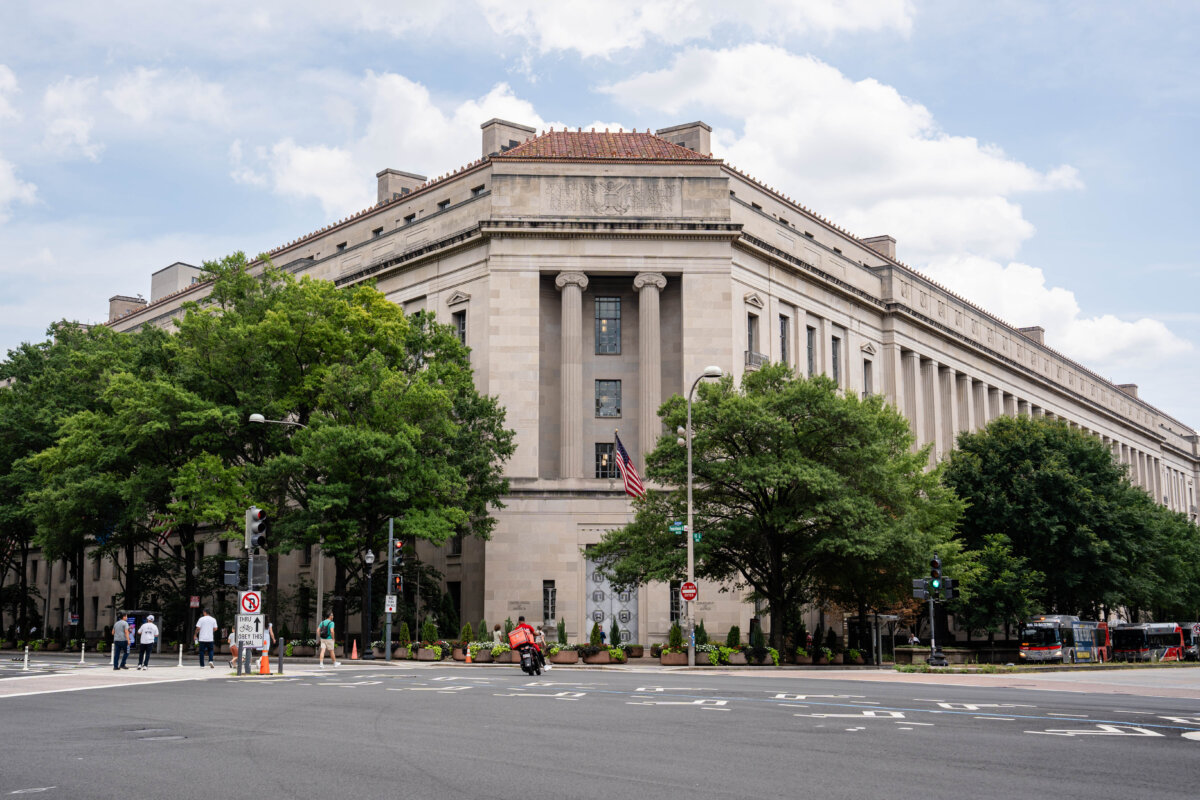

The Department of Justice has created a new unit to investigate international trade crimes that harm U.S. industries, avoid tariffs, support forced labor, or help finance foreign adversaries.
The Global Trade & Commerce Enforcement Section (GTCES) will operate within the department’s National Fraud Enforcement Division, the Justice Department said on July 14.
With a focus on criminal prosecutions, the new unit will lead complex criminal cases, including ones related to customs fraud, smuggling, false import documents, sanctions evasion, and international supply chain forced labor offenses.
“For too long, fraud actors have viewed customs violations as a mere surcharge or cost of doing business,” Assistant Attorney General Colin McDonald, head of the National Fraud Enforcement Division, said in a statement. “By utilizing the Department’s full weight, we are making it clear that trade fraud is a serious economic crime.”
The department said the new section will work closely with the Trade Fraud Task Force, which was jointly established by the Departments of Justice and Homeland Security in August 2025, with a mission to enforce what the agencies described as the Trump administration’s “America First” trade policy, aiming to bolster U.S. manufacturing by “ending unfair trade practices.”
In less than a year, the task force has recovered, forfeited, penalized, or charged more than $1 billion in civil and criminal cases.
Fraud Across Supply Chain
Trade fraud can take various forms, including falsely labeling a product’s country of origin, routing goods through another country to avoid tariffs, undervaluing imported merchandise, using fake invoices, or misclassifying products to qualify for a lower duty rate.
Federal law allows prosecutors to pursue not only the original importer but also brokers, distributors, buyers, and other businesses that knowingly help transport or sell illegally imported goods.
The most “expansive tool” in its arsenal against smuggling crimes is Section 545 of Title 18, the Justice Department said in a trade-fraud enforcement guide. It noted that penalties for crimes prosecuted under this authority can carry prison sentences of up to 20 years, criminal fines, and the forfeiture of the smuggled goods or their equivalent value.
Prosecutors may also bring conspiracy charges under the Racketeer Influenced and Corrupt Organizations (RICO) Act against people who help organize or carry out the schemes.
The Chicago U.S. Attorney’s Office will serve as the task force’s lead prosecutorial partner. U.S. Attorney Andrew Boutros said in a statement that his office intends to be the “tip of the spear” in enforcing U.S. trade and forced-labor laws.
The new unit is also expected to strengthen enforcement of tariffs imposed under Section 301 of the Trade Act, including duties aimed at China and other countries accused of unfair trade practices.
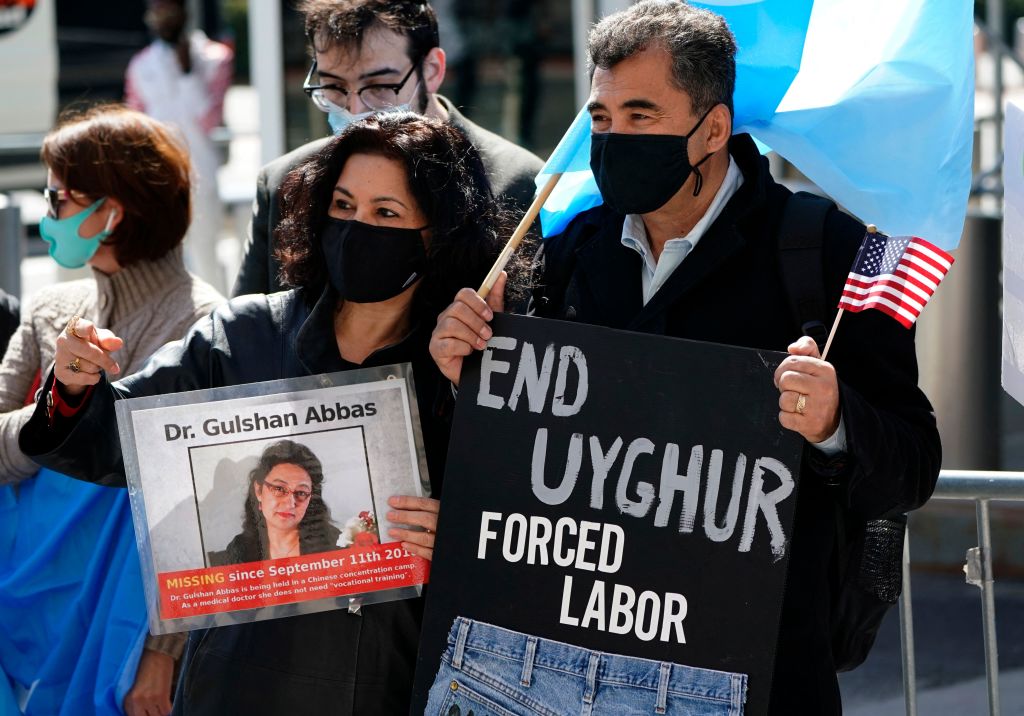
Forced labor is another major focus, with the Justice Department describing this enforcement priority as a “direct response to a staggering global crisis.”
Nearly 30 million people worldwide are trapped in forced labor, including slave labor, child labor, and other work carried out through coercion, the Justice Department said. Such labor generates an estimated $236 billion in illegal profits annually.
China was singled out in the Justice Department’s trade-fraud guide as a major focus of forced-labor enforcement efforts, particularly over allegations involving supply chains linked to the Xinjiang region.
In its guide, the department highlighted the Uyghur Forced Labor Prevention Act, a 2021 law that bars the import of goods produced wholly or partly in Xinjiang unless importers can prove that forced labor was not involved.
Separately, the Office of the U.S. Trade Representative last month proposed additional tariffs on imports from dozens of countries that it said had failed to adequately prevent goods made with forced labor from entering their markets. Among the economies facing the higher proposed tariff rate of 12.5 percent are China, India, and Russia.
Iran, Sanctions Evasion in Crosshairs
The new trade enforcement section comes as the Trump administration steps up efforts to disrupt Iranian shipping, oil exports, and financial networks after Tehran resumed attacks on vessels in the Strait of Hormuz.
Over the past week, the U.S. Department of the Treasury has unveiled a series of sanctions targeting Iranian exchange houses, shipping companies, front businesses, and cryptocurrency wallets that U.S. officials say help Iran move money and evade restrictions.
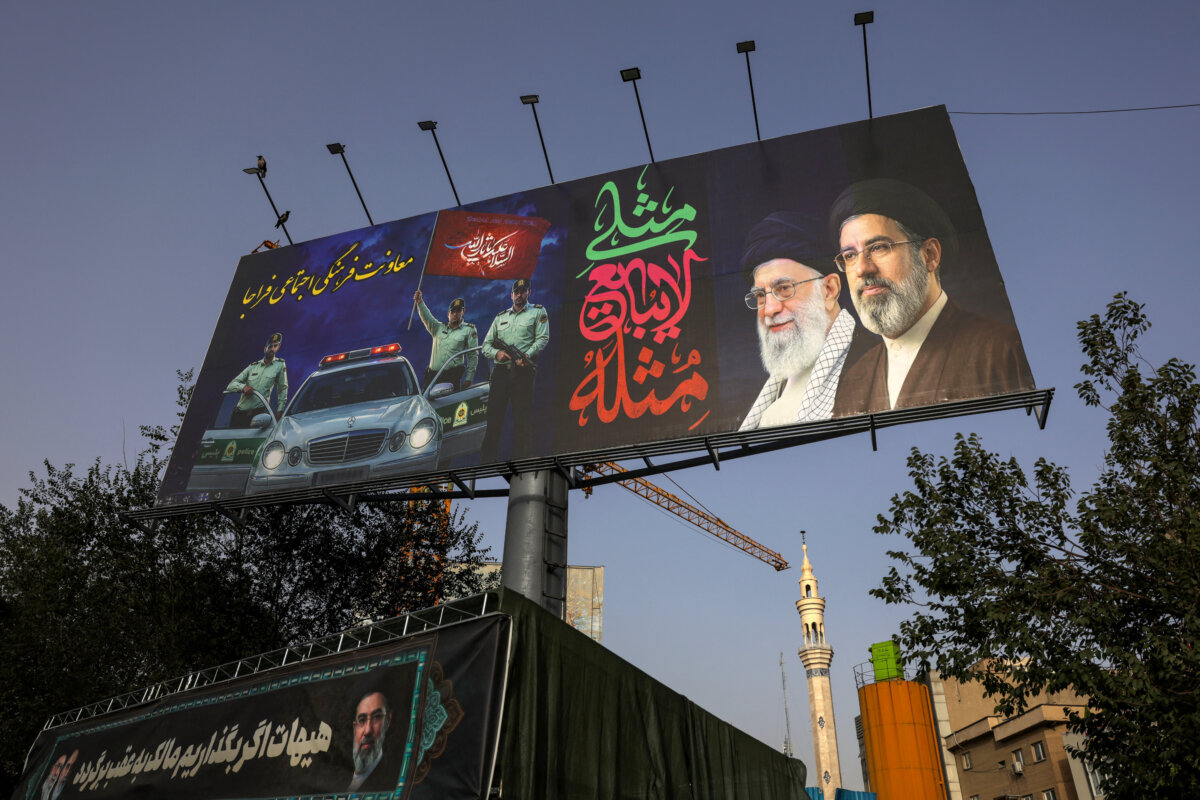
On July 10, the Treasury Department sanctioned several Iranian exchange houses and shell companies accused of moving billions of dollars on behalf of blacklisted Iranian banks through networks spanning multiple jurisdictions.
Days later, the Treasury unveiled sanctions against more than 50 individuals, companies, and vessels linked to an alleged shipping empire run by Mohammad Hossein Shamkhani, whom officials described as a key figure in Iran’s oil-export network.
Treasury Secretary Scott Bessent said on July 15 that the department had also sanctioned cryptocurrency wallets tied to Iran’s central bank, freezing more than $130 million in assets.
 Friends Read Free
Copy
Facebook
Tweet
Friends Read Free
Copy
Facebook
Tweet