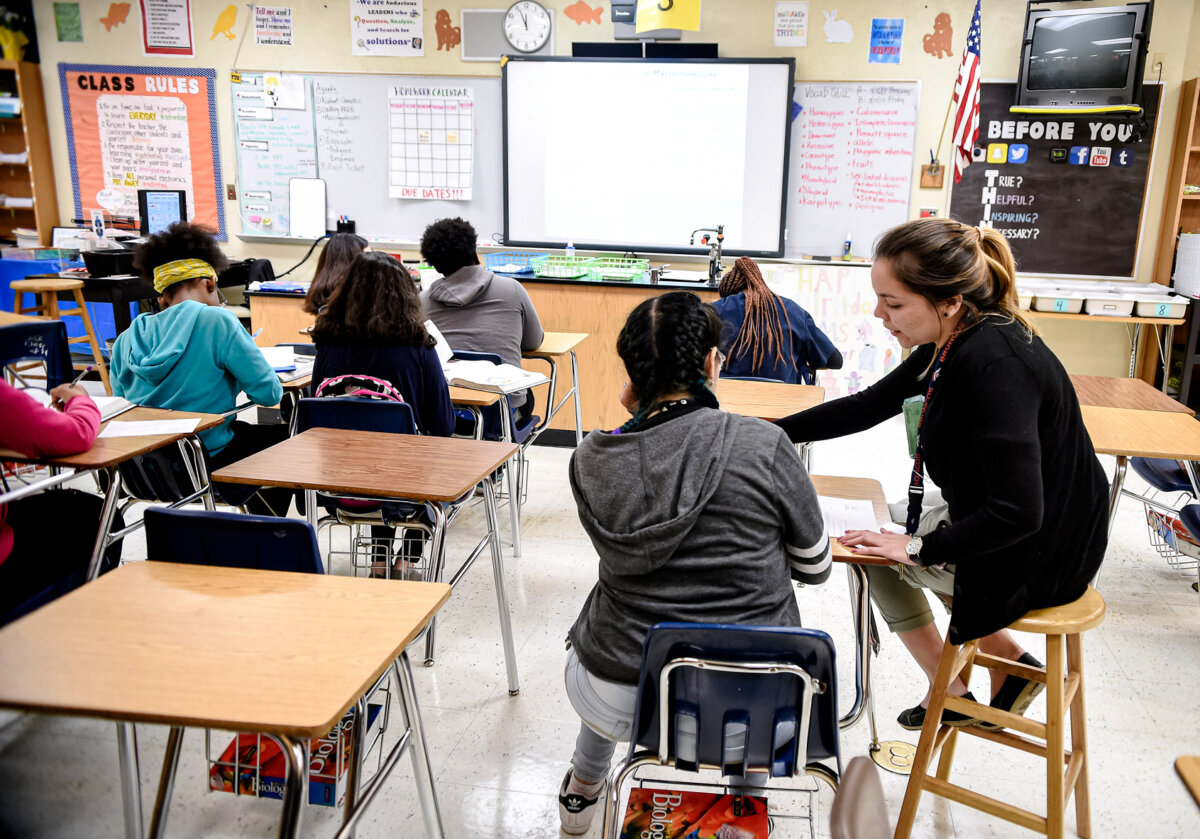

While universities debate whether to skip standardized admissions tests and the University of Michigan waives first-term grades for some incoming students, new research suggests that relaxing standards might not be the best way to help kids who are struggling in school.
The new report by the Institute for Family Studies (IFS) and the American Enterprise Institute, based on data collected from grade school students by the National Survey of Children’s Health, focused on how kids performed in school and what they said about their home life. The report found that “family structure is a more powerful predictor of school problems, academic performance, and depression than are race and poverty.”
The Department of Education’s Nation’s Report Card sorts results by race, sex or income, but it ignores family structures even though it has been collecting data on that factor since 2013, researchers said.
By contrast, the report looked at “whether or not kids are being raised by their own mother and father,” IFS Senior Fellow Brad Wilcox said, and they found that family structure was often a more important factor in children’s well-being.
“It’s pretty clear that the character of the family you grew up in is more important than the color of your skin,” Wilcox told The Epoch Times.
The study reported that 74 percent of children from “intact, married-parent families” achieved top grades (As and Bs), compared with 60 percent of children from “other family structures.” In addition, the IFS stated that children who were not raised by both biological parents were 47 percent more likely to have disciplinary problems at school and more than twice as likely to be depressed.
“Raising children in a stable married family is incredibly helpful to kids,” Wilcox said.
Graduating Without Basic Skills
The IFS’s findings come at a time when data increasingly indicates that many American children are struggling in school, and looking at grades may not even show the full picture. Reports and anecdotes suggest that even among students who receive passing grades, many are not learning basic skills.
The National Literacy Institute reports that 64 percent of America’s fourth graders do not read proficiently, and more than half of American adults now read below a sixth-grade level. And statewide reports are indicating that grade school children are being passed on to the next grade, or graduating, regardless of whether or not they have basic reading and math skills.
In 2023, Baltimore City schools announced that they would “avoid the punitive approach of failing students,” citing effects of school closures during the COVID-19 pandemic. This followed a 2021 report by the state of Maryland, which said that across the state, “approximately half of the students who graduated high school and enrolled in a Maryland college or university in 2013 were assessed to need remediation in math, English, and/or reading.”
Studies in Texas, Alabama, and Missouri over the past two decades showed similar findings.
A 2025 report from the University of California-San Diego stated that the math skills of one-in-12 incoming students were below a middle school level. More recently, University of California-Berkeley mathematics professor Zvezdelina Stankova said in an op-ed for the San Francisco Standard that she had to pause her calculus course in order to teach her students middle-school level algebra and fractions.
In many cases, the response from schools has been to accommodate a lack of basic skills by loosening assessment tests, or getting rid of them altogether. Currently, more than 2,000 colleges and universities, including some Ivy League and state universities, do not require standardized tests like the SAT and the ACT as a criterion for admission.
In a possible case of “grade inflation,” Harvard University reported that 60 percent of the grades given to students in 2024–25 were As, up from about 25 percent in 2005–06. Meanwhile, the University of Michigan’s College of Literature, Science, and the Arts announced that starting in the fall of 2027, it would refrain from giving grades to incoming students during their first term, in order to “curb the mental health crisis unfolding among college-aged individuals.”
Family Structure
According to Wilcox, focusing on family structures is likely a better solution than inflating or avoiding grades. He advocates, among other things, making Americans aware of the difference it makes to kids’ success when both parents are raising them in a stable home.
“Not every couple who are having kids should get married and not every couple who are married should stay married,” Wilcox said. “But it’s important when it comes to having and raising kids to do what you can to be married and to stay married.”
In an effort to keep parents together, some advocates have called for the removal of what they call the “marriage penalty,” which occurs when two individuals with similar incomes marry, pushing their joint income to a level that exceeds welfare eligibility.
“Marriage penalties are one of the most damaging and misguided features of the federal welfare system,” said Rep. Glenn Grothman (R-Wis.) in a statement. “For decades, Washington has punished families for getting married, discouraging responsibility and trapping parents and children in long-term dependency.”
Based on federal data, the IFS states that only 3 percent of subsidized housing serves two adults with children, compared with 30 percent that goes to a female head with children.
The IFS report states that family trends in America are tilting in a slightly positive direction, however. The proportion of American children living in married families hit a low point of 64 percent in 2012, and has since increased to 66 percent as of 2024.
 Friends Read Free
Copy
Facebook
Tweet
Friends Read Free
Copy
Facebook
Tweet