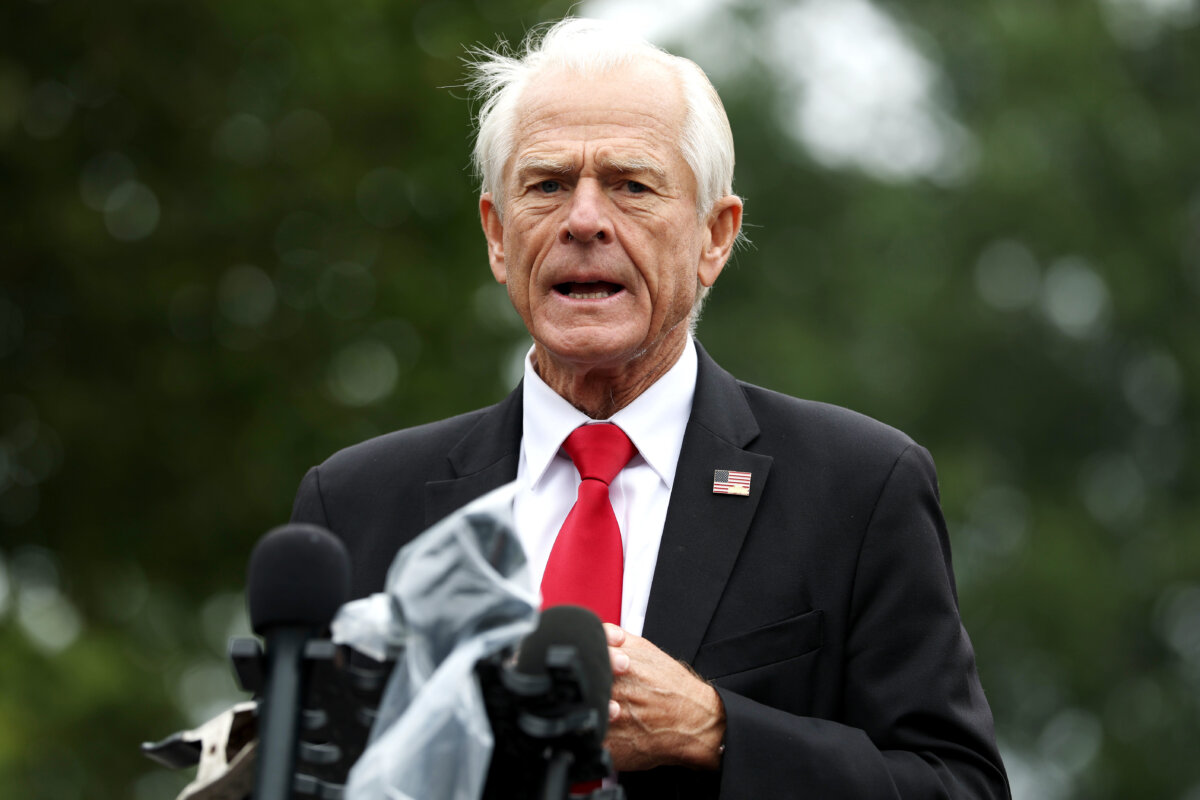

A federal appeals court in Washington ruled on July 21 against White House trade advisor Peter Navarro, upholding his criminal conviction for contempt of Congress.
A federal jury convicted Navarro in 2023 on two misdemeanor counts of contempt of Congress for refusing to comply with a congressional subpoena.
Navarro was indicted in 2022 for not honoring the subpoena from the Jan. 6 Select Committee that existed when Democrats controlled the U.S. House of Representatives. He entered not guilty pleas to the charges.
One count covered Navarro’s failure to produce documents the Select Committee requested; the other related to his failure to appear to provide testimony at a deposition. After sentencing, he served four months in prison.
Hours after his release, he spoke at the 2024 Republican National Convention, telling the audience, “I went to prison so you won’t have to.”
The new, unanimous ruling was issued by a three-judge panel of the U.S. Court of Appeals for the District of Columbia Circuit. Circuit Judge Patricia Millett authored the opinion.
The panel noted that in 2021, Navarro published a book about his time in politics. He took credit for coming up with a plan to “leverage” then-Vice President Mike Pence’s powers under the Electoral Count Act of 1887 to “delay certification” of the official results for the presidential election on Jan. 6, 2021. The certification process was delayed that day for several hours by a security breach at the U.S. Capitol.
His statements were noticed by the Select Committee, which served Navarro with a subpoena that sought documents related to his book and public comments, and directed him to show up for a deposition. Navarro declined to appear or comply with the committee’s requests and pleaded executive privilege as a former advisor to a president. After the compliance deadline went by, the House of Representatives held him in contempt and a grand jury indicted him, the panel’s written opinion said.
Navarro moved to dismiss the indictment, arguing that President Donald Trump, had invoked executive privilege. The district court held an evidentiary hearing and found that executive privilege had not been invoked and declined to throw out the indictment. The court also granted the government’s motion to block Navarro from telling the jury that he mistakenly believed he did not have to reply to the committee’s subpoena. The jury found him guilty on both counts.
The panel said it was affirming because executive privilege is a prerogative that belongs to the president, not his aides, and besides, it was not actually invoked by the president.
The panel said Navarro’s decision not to comply went beyond any possible claim of privilege. He should have appeared, at which point he could have asserted specific privileges regarding individual questions, and could have produced non-privileged materials.
Moreover, Navarro “has acknowledged that even if executive privilege had been invoked, that would not have excused his categorical failure to comply with the Select Committee’s subpoena,” the panel said.
The U.S. Department of Justice did not participate in the appeal. Navarro’s team alone argued against the conviction.
Navarro’s attorney, Abhishek Kambli, said his client intends to appeal the latest ruling, which the lawyer described as “one step in a battle to correct decades of incorrect [D.C. Circuit] precedent.”
“He intends to move swiftly with his appeal because his case affects every senior presidential advisor, regardless of political party, who believes in good faith they cannot comply with a congressional subpoena based on executive privilege,” Kambli said.
The Associated Press contributed to this report.
 Friends Read Free
Copy
Facebook
Tweet
Friends Read Free
Copy
Facebook
Tweet