
Those considering bringing a drone to a sporting event in New York City might want to think again. New York City police officers now have the equipment, training, and authorization to take down drones midflight.
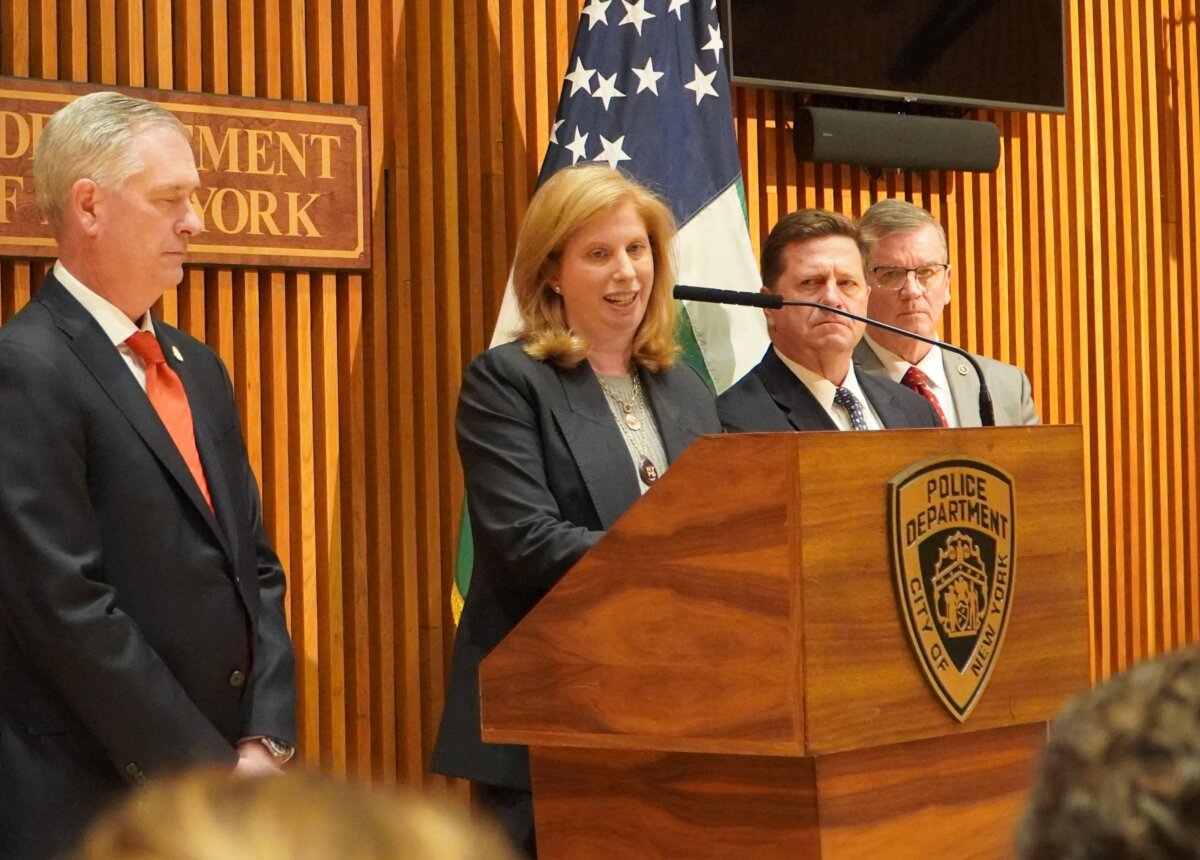
“This is something that we have been advocating for because this is something that New York City needs,” Commissioner Jessica S. Tisch said at New York City Police Department (NYPD) headquarters on May 21. “The threat picture has changed. The technology has changed. And our capabilities have to change with it.”
She was joined by Jay Clayton, U.S. attorney for the Southern District of New York, and James Barnacle, head of the FBI’s New York field office.
The New York City Police Department spent $6.5 million on drone mitigation tools ahead of what is expected to be an unusually busy summer, including visitors coming to New York to celebrate the World Cup, a Sail250 armada passing through New York Harbor on July Fourth, and other events honoring the 250th anniversary of the nation’s founding.
In December 2025, Congress passed the Safer Skies Act, authorizing state and local law enforcement to use counter-drone technology and mitigation techniques for large-scale public gatherings, critical infrastructure, or correctional facilities. The legislation requires that local law enforcement be trained and certified by the Justice Department or the Department of Homeland Security.
Before the legislation was passed, only federal law enforcement was authorized to use technologies that can ground drones by disrupting their GPS positioning, by jamming signals to hinder a remote pilot’s control of the drone, or by other means.
NYPD teamed up with the FBI in preparation for the events this summer, which are expected to draw millions of visitors to the region. The FBI has already trained NYPD officers how to use such techniques against drones if they detect a threat.
As for how the NYPD will deploy anti-drone tools into the future, Tisch said she’s still waiting for the Department of Justice to finalize rules governing how local-federal collaboration works beyond the World Cup and events celebrating the United States’ 250th anniversary.
“I was thrilled in December when that legislation passed in Washington, D.C., and we’re taking the next step now, obviously, with the partnership during the World Cup and the implementing regulations coming out of the FBI,” Tisch said.
Tisch said the threat of drones is one of her greatest concerns.
“The war on Ukraine has become a real-world testing ground for drone technology, and if there is one threat that keeps me up at night, it is from drones,” she said. “Tactics that once belonged to militaries are now increasingly accessible to smaller groups and individuals, and commercial drones can be easily adapted into weapons of war.”
 Friends Read Free
Copy
Facebook
Tweet
Friends Read Free
Copy
Facebook
Tweet