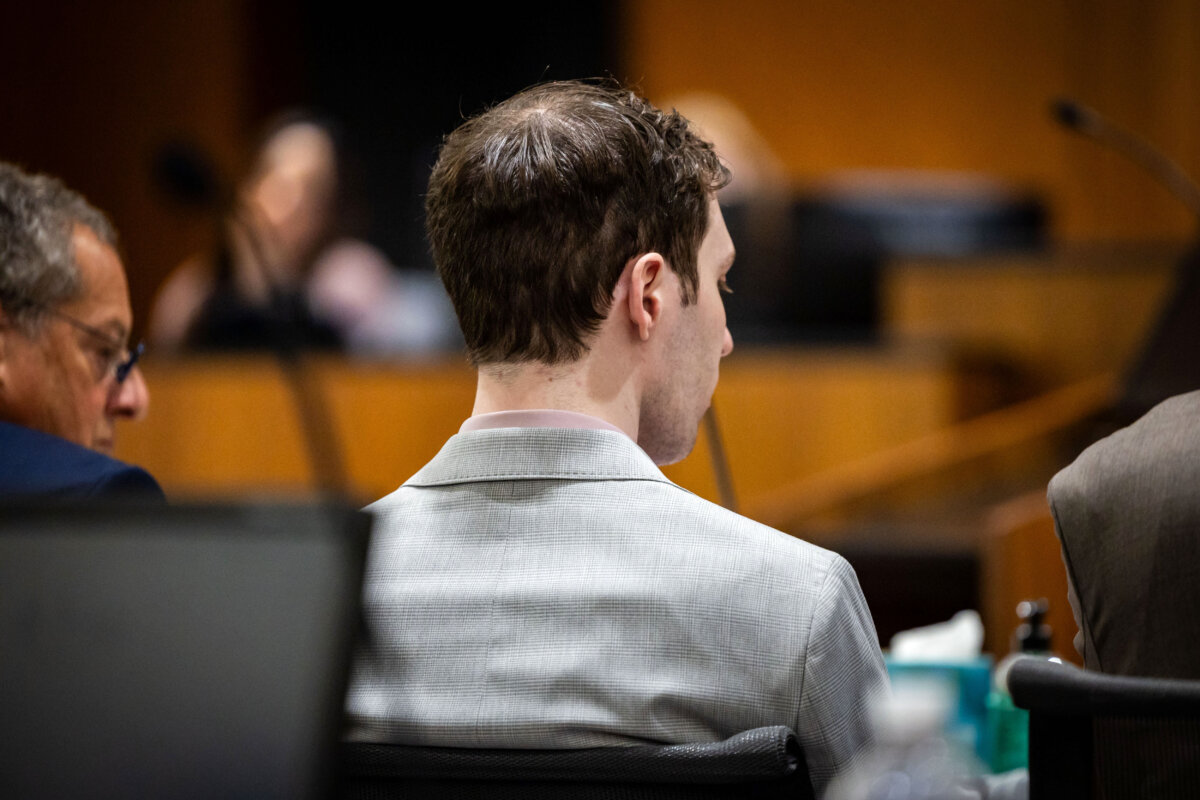

The Utah judge in Charlie Kirk’s murder case barred the prosecution from presenting about 16 minutes of an incriminating video in which Tyler Robinson’s transgender partner apparently alleges that Robinson admitted to targeting Kirk.
Tyler Robinson’s defense team argued against allowing portions of the Lance Twiggs video to be publicly presented on July 8, the third day of a weeklong evidentiary hearing, because it would hurt Robinson’s chances of getting a fair trial.
The prosecution is expected to present the edited video on July 9.
Brian Davis of the Utah State Bureau of Investigation began laying the groundwork to present Robinson’s former roommate’s video statement at the Fourth District Courthouse in Provo, Utah. Davis said he was present during a police interview with Twiggs after Kirk’s murder.
The defense presented a transcript of the video and attempted to redact half of it, a move the prosecution rejected, arguing that the video was admissible and public in a probable cause hearing.
Utah State District Judge Tony Graf Jr. will be able to see the entire video, but he ruled on July 8 that the public will not.
At a preliminary hearing in Utah, prosecutors may introduce “reliable hearsay,” which consists of statements by witnesses about what someone else said. The defense has repeatedly objected to the admission of hearsay evidence.
Kirk, founder of Turning Point USA, was fatally shot in the neck by a sniper’s bullet while speaking at a Utah university on Sept. 10, 2025.
The hearing offers the first detailed look at the prosecution’s case against Robinson, 23, who is charged with aggravated murder.
Robinson, who has not entered a plea, faces a possible death sentence if convicted.
Graf will determine whether the prosecution has demonstrated probable cause to proceed to trial.
On July 7, Robinson’s attorneys attempted to undermine DNA evidence allegedly linking Robinson to items found at the murder scene.
Prosecutors called Utah State Bureau of Investigation Sgt. Jennifer Faumuina, who oversaw the crime scenes and physical evidence in the case.
She testified that DNA testing determined that it was very probable that DNA belonging to Robinson and Twiggs was present on a screwdriver found near a “sniper pad” on the Losee Center roof and on a towel wrapped around a rifle recovered in the nearby woods.
But when cross-examining FBI forensic examiner Amanda Bakker, the defense attempted to poke holes in how the FBI’s DNA analysis was conducted.
Also on July 7, the prosecution presented never-before-seen video of the day of Kirk’s assassination that allegedly shows Robinson interacting with Kirk’s representatives and stopping for lunch at a Chick-fil-A restaurant.
The surveillance video allegedly places Robinson at Utah Valley University on the day that Kirk was killed.
Former campus police officer Chris Bagley, who testified on July 6, described finding a “sniper pad” on top of the Losee building, with markings of elbow, knee, and foot indentations in the graveled roof and “where, like, somebody laid a gun down,” he said.
The state’s lead investigator, David Hull, also testified that police stopped a vehicle near campus after midnight on Sept. 11 and an officer made contact with Robinson during the manhunt for the killer.
Last month, Graf denied a defense request to remove the death penalty as a possible punishment.
However, the judge also found prosecutors in contempt after they publicly stated that they could prove Robinson’s guilt beyond a reasonable doubt before the case reaches trial.
Robinson turned himself in to the Washington County Sheriff’s Office the day after Kirk’s assassination.
Kirk’s widow, Erika Kirk, who attended the hearing with the victim’s family, made a statement on X that the family was “deeply grateful for the support, prayers, and kindness” that they have received during the “darkest days of their lives.”
 Friends Read Free
Copy
Facebook
Tweet
Friends Read Free
Copy
Facebook
Tweet