
Republicans in Maryland filed suit on Aug. 6 asking a state court to keep a proposed redistricting amendment off the Nov. 3 ballot, arguing that the Democrat-led General Assembly missed deadlines for putting questions before voters that it had written into law without a single no vote three months earlier.
The plaintiffs are all seven members of the Maryland Freedom Caucus of the state’s House of Delegates—along with state Senate Minority Leader Steve Hershey, Senate Minority Whip Justin Ready, and Mike Howell, president of The Oversight Project, a conservative group that filed the case and announced it in a separate statement the same day. Each is suing in a personal capacity as a Maryland resident and registered voter rather than as an officeholder. The case is captioned Howell v. Maryland State Board of Elections.
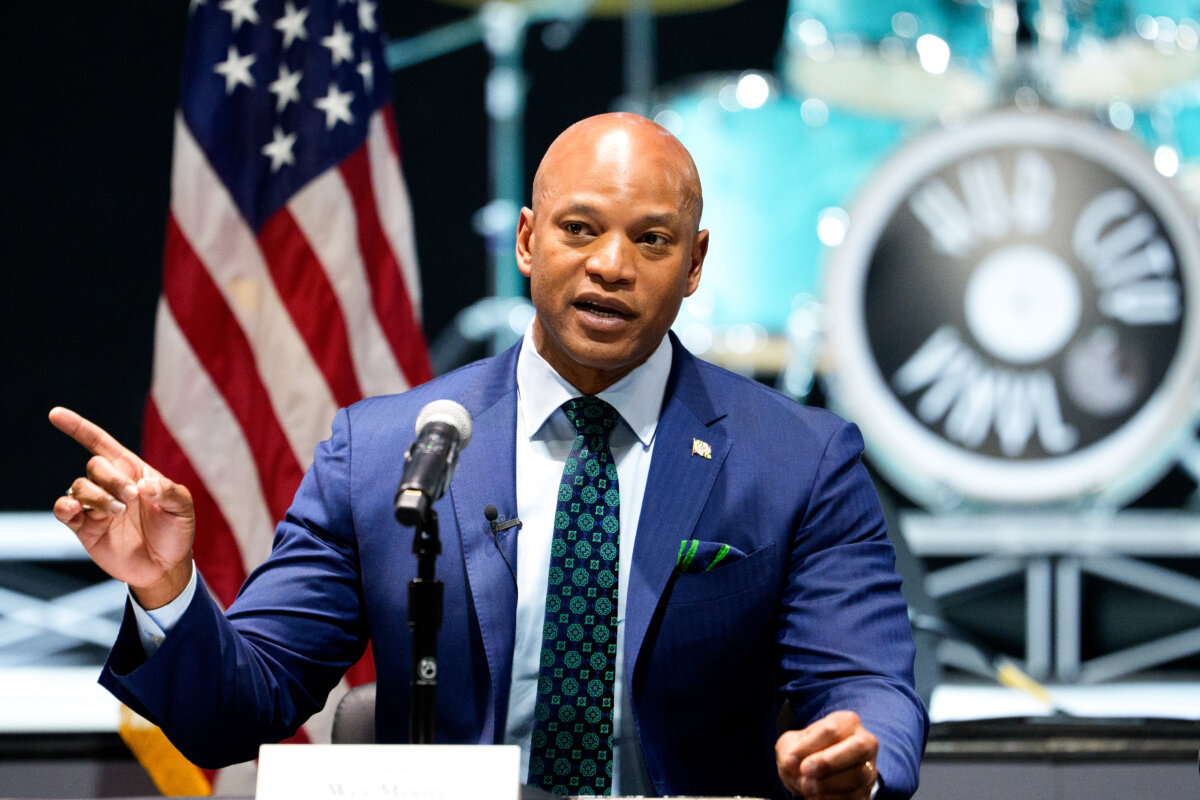
The complaint, filed in the Circuit Court for Anne Arundel County, targets House Bill 2100, which passed during a special session on Aug. 4 and was approved by Gov. Wes Moore, a Democrat, on Aug. 5. The measure asks voters to amend the state constitution to say it sets no rules for how congressional districts are drawn—rules a state judge applied in 2022 when striking down a Democrat-drawn map that would have given the party all eight of Maryland’s U.S. House seats.
The lawsuit does not ask the court to rule on redistricting itself. Instead, it argues that the question cannot lawfully appear on this year’s ballot because of how it was passed.
At the center of the case is Senate Bill 29, a ballot-question law the Legislature passed earlier this year. It cleared the state Senate 44–0 on Feb. 5 and the House of Delegates 135–0 on April 13. Moore signed it on May 12, and it took effect June 1. Among other things, it requires the secretary of state to prepare and certify the language of every statewide ballot question on or before July 1 of a general election year, replacing an earlier 95-day rule, and it gives the public a 15-day comment period on that language.
July 1 came and went more than a month before the special session convened on Aug. 3. The plaintiffs argue that no lawful certification could have occurred because the amendment did not yet exist as passed legislation, and that state election law contains no exception, grace period, or alternative procedure for a late statewide question. On that basis, they contend the measure “does not and never did carry the force or effect of law.”
A second count concerns notice. State law requires the Department of Legislative Services to draft explanatory language for constitutional amendments, have it approved by the attorney general, and submit it to the State Board of Elections by the first Monday in August. The plaintiffs say that deadline could not have been met either.
The plaintiffs asked for expedited consideration and for the case to be assigned to a three-judge panel, both provided for under state election law.
The ‘Notwithstanding’ Clause
Much of the complaint focuses on a single phrase added to the bill on the House floor on Aug. 3: “Notwithstanding any other provision of law,” the question shall be submitted to voters at the November election.
The plaintiffs say that language was inserted with less than an hour’s notice before a joint committee hearing and was presented in the House as a technical amendment, while sponsors in the Senate acknowledged it was meant to work around the missed deadlines. Wiping out the application of a statute the Legislature had just enacted, they argue, is not technical.
Suspending those deadlines, the complaint says, would have required ordinary legislation passed through both chambers and presented to the governor on its own terms—not a clause attached to a constitutional amendment.
The plaintiffs cite floor remarks from state Sen. Cheryl Kagan, a Democrat representing District 17, who is quoted as saying during the Aug. 4 Senate debate that there was no time left to follow the new law because “July 1st is in the rearview mirror,” and that having the secretary of state draft language, publish it, and run a comment period was “just not an option.”
The complaint also points to the legislature’s own nonpartisan analysts. A fiscal and policy note from the Department of Legislative Services flagged that the July 1 certification deadline had passed and noted that the special session was scheduled to end on Aug. 5—exactly 90 days before the election, the minimum period for public posting of a proposed amendment.
Two further counts argue the clause is invalid on constitutional grounds. The plaintiffs say Moore’s signature on a constitutional amendment carries no legal weight because the state constitution’s amendment process does not involve the governor, and that his signature cannot convert the bill into ordinary legislation overriding the deadlines.
They also argue the clause violates the requirement that a proposed amendment embrace only a single subject, saying ballot procedure has nothing to do with congressional districting.
A final count invokes Articles 7 and 24 of the Maryland Declaration of Rights, which cover free elections and due process, citing a 2012 state high court decision holding that voters must receive adequate notice of a referendum before an election.
“This error is not harmless because the deadlines are integral to voter’s Due Process Clause rights,” the complaint states.
Republicans Point to 2022
Del. Kathy Szeliga (R-Baltimore County), the caucus vice chair and a plaintiff in the current suit, was the lead plaintiff in the challenge that ended with Judge Lynne Battaglia striking down the Democrat-drawn congressional map in 2022.
The replacement map adopted afterward produced the current 7–1 Democratic delegation. The new complaint cites that case, Szeliga v. Lamone, as the decision the proposed amendment is meant to override.
“Four years ago, I was the lead plaintiff when Judge Lynne Battaglia struck down the Democrats’ extreme partisan gerrymander,” Szeliga said in the caucus release. “Today, the Maryland Freedom Caucus is once again leading the fight to stop them from changing the rules midstream. The process matters. We will not let them rewrite the Constitution on a rushed, defective timeline and without due process.”
Del. Matt Morgan (R-St. Mary’s), who chairs the caucus, said Democrats “spent taxpayer dollars on a special session for one reason: to rewrite the Maryland Constitution and eliminate the last remaining Republican congressional seat.”
“Like a banana republic, they suspended the rules, ignored statutory deadlines, and treated the Constitution as an obstacle to be removed,” Morgan said. “Our Declaration of Rights exists to protect the people from politicians who undermine free and fair elections.”
Group Behind the Suit
Three of the four attorneys who signed the complaint work for The Oversight Project, which described the case as part of what it calls its REPAIR Initiative on redistricting and election integrity.
Its public framing of the case is broader than the complaint, which argues only that the ballot question was placed unlawfully and takes no position on any future map. In its statement, the group argued that an 8–0 Democratic delegation would be filled by lawmakers who would “put illegal aliens before the American people,” and said noncitizens should not be counted when apportioning congressional districts.
“Maryland can be great again but not if the plan is to turn the Eastern Shore into Baltimore and Prince George’s County,” Howell said in the statement, accusing Moore of seeking to extinguish the region’s congressional representation ahead of a possible presidential run.
What Democrats Say
Democrats hold supermajorities in both chambers, more than the three-fifths needed in each to send a constitutional amendment to voters. HB 2100 passed along party lines.
Moore framed the amendment last week as a response to Republican map changes elsewhere, writing that it would ensure Marylanders “have the final say over their representation.”
Senate President Bill Ferguson, a Democrat, has said the 2022 circuit court decision is not binding precedent, and told reporters the state was taking the matter “one step at a time” and would assess whether to draw a new map after November.
House Democratic Leader Hakeem Jeffries (D-N.Y.), who pressed Maryland Democrats for months to act on the issue, thanked Moore and state lawmakers for “standing up to the MAGA power grab.”
The defendants are the Maryland State Board of Elections; Jared DeMarinis, the board’s administrator; Secretary of State Susan C. Lee; Attorney General Anthony G. Brown; and Moore, all in their official capacities.
The plaintiffs ask the court to declare the certification and ballot placement unlawful and to bar state officials from certifying, printing, distributing, tabulating, or canvassing votes on the question. If ballots have already been printed by the time of a ruling, they ask the court to separate the amendment from certification of the rest of the election.
Moore and the Democratic leaders in the state house and senate did not respond to a request from The Epoch Times for comment on the suit before publication.
 Friends Read Free
Copy
Facebook
Tweet
Friends Read Free
Copy
Facebook
Tweet