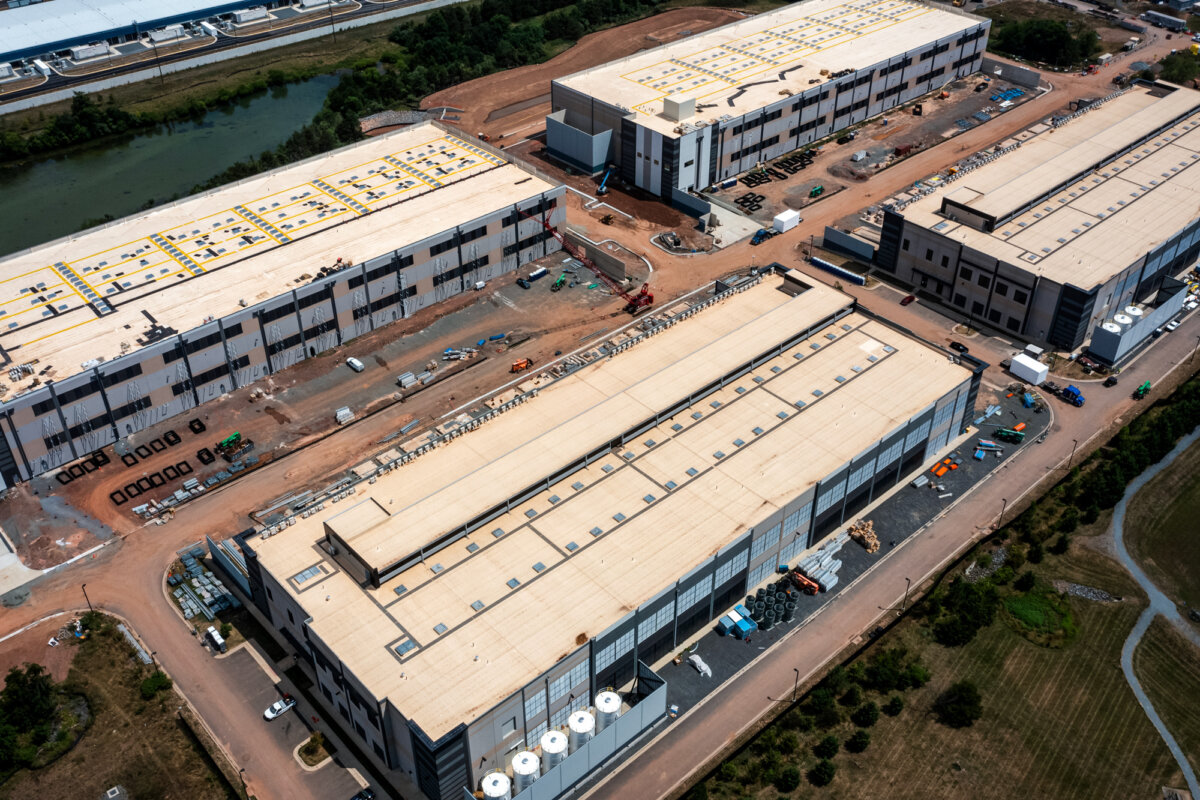

Local governments increasingly are halting data center development to protect farmland and research their effects on land and water resources.
Last week, Saline County, Kansas, joined a handful of other local jurisdictions in pressing the pause button on data centers.
Driven by a desire to protect farmland and stop energy-hungry data centers from popping up in its jurisdiction, the Saline County Board of Commissioners on March 17 voted 4–0 to place a three-year moratorium on data center construction in unincorporated parts of the county.
“This is one of those deals where, you know, let’s prepare for it before it happens,” Saline County Commissioner Joe Hay Jr., of District 5, told The Epoch Times.
“Some of these data centers, they’re looking at 1,200 to 1,500 acres. We don’t have any way of putting anything like that in the unincorporated area of Saline County. We just don’t have the water, and we don’t have the electricity.”
The reason the commissioners voted for the multi-year pause, Hay said, was not to prevent future development but to protect farmland, and to allow a nine-person planning commission time to research regulations in other places and draft rules to be adopted in the future.
Saline County’s decision comes on the heels of votes in other counties and municipalities to place moratoriums on development.
On March 3, city council members in Urbana, Ohio, voted 6–1 to pass a 12-month moratorium on new data centers—again for the purpose of assessing their effects. One day earlier, commissioners in Fulton County, Indiana, voted 2–1 to halt future data center projects for one year.
In February, the Baltimore County Council in Maryland voted 7–0 to block the county from issuing permits to data center developers until 2027. That decision, like the one in Saline County, was made to let the local planning board assess data centers’ effects and make recommendations for regulations.
State Moratoriums
Because of rising concerns over data center energy and water requirements, lawmakers in a dozen states have introduced data center moratorium bills.
According to Good Jobs First, a watchdog group that tracks economic development, Georgia, Maryland, Michigan, Minnesota, New Hampshire, New York, Oklahoma, South Carolina, South Dakota, Vermont, Virginia, and Wisconsin have such bills.
However, so far in 2026, not one of those bills has passed a single chamber of any state legislature.
In Virginia, the state that leads the country in data center facilities, with nearly 600, some lawmakers are trying to slow down development by reassessing tax benefits for the facilities.
Senate lawmakers proposed eliminating a retail sales and use tax exemption that, in fiscal year 2025, benefited 56 tech companies but cost Virginia about $1.9 billion in lost tax revenue. The tax incentive delivered 1,610 new data center jobs during that period.
The bill stalled out, however, as Virginia’s legislative session came to an end on March 14, with the state Senate largely in favor of eliminating the tax break, but the House of Delegates and Virginia Gov. Abigail Spanberger firmly opposed.
If the exemption is eliminated, tech companies will have to resume paying a minimum 5.3 percent sales tax on equipment and software.
The General Assembly will convene a special session on April 23 to resume talks over the state budget, including discussions over the tax exemption.
According to an analysis by the Joint Legislative Audit and Review Commission (JLARC), Virginia’s data center industry is estimated to benefit the state by providing “74,000 jobs, $5.5 billion in labor income, and $9.1 billion in [gross domestic product] to Virginia’s economy annually.”
Although most of those benefits go to portions of northern Virginia, where data centers tend to be located, other areas of the state benefit because local businesses typically provide materials for construction.
In addition, JLARC found, any local town or county with a data center can expect “substantial tax revenues from the industry” through real estate taxes and business personal property taxes.
Despite the legislature’s ongoing debate over tax exemptions, multiple bills regulating data centers passed both chambers this session and are awaiting Spanberger’s decision.
Senate Bill 553 would increase reporting requirements and transparency on how much water data centers use, House Bill 153 would require developers to deliver an assessment of noise levels and potential effects on water and land before receiving permits or application approvals, and House Bill 507 would prohibit the Virginia Department of Environmental Quality from issuing air permits to data centers depending on emissions levels.
Will the Boom Continue?
Numerous efforts to halt or block data centers appear to have been successful. Data Center Watch, a group that tracks opposition to the facilities, said that between May 2024 and March 2025, data center projects worth $64 billion had been blocked or delayed.
Even with such pushback, the United States leads all countries in this sector, with more than 5,000 data centers in operation. Areas having the largest concentration of data center facilities include northern Virginia; Dallas and Fort Worth, Texas; Silicon Valley, California; Chicago; Phoenix; New York City; Atlanta; and Hillsboro, Oregon.
Proponents of the data center boom say the facilities attract businesses, create jobs, and contribute billions of dollars in state tax revenue.
Earlier this year, Microsoft addressed concerns about data centers’ effects when it released an initiative for a “community-first [artificial intelligence] infrastructure plan.”
“We’ll pay our way to ensure our datacenters don’t increase your electricity prices,” the company stated in January.
It stated that it would replenish water and contribute to local tax bases, among other things.
Opponents say the centers use enormous amounts of energy and water resources while taking up land that would otherwise be used for farming.
“It hurts the farmer more than anything,” Hay said. “If you take wind towers—you know, they can graze cattle around that, and they can work around that.
“[But with] these data centers, you know, God’s not going to make any more farmland. What we got is what we got. And if we start taking and using it up on something like that, then we’re gonna have a problem one of these days.”
 Friends Read Free
Copy
Facebook
Tweet
Friends Read Free
Copy
Facebook
Tweet